








Original Research for Personal Injury SEO

LAW FIRM SEO THAT WORKS®
Our Focus: Your Firm
The best law firm marketing comes with a No Competition™ Guarantee.
Original research is the single most powerful content asset a personal injury firm can publish for SEO. A well-designed study, survey, or data analysis gives journalists, academics, and other websites a concrete reason to link back to your firm, producing the kind of authoritative backlinks that generic blog posts almost never earn on their own.
Table of Contents
- Why Original Research Earns Links That Other Content Cannot
- What Types of Original Research Work Best for Personal Injury Firms
- How to Structure a Personal Injury Study for Maximum SEO Impact
- Distributing Your Research to Earn the Links It Deserves
- Connecting Research to E-E-A-T and YMYL Requirements
- FAQs About Original Research for Personal Injury SEO
Why Original Research Earns Links That Other Content Cannot
Most personal injury websites publish the same recycled content: “What to do after a car accident,” “How long does a personal injury case take?” These pages compete for attention in a crowded field and attract few organic backlinks. Original research breaks that pattern entirely.
When your firm publishes data that nobody else has, you become the primary source. Journalists, law professors, public health researchers, and advocacy organizations all need data to support their own work. If your study gives them a number they can cite, they link to you. That link carries authority that no amount of on-page optimization can replicate.
The personal injury space is rich with data opportunities. NHTSA estimates that 39,345 people died in traffic crashes in 2024, a decrease of about 3.8% compared to the 40,901 fatalities reported in 2023. Firms that analyze and contextualize publicly available data like this, adding local breakdowns, trend comparisons, or injury-specific analysis, create derivative research that earns citations from the same institutions that originally published the underlying numbers.
The mechanism is straightforward. A meta-analysis of studies conducted between 2022 and 2024 found that SEO implementation is consistently associated with significant increases in organic search rankings and website traffic, with content quality, keyword optimization, and backlinks identified as having significant influence on SEO effectiveness. Original research addresses all three variables at once: it produces genuinely high-quality content, targets specific search queries, and generates the backlinks that amplify every other SEO signal on your site.
Personal injury law firm SEO is intensely competitive. Car accident lawyer, for example, draws 76,000 monthly searches nationally, according to Custom Legal Marketing’s keyword research. Ranking for terms at that volume requires domain authority that only a sustained backlink strategy can build. Original research is one of the few content formats that generates that authority at scale, because it gives external sites a genuine editorial reason to cite you.
What Types of Original Research Work Best for Personal Injury Firms

Four research formats consistently earn citations in the personal injury space, and each serves a different SEO purpose.
The first is local accident data analysis. NHTSA’s 2024 data shows the fatality rate decreased to 1.20 fatalities per 100 million vehicle miles traveled, with fatalities decreasing in 35 states and Puerto Rico while increasing in 14 states and the District of Columbia. A firm that takes this federal data and maps it against their specific metro area, identifying which intersections, highways, or counties are most dangerous, creates a resource that local news stations and city government websites have genuine editorial reasons to cite. That is a fundamentally different kind of link than a directory listing.
The second format is survey-based research. Surveying past clients, local residents, or a panel about their experiences with injury claims, insurance negotiations, or medical treatment timelines produces proprietary data that no other source holds. Survey research is linkable precisely because the data cannot be found anywhere else.
Third, trend analysis over time builds topical authority. NHTSA announced that traffic deaths fell to record lows in 2025, with an estimated 36,640 traffic fatalities representing a 6.7% decrease from 2024 and the nation’s second-lowest traffic fatality rate in recorded history at 1.10 fatalities per 100 million vehicle miles traveled. A firm that publishes annual analyses of these trends, specifically for their practice area and geography, becomes the go-to local source for this data. Journalists covering road safety stories will return to that page repeatedly.
Fourth, case outcome analysis, done carefully and within ethical guidelines, gives prospective clients real data about what settlements look like in your jurisdiction. This type of content maps directly to high-intent search queries about settlement values, which are among the most commercially valuable keywords in personal injury SEO.
All four formats connect naturally to the broader content strategy a firm should already have in place. The keyword research informing your practice area pages should also drive your research topics. If “drunk driving accident lawyer” is a priority keyword, a study on alcohol-impaired driving fatalities in your city ties research directly to rankings. About 30% of all traffic crash fatalities in the United States involve drunk drivers, and in 2024 there were 11,904 people killed in these preventable crashes, according to NHTSA. A local analysis of those numbers for your market is a study that no other firm in your city has published.
How to Structure a Personal Injury Study for Maximum SEO Impact
A research study that earns links needs to be structured so that both human readers and search engine crawlers can extract its key findings immediately. Burying the data in long narrative passages kills the page’s ability to rank for informational queries and reduces the likelihood that journalists will cite it.
Start with a clear, specific finding in the headline. “Car Accident Fatalities in [City]: A Five-Year Analysis” is more linkable than “Our Research on Local Traffic Safety.” The specificity signals that the page contains data, which is what potential linkers are searching for.
Follow with a methodology section. Explain where your data came from, how you collected or processed it, and what the time period covers. This is not optional. Academic institutions and government agencies, the highest-value linkers in this space, require methodological transparency before they cite a source. Connecting your research to authoritative public datasets, like NHTSA’s Fatality Analysis Reporting System (FARS), which provides nationwide census data on fatal injuries in motor vehicle traffic crashes, gives your study the credibility chain those institutions need.
Present findings in a format that supports featured snippet capture. Numbered lists, data tables, and definition-style answers to specific questions all align with how Google surfaces structured answers in search results. This connects directly to your Answer Engine Optimization strategy, where the goal is to format content so AI systems and search engines can extract and surface it in response to direct user queries.
Include a visuals layer. Charts, maps, and data tables make research more shareable on social media and more embeddable by journalists, which means more backlinks. A local news outlet covering a traffic safety story is far more likely to embed a well-designed chart than to paraphrase a paragraph of text.
End with a clear takeaway section that states the practical implications of your findings in plain language. Potential clients reading your research should understand what the data means for someone in their situation. Journalists should be able to pull a quote-ready summary. Both audiences matter for your SEO goals.
Distributing Your Research to Earn the Links It Deserves
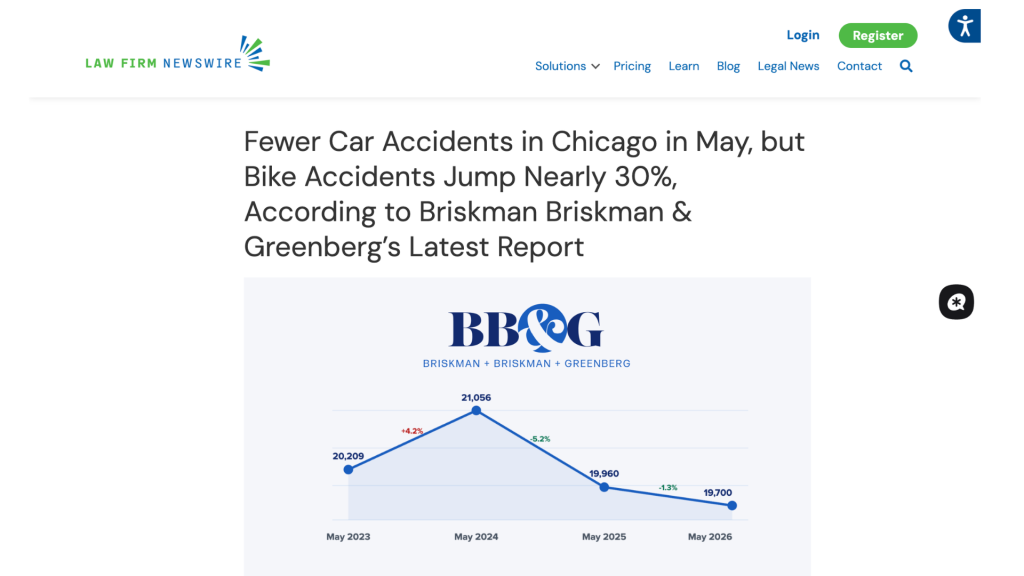
Publishing a study on your website is step one. Without active distribution, even excellent research earns few links. The distribution strategy determines whether a study generates ten citations or a hundred.
Press releases remain an effective tool for getting local research in front of journalists. A release announcing your firm’s analysis of local traffic fatality data, timed to coincide with a relevant news hook like a major local accident or a state safety report, gives reporters a ready-made story with a local angle. This connects to the broader reactive PR approach that strong personal injury law firm marketing programs use to earn editorial coverage.
Direct outreach to academic departments is another high-value channel. Law schools, public health departments, and transportation engineering programs at universities regularly publish resource pages linking to external data sources. The Bureau of Labor Statistics reported that private industry employers reported 2.6 million nonfatal workplace injuries and illnesses in 2023, an 8.4% decrease from 2022. A firm that publishes a local analysis of workplace injury trends could legitimately earn a citation from a university’s occupational health or labor law program.
Nonprofit organizations and advocacy groups are also strong distribution partners. Road safety nonprofits, consumer protection organizations, and public health advocacy groups all maintain websites with resource pages. If your research aligns with their mission, a simple outreach email explaining the data and its relevance can earn a link that carries substantial authority.
Social media distribution, particularly on LinkedIn and X (formerly Twitter), puts your research in front of journalists, academics, and policy professionals who actively look for local data to reference. Sharing key statistics from your study with a link back to the full report is a standard distribution tactic that costs nothing beyond the time to post.
Finally, internal linking from your research pages to your practice area pages creates a direct authority transfer pathway. A study on local car accident fatalities should link to your car accident attorney practice area page. The research earns the external links; the internal links pass that authority to the pages you actually want to rank.
Connecting Research to E-E-A-T and YMYL Requirements
Personal injury content falls squarely within Google’s Your Money or Your Life (YMYL) category. Pages that could influence a person’s legal decisions face a higher bar for quality assessment, and original research addresses that bar directly.
Google’s quality guidelines emphasize Experience, Expertise, Authoritativeness, and Trustworthiness (E-E-A-T). A study authored by a named attorney, grounded in government data, and cited by external authoritative sources demonstrates all four dimensions simultaneously. The attorney’s byline establishes expertise. The government data citations establish trustworthiness. The external citations establish authoritativeness. The firm’s track record of publishing multiple studies establishes experience.
Generic blog posts on personal injury topics can satisfy some E-E-A-T signals, but they struggle with authoritativeness because they rarely earn the kind of external citations that signal to Google that a page is a trusted source. Original research closes that gap. NHTSA’s final 2024 annual data reports 39,254 people died in traffic crashes, with a fatality rate of 1.19 per 100 million vehicle miles traveled. A firm that publishes a local analysis built on this data, properly attributed and linked to the original NHTSA source, creates a YMYL page with a clear, verifiable evidentiary foundation.
The same principle applies to workplace injury data. Private industry employers reported 2.6 million nonfatal workplace injuries and illnesses in 2023, an 8.4% decrease from 2022, according to the Bureau of Labor Statistics. A workers’ compensation or construction accident attorney who publishes an annual local analysis of these figures, with methodology and source attribution, produces content that meets the evidentiary standard YMYL pages require.
Research-based content also performs well in AI-generated search results and answer engine contexts. When an AI system is deciding which sources to cite in response to a query about local accident rates or personal injury claim statistics, it favors pages with clear authorship, cited data, and external validation. These are exactly the characteristics that original research provides, making it a strong asset for both traditional SEO and the emerging AI visibility channel.
If you want a research strategy built specifically for your market, practice area, and competitive position, Custom Legal Marketing builds and executes these programs for personal injury firms across the country. Contact us to talk about what a research-driven SEO program would look like for your firm.
FAQs About Original Research for Personal Injury SEO
What makes original research different from standard blog content for personal injury SEO?
Standard blog content rephrases information that already exists. Original research produces data or analysis that no other source holds. That distinction matters for link building because journalists, academics, and advocacy organizations only cite sources that give them something they cannot find elsewhere. A blog post explaining what to do after a car accident competes with thousands of identical pages. A study analyzing local car accident fatality trends by neighborhood gives local news outlets a unique story to cover, which earns editorial backlinks that no amount of content optimization can replicate.
How does a personal injury firm without a research department produce original studies?
Most firms start with publicly available government data. NHTSA’s Fatality Analysis Reporting System (FARS), the Bureau of Labor Statistics’ annual workplace injury reports, and CDC injury data are all free, authoritative, and updated regularly. A firm can produce genuine original research by downloading this data, filtering it for their state or metro area, and publishing a local analysis with proper attribution. That localization is the original contribution. Alternatively, firms can commission surveys through established research panels, asking respondents about their experiences with insurance claims, medical treatment after accidents, or knowledge of their legal rights.
How long does it take for a research study to earn backlinks and improve rankings?
Timeline varies based on distribution effort and topic relevance. A study on a topic tied to a current news cycle, such as drunk driving fatalities during a high-profile local case, can earn citations within days if the press release reaches the right journalists. Studies on evergreen topics, like annual accident trends, typically accumulate links over months as the content is discovered organically by researchers and writers. Rankings improvements from earned backlinks generally appear within three to six months, though competitive markets may take longer to reflect authority gains.
Can original research help a personal injury firm rank in AI-generated search results?
Yes. AI systems that generate search summaries, including Google’s AI Overviews and large language model-based answer engines, pull from sources that demonstrate clear authorship, cited evidence, and external validation. Original research satisfies all three criteria. A study with a named attorney author, data sourced from NHTSA or BLS, and citations from news outlets or academic institutions is precisely the type of content these systems treat as authoritative. Structuring your research with direct answers to specific questions, consistent with how answer engine optimization works, further increases the probability that AI systems will surface your content in response to relevant queries.
How often should a personal injury firm update its research studies?
Annual updates are the minimum standard for studies based on government data, because the underlying datasets are updated annually. NHTSA releases updated traffic fatality figures each year, and the Bureau of Labor Statistics publishes new workplace injury data on a similar cycle. Updating your study each time the source data refreshes keeps the page current, gives you a reason to re-pitch journalists, and signals to search engines that the page is actively maintained. Studies that go stale lose rankings and stop earning new citations. A firm that commits to annual updates treats its research as a long-term asset rather than a one-time publication.
More Resources About Link Building for Personal Injury Firms
- Link Building Strategy for Personal Injury Firms
- Press Releases for Personal Injury Law Firms
- Reactive PR for News Cycles and Personal Injury
- Surveys and Studies for Law Firms
- Local Sponsorship Strategy
- Community Involvement and Earned Links
- Bar Association Link Opportunities
- Law School Alumni Link Sources
- Podcast Guesting for Attorneys
What Our Clients Are Saying
