








Case Study: Deep AI Research Leads to Big AI Visibility Gains
By partnering with CLM, MyPhillyLawyer transformed a traffic-safety topic into a strategic SEO & AI asset.

THIS STUDY FEATURED ON:





MYPHILLYLAW CASE STUDY
Client & Project Background
Custom Legal Marketing used its AI-powered research system to uncover data our writers could use to create an authoritative report and amplify MyPhillyLawyer's visibility in search and answer engines.
Custom Legal Marketing’s content team collaborated with MyPhillyLawyer, a Philadelphia-based personal injury law firm, to deliver crash data content that didn’t just rehash the city’s “Vision Zero” reports like every other law firm in the city, in the report, "The Most Dangerous Intersections and Roads in Philadelphia."
We aimed to identify the underreported intersections that pose a danger to both drivers and pedestrians, to help MyPhillyLawyer raise awareness and advocate for action at City Hall to make the streets safer.
CLM’s content development and AI-powered research system, along with our team of writers and analysts, got to work:
- Sifting through multiple large data sources, like traffic-camera records, crash data from the Pennsylvania Department of Transportation (PennDOT), and collisions reported in the media
- Identifying additional dangerous intersections not explicitly mentioned in the Vision Zero Plan
- Creating a publication-ready dataset/report for MyPhillyLawyer
- Amplifying visibility via search, answer engines, and AI “overviews”
Research & Methodology
CLM’s approach involved several key steps:
1. Data ingestion and normalization
Our team analyzed the following data sets:
- Traffic-camera and red-light intersection listings (from Philadelphia Parking Authority) and their documented crash histories.
- PennDOT crash statistics for Philadelphia County, including intersections, severity, fatalities, and injury counts.
- Media-reported serious collisions, hit-and-runs, pedestrian fatalities gathered via news-API and web-scraping (2023-2025).
- Official Vision Zero “High Injury Network” / Priority Intersections list for context.
2. AI-driven pattern detection
Our team used AI algorithms to detect “hot-spots” of intersection risk by combining metrics:
- The frequency of crashes, crash severity, pedestrian involvement, red-light camera presence, and media coverage volume.
- Filtering for intersections not yet named by the Vision Zero plan but showing strong risk signals.
- Generating rankings and a chart of “most dangerous intersections” beyond the official list.
Our hypothesis: We can identify underreported dangerous intersections and build a dataset that helps establish authority.
3. Expert analysis & validation
Our team used human analysts to confirm the data.
- CLM’s traffic safety analysts reviewed flagged intersections for plausibility. For example, are there multiple lanes or high-speed corridors? What is the pedestrian mix? Is there camera data?
- Intersection names and contexts were cross-checked manually using news references and camera program reports to ensure quality.
4. Content & publication optimization
The findings were published on MyPhillyLawyer’s site and enhanced with structured headings, charts, and explanatory methodology. CLM then optimized the page for search and AI answer-engine visibility. We achieved this using schema markup for datasets and reports, internal linking, and semantic keyword targeting (e.g., “dangerous intersections Philadelphia”, “Vision Zero Philadelphia missing intersections”, etc.).
Additionally, CLM configured the report to be reference-friendly for AI systems, with clear headings, data tables, and a methodology section to encourage citation by large language models and Google’s AI Overview panels.
Results & Impact
MyPhillyLawyer’s report gained traction across search and AI platforms, establishing itself as a reference dataset for Philadelphia car accident and pedestrian risks.
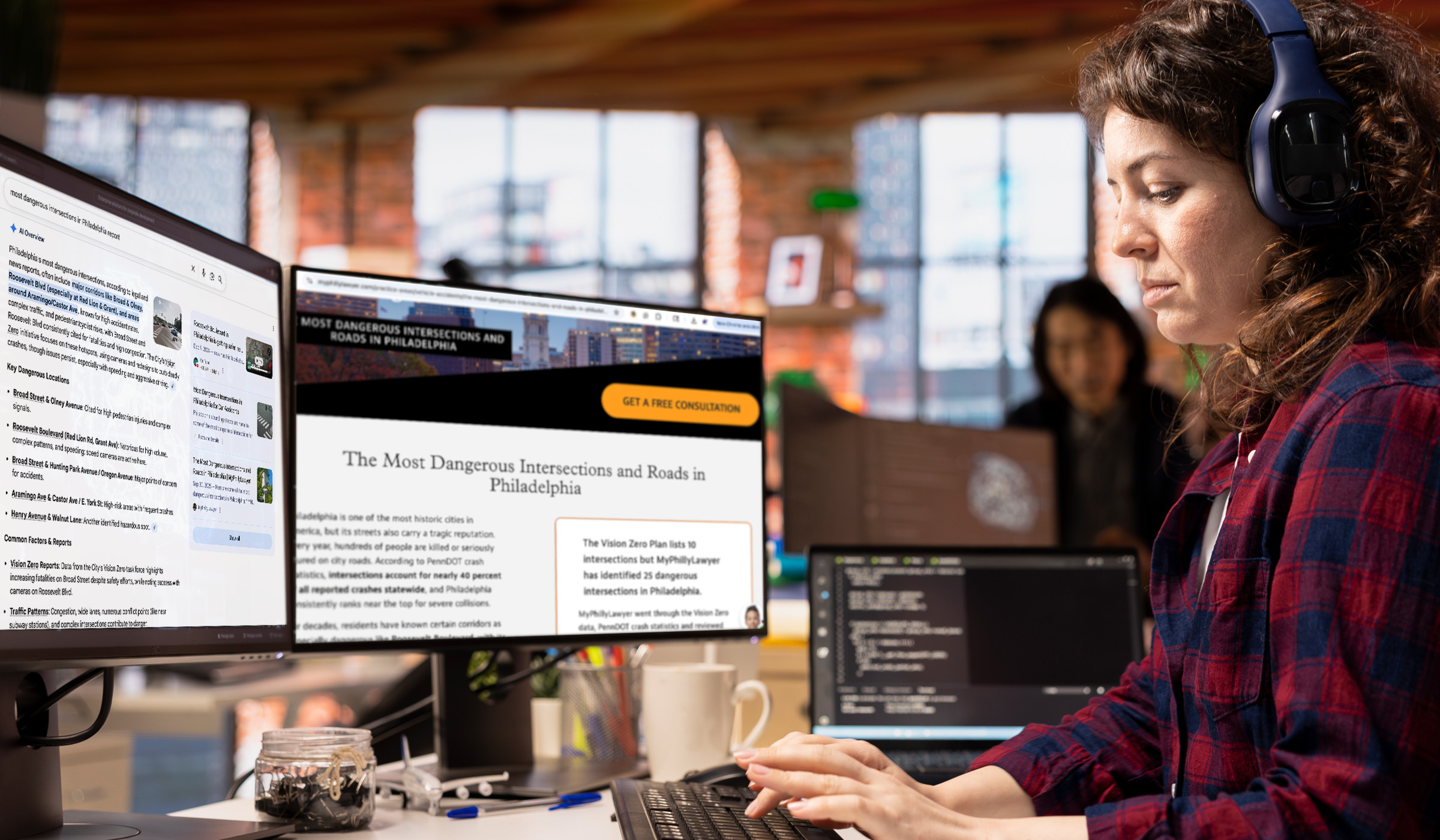
Notably, the report’s insights, especially the expanded list of 25 high-risk intersections, including 15 omitted by the Vision Zero plan, were picked up by answer engines as a credible source. For example, the site references “The Vision Zero Plan lists 10 intersections, but MyPhillyLawyer has identified 25 dangerous intersections in Philadelphia.”
Within weeks of publication, MyPhillyLawyer began showing up in search results and featured snippets for queries such as “most dangerous intersections in Philadelphia”, “Vision Zero Philadelphia missing intersections”, and “Roosevelt Boulevard dangerous intersections”.
Because the content was structured and data-driven, it was eligible for Google’s AI “Overview” panels and general LLM-based answer generation, boosting the visibility and authority of MyPhillyLawyer’s domain.
The report also functioned as a powerful content asset for link-earning, PR, and authority building, reinforcing MyPhillyLawyer’s position as a topical expert on vehicle accidents in Philadelphia.
Why It Worked
Novel Insight: The core value proposition was unique. It went beyond the city’s official list and uncovered additional high-risk intersections via proprietary research.
Data + Narrative: By combining traffic camera data, PennDOT statistics, and media incident reports, the research had empirical weight and storytelling appeal.
Answer-Engine Optimization: CLM anticipated the rise of AI/LLM search behaviors and optimized the asset not only for traditional SERPs but also for machine-readable formats with data tables, schema markup, and clear tags.
Publisher Credibility: MyPhillyLawyer had the domain authority and topical relevance in the personal injury/vehicle accident niche, which helped the content gain trust from search and AI systems.
Timeliness and Local Relevance: The topic had immediate relevance in Philadelphia and garnered media interest, making it link-worthy and shareable.
Conclusion
Law-firm content can move beyond standard practice area page pages into research-driven authority assets.
By partnering with CLM, MyPhillyLawyer transformed a traffic-safety topic into a strategic SEO/AI asset. The firm’s report on the “Most Dangerous Intersections and Roads in Philadelphia” went beyond existing municipal lists, leveraged AI-powered research to identify additional risk zones, and was optimized for modern search/AI ecosystems.
This case demonstrates how law-firm content can move beyond standard service pages into research-driven authority assets that generate long-term organic visibility not just among human searchers, but within the evolving realm of AI/answer-engine results.

CLM is singularly focused on my firm's success and frequently over-delivers. I don’t think that you could make a better choice.
- Paul Greenberg, Briskman Briskman & Greenberg
We have been using CLM for our websites for a number of years and they have been outstanding! Their entire team has always been highly responsive and met all of our marketing needs.
-Todd J. Leonard, Todd J. Leonard Law

