









Optimization
Prepare your firm for the future of search, including AI-powered engines like Google’s AI Overviews, ChatGPT, Claude and Perplexity with Law Firm Answer Engine Optimization (AEO). We structure content in a way that AI prefers and build topical authority so machine learning systems will reward your firm with cases.
Your firm plus AI equals more clients.
ANSWER ENGINE OPTIMIZATION
Answer Engine Optimization (AEO) for Law Firms
The way potential clients find lawyers shifted in 2025 and shifted again in early 2026. Google's AI Overviews now sit above organic results for most legal queries. ChatGPT, Perplexity, Claude, and Gemini handle millions of legal questions every day, and each one of them picks one or two sources to cite when constructing an answer. Answer Engine Optimization (AEO) is the discipline that decides whether your firm gets cited or skipped.
This guide covers the architecture behind AI answer engines, the six-pillar framework CLM uses on every client campaign, practice-area-specific AEO playbooks, and the proprietary research that informs the Custom Legal Marketing approach. It runs longer than most pieces on this topic.
What Is Answer Engine Optimization (AEO) for Lawyers?
Answer Engine Optimization (or AEO) is how a law firm structures its digital presence so AI platforms can find content, parse it, trust it, and pull from it when a potential client asks a legal question. When someone types "Do I need a lawyer after a car accident in Chicago?" into ChatGPT, the chatbot picks one source, maybe two, and builds a response. The firm with the clearest, best-structured answer gets cited. Everyone else loses that lead before the intake form even opens.
Traditional law firm SEO ranks web pages. AEO ranks answers. When a person asks ChatGPT for a personal injury lawyer recommendation, or when Google generates an AI Overview summarizing the statute of limitations in their state, the content that gets selected often has nothing to do with who has the most backlinks or the highest Domain Authority score. What matters is which page answers the question most directly, in a structure machines can actually parse, with trust signals AI systems can verify.
AEO builds on top of solid law firm SEO fundamentals. Technical performance, mobile responsiveness, a real backlink profile, and content that targets the right keywords still matter. AEO adds the structural and strategic layer that lets AI systems confidently extract content, summarize it, and attribute the firm as the authoritative source.
From Page Rankings to Cited Answers
Why traditional SEO no longer covers the surface area where potential clients find lawyers.
Why Does AEO Matter for Law Firms in 2026?
Legal queries trigger AI-generated answers at rates well above baseline for any other category. SE Ranking's YMYL research found that 77.67 percent of "Your Money or Your Life" legal queries trigger a Google AI Overview. Question-format queries trigger AI Overviews 57.9 percent of the time, "why" queries trigger them 59.8 percent of the time, and long-tail queries of seven or more words trigger them 46 percent of the time (Ahrefs, 146M SERP analysis). Those three query shapes describe almost every informational legal search a potential client performs before filling out an intake form.
Google's AI Overviews now sit above traditional search results for the majority of legal queries, pulling information from multiple sources and summarizing it before anyone scrolls to a blue link. ChatGPT references live web data and structured knowledge bases. Perplexity shows its sources with every answer, linking directly to the pages it pulls from. Claude handles long-form, nuanced legal questions with multi-step reasoning. Gemini works across Google Search, Workspace, and Android. Every one of those platforms is a surface where a firm either appears or gets left out.
The early movers compound their advantage. Once an AI platform cites a firm's content and the response performs well, the association sticks. That platform becomes more likely to pull from the same site on related topics. CLM calls this information asymmetry: firms building AI authority now are making it harder for everyone else to catch up later.
Legal Queries Are AI Overview Magnets
Four query types potential clients use most before hiring a lawyer all trigger Google AI Overviews at rates well above the 21 percent baseline.
Sources: SE Ranking YMYL research; Ahrefs query-type trigger study across 146M SERPs.
The AI Answer Engine Landscape for Legal Search
Five platforms dominate AI-driven legal search in 2026. Each one retrieves and weights information differently, but all of them reward clear, authoritative, structured content backed by verifiable trust signals.
Where Legal Searches Are Resolved in 2026
Five platforms dominate AI-driven legal search. Each retrieves and weights information differently.
Why AI Overview Citations Have Decoupled From Traditional Rankings
The single most important development in AI visibility over the past year is that AI Overview citations have stopped tracking traditional search rankings. As recently as July 2025, an Ahrefs study of 1.9 million AI Overview citations found 76 percent of cited pages also ranked in Google's top ten for the same query. By February 2026, an updated Ahrefs study of 863,000 keywords put that overlap at 38 percent. A parallel BrightEdge analysis using different methodology put the overlap closer to 17 percent. In roughly seven months, the share of AI Overview citations from pages also ranking on page one fell by half or more.
Google rolled Gemini 3 out as the global default for AI Overviews in January 2026. Ahrefs notes the timing aligns with the citation shift, while flagging that improvements to its own parsing methodology since the July 2025 study also account for some of the apparent change. Either way, the practical takeaway is direct: ranking on page one is no longer a reliable proxy for AI visibility, and AEO has become a separate discipline with its own rules.
The AI Overview Overlap Collapse
Share of AI Overview citations that also appeared in Google's top 10 organic results for the same query, measured over seven months across two independent datasets.
Sources: Ahrefs July 2025 study (1.9M citations across 1M AI Overviews); Ahrefs February 2026 update (863K keyword SERPs, 4M AI Overview URLs); BrightEdge October 2025 and February 12, 2026 citation overlap analyses, reported by Search Engine Journal.
How AI Answer Engines Actually Work
Two architectural shifts changed the rules in 2025 and 2026: query fan-out and passage-level extraction. Both run beneath every AI Overview impression and most ChatGPT, Perplexity, and Gemini responses to legal queries.
Query Fan-Out: Why Topic Coverage Beats Single-Page Optimization
Google publicly introduced query fan-out at I/O 2025, and Gemini 3 substantially expanded its scope. When a potential client asks a legal question complex enough to trigger an AI Overview, Gemini does not retrieve results for that exact query. It decomposes the query into multiple parallel sub-queries, each targeting a different facet of the user's likely intent. Each sub-query runs its own independent retrieval against Google's index. Gemini then synthesizes a draft answer across the passages returned from all sub-queries and attaches citations to the specific sources that supported specific claims.
A single practice area page that addresses only the head term of its topic will miss citations on every adjacent sub-query. A DUI defense page that only answers "what is a DUI in Texas" will not get cited when a potential client asks about implied consent penalties, license suspension timelines, diversion program eligibility, or bail procedures, even though those questions sit inside the same intake journey. Firms that build citation surface across the full fan-out of sub-queries around their practice areas win a structurally larger share of AI Overview citations than firms optimizing only for head terms. This is the engineering reason why topical clusters and content hubs matter so much more for AEO than they ever did for traditional search.
The AI Overview Retrieval Architecture
How Gemini converts a single user query into a set of parallel retrievals, synthesizes a draft answer, and attaches citations to the specific passages that supported specific claims.
Simplified illustration. Standard queries trigger multiple parallel sub-queries; deep-research requests can trigger many more.
A Real Fan-Out Walkthrough: One Legal Query, Twelve Sub-Queries
A potential client in Houston types "how long do I have to sue after a car accident in Texas" into Google. Gemini does not run that exact string. It generates a fan of related queries the user is likely to need answered before they decide to act. Below is a representative sub-query decomposition for that head query, along with the content shape that wins each sub-query.
One Legal Query, Twelve Sub-Queries
Representative sub-query decomposition for a Houston car accident query, mapping each sub-query to the content shape that wins it.
| Sub-Query | Winning Content Shape | |
|---|---|---|
| 01 | What is the statute of limitations for a Texas car accident? | Direct answer 40 to 60 word lead under question H2 with statute citation (Texas Civ. Prac. & Rem. Code § 16.003). |
| 02 | When does the 2-year clock start in a Texas car accident case? | FAQ block Date-of-injury vs. discovery rule explanation, 60 to 90 words. |
| 03 | Are there exceptions to the Texas car accident statute of limitations? | Listicle Tolling for minors, mental incapacity, defendants out of state, fraudulent concealment. |
| 04 | How long do I have to sue a government entity after a Texas car accident? | Edge-case FAQ Texas Tort Claims Act 6-month notice requirement explained inline. |
| 05 | What if the other driver lives out of state? | Cluster page Long-arm jurisdiction, service of process, tolling considerations. |
| 06 | Can the statute of limitations be extended in a Texas wrongful death case? | Cluster page Wrongful death-specific 2-year window with date-of-death trigger. |
| 07 | What happens if I miss the deadline to file a Texas car accident lawsuit? | Direct answer Hard bar with rare equitable exceptions, plain-language consequence. |
| 08 | Do I need a lawyer to file a Texas car accident claim? | HowTo Process steps with named decision criteria. |
| 09 | How long does a Texas car accident lawsuit take to settle? | Cluster page Settlement vs. trial timelines, discovery phases, mediation expectations. |
| 10 | What is the average car accident settlement in Texas? | Cluster page Range data with damage categories, anonymized verdict references. |
| 11 | What are the deadlines to file a car accident insurance claim in Texas? | Direct answer Insurance contract notice clauses (typically 30 days) vs. statute of limitations. |
| 12 | How do I find a Houston car accident lawyer near me? | Local AEO GBP optimization, neighborhood references, Harris County court familiarity. |
Per Google's documentation, AI Overview retrieval splits the original query into multiple related sub-queries; the specific decomposition above is illustrative. Ahrefs research found AI Overviews change every 2 days on average, so any single fan-out trace is a snapshot.
Most law firm pages cover 2 or 3 of those sub-queries on a single URL and ignore the rest. The firms cited across all 12 win the AI Overview by structural margin, not by Domain Authority.
Passage-Level Extraction: Why the First Paragraph Under Every Heading Decides Everything
AI Overview selection happens at the passage level, not the page level. Traditional ranking evaluates pages as whole units competing for positions in an ordered list. Gemini evaluates content blocks between heading boundaries and looks for the best self-contained answer to each sub-query. Established AEO heuristics call for self-contained content blocks in the 100 to 300 word range, with question-format headings followed by a direct lead answer of roughly 40 to 60 words that opens with the answer itself and includes specific jurisdictional or statutory detail.
A January 2026 Harvard Journal of Law and Technology commentary reviewed fifty U.S. law firm websites and found that firms opening pages with general commentary about stress, uncertainty, or the value of hiring a lawyer were cited less often than firms that opened with one or two direct sentences answering the question. The "we understand how difficult this time can be" introduction that most firm content has relied on for a decade is a recurring reason competitor pages get selected by AI Overview instead.
Side-by-Side: Generic Legal Intro vs. AEO-Optimized Rewrite
The fastest way to see the extraction profile in action is to look at an actual law firm intro before and after AEO optimization. Both blocks below answer the same query: "What is the statute of limitations for a car accident in Texas?"
Generic Legal Intro vs. AEO-Optimized Rewrite
Both blocks answer the same query: "What is the statute of limitations for a car accident in Texas?" Only one of them gets cited.
Retrieval, Synthesis, and Trust Evaluation
Google's AI Overviews run on a proprietary retrieval system called FastSearch, which relies on a signal set called RankEmbed. Court documents from Google's antitrust case show that RankEmbed measures semantic relationships between queries and documents. It evaluates how closely a piece of content aligns with the actual meaning behind what someone asked, rather than counting backlinks or checking domain metrics. For a law firm, a well-structured page that directly answers a specific legal question can outperform a page with a higher Domain Authority score that covers the same topic in vague language. CLM's Domain Authority research found near-zero correlation between DA scores and actual law firm rankings, and AI answer engines push that signal even further into irrelevance.
After pulling relevant content, the AI model combines information from multiple sources into one coherent answer. Content structure matters at this stage. AI systems look for discrete answer blocks: a clear question, a direct response, supporting evidence or context. Pages built this way are easier to extract from and credit. AI answer engines also evaluate trust on multiple levels at once, looking at domain credibility, on-page expertise signals (author credentials, citations to statutes), and consistency across the firm's site and external sources including legal directories, bar association profiles, news outlets, review platforms, YouTube transcripts, and Reddit discussions.
Featured Snippets, People Also Ask, and AI Overviews: How They Connect
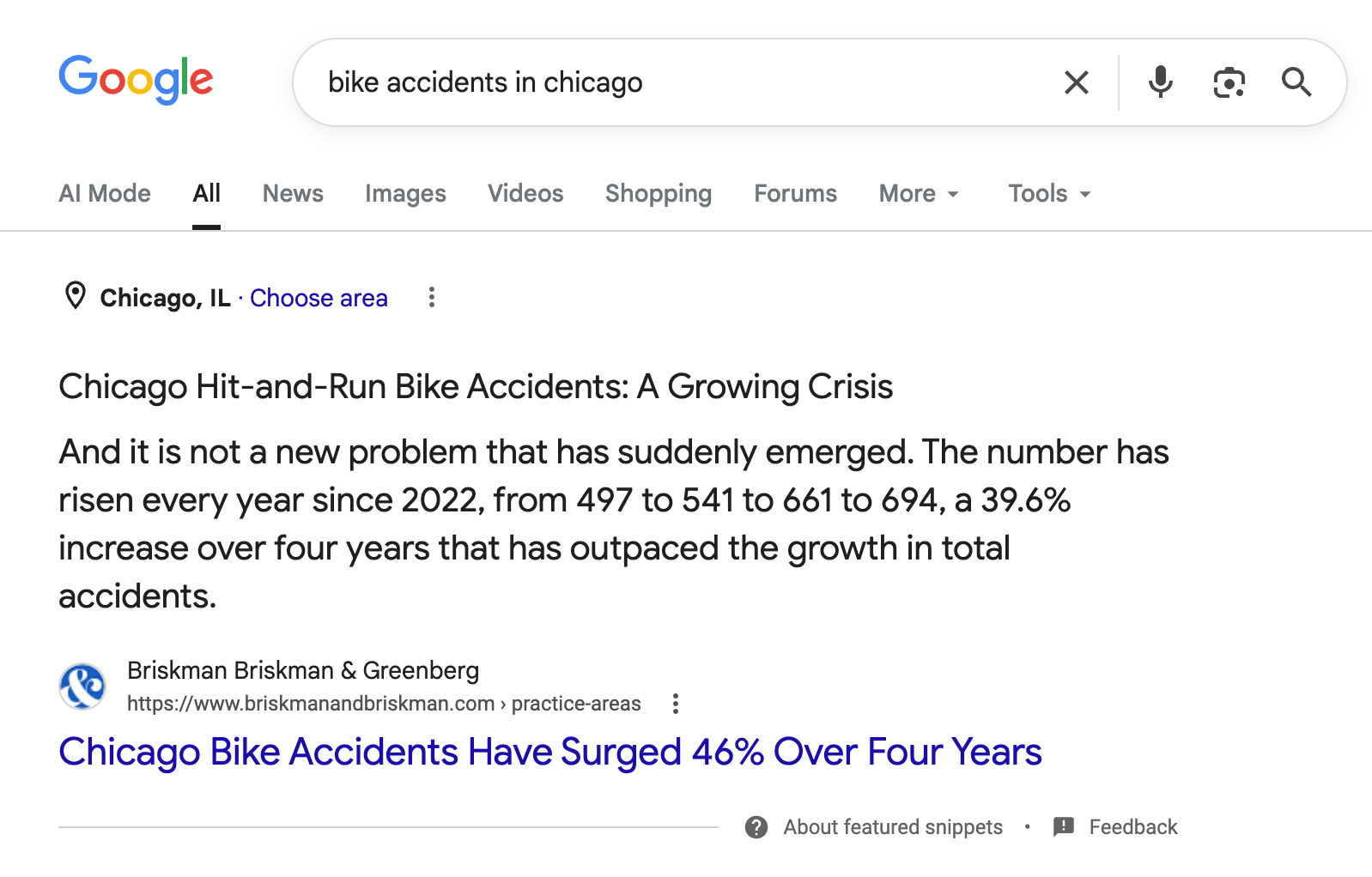
Three answer surfaces compete for attention above organic listings: classic featured snippets, People Also Ask boxes, and AI Overviews. They look similar to a user. They behave differently underneath. Understanding the distinction matters because the optimization tactics that win one do not automatically win the others.
Featured snippets are extracted directly from a single high-ranking page. Google pulls a paragraph, list, or table verbatim and displays it at position zero. Featured snippet wins still depend on classic ranking signals, the page typically already sits in the top five for the target query, and content structure (definition + bulleted list, or question + 40-60 word direct answer) drives selection.
People Also Ask boxes pull short answers from multiple pages, displaying them as expandable accordion items. PAA selection rewards pages with explicit FAQ sections, FAQPage schema, and question-format H2 or H3 headings. A single law firm page can earn three or four PAA placements if it covers a topic comprehensively with question-structured subheadings.
AI Overviews synthesize across multiple sources, attribute citations to specific passages, and generate net-new prose rather than extracting it. AIO citations reward topical cluster coverage (because of query fan-out), schema markup, freshness, and entity-level trust signals beyond the on-page content itself.
A single optimized page can win all three surfaces. The structural overlap is question-format headings with direct 40-60 word lead answers, FAQPage schema, and supporting context that demonstrates topical depth. Firms that treat featured snippets, PAA, and AIO as one unified optimization target capture more screen real estate above the fold than competitors chasing each surface in isolation.
Featured Snippets vs. People Also Ask vs. AI Overviews
Three answer surfaces compete for attention above organic results. They look similar to a user. They behave differently underneath.
| Featured Snippets | People Also Ask | AI Overviews | |
|---|---|---|---|
| Source Behavior | Extracts from 1 high-ranking page verbatim | Pulls short answers from multiple pages | Synthesizes across many sources, generates net-new prose |
| Ranking Dependency | High · usually top 5 already | Medium · top 10 typical | Low · top-10 overlap dropped from 76% to 17-38% |
| Optimization Target | Definition + bulleted list, or 40-60 word answer | FAQPage schema, question H2/H3, brief answers | Topical cluster coverage, schema, freshness, entity trust |
| Schema That Helps | Article, HowTo | FAQPage (critical) | FAQPage, Article, Person, LocalBusiness, LegalService |
| Citation Visibility | Single source link | One source per accordion item | Multiple numbered citations per response |
Voice Search and AEO: The "Near Me" Channel
Voice search is the original conversational query engine, and it now feeds the same AI answer infrastructure as text. Siri routes most informational queries through Google or Apple Intelligence. Google Assistant pulls from Gemini-powered AI Overviews. Alexa increasingly hands off legal queries to its generative answer layer. Every voice query is a long-tail, conversational, often location-anchored question, which makes voice search one of the highest-AEO-trigger surfaces for legal traffic.
Voice queries skew local. "Best personal injury lawyer near me," "DUI attorney open now," "family law office in Plano" all resolve through a hybrid of Google Business Profile data, AI Overview citations, and local pack rankings. A complete voice AEO posture requires Google Business Profile completeness (categories, hours, services, FAQs, posts), NAP consistency across directories, review velocity and recency, and on-site content that answers "near me" intent with explicit city, neighborhood, and county references.
Voice queries also skew toward immediate action. "Call a divorce lawyer in Austin" or "schedule consultation with a criminal defense attorney" are transactional intents that AI assistants resolve by recommending a specific provider. Firms that win voice AEO have explicit booking flows, click-to-call CTAs, and structured data marking their phone number, address, and service hours as machine-readable fields.
Voice AEO Optimization Checklist
- Conversational H2s that mirror spoken phrasing ("How much does a personal injury lawyer cost in Dallas?" instead of "Personal Injury Attorney Fees")
- 40-60 word direct lead answers immediately under each question heading
- Google Business Profile fully populated with services, FAQs, weekly posts, and category alignment
- LocalBusiness, LegalService, and Attorney schema with sameAs links to bar profiles, GBP, Avvo, Justia
- City, neighborhood, county, and court references woven into supporting paragraphs
- Click-to-call buttons and SpeakableSpecification schema on key pages
- Review profile management across Google, Avvo, Yelp, and bar association ratings
AEO by Practice Area: Where the Citation Battles Get Fought
Every practice area has its own query fan-out shape, its own dominant AI platform, and its own trust-signal profile. A generic AEO playbook applied uniformly across practice areas leaves citations on the table. Below is the practice-area-specific breakdown CLM uses on client campaigns.
Where the Citation Battles Get Fought
Each practice area has its own query fan-out shape, dominant AI platform, and trust-signal profile. A generic playbook leaves citations on the table.
| Practice Area | Fan-Out Density | Dominant Platforms | Trust-Signal Priority |
|---|---|---|---|
| Personal Injury | Highest of any practice area. SOL, comparative fault, insurance tactics, settlement values, MMI, lien resolution, plus 12+ accident-type variants. | ChatGPTPerplexityAIO | Verdict references, attorney bar admissions, case result transparency, Avvo and Google reviews. |
| Criminal Defense | Charge-specific (DUI, possession, assault, theft, DV, federal) plus jurisdictional layers (state, county, municipal court). | ChatGPTVoiceReddit-fed | YouTube explainers, Reddit AMA presence, court-specific experience, prior prosecutor credentials. |
| Family Law | Custody, divorce, support, modification, adoption, prenups. Each generates its own fan-out. Highest AIO trigger rate in legal. | ClaudeGeminiAIO | Long-form scenario coverage (high-asset, military, same-sex, business-owner), board certifications, mediator credentials. |
| Immigration | Visa-specific (H-1B, EB-5, U visa, asylum), country-of-origin guidance, process timelines. Federal policy churn drives constant refresh. | AIOChatGPTPerplexity | Freshness signals dominate. Pages older than 18 months drop from citation pools regardless of rankings. |
| Mass Tort & Class Action | Episodic. New MDLs and settlements open citation surface fast. 48-hour publishing window captures early citations that compound. | AIOChatGPTPerplexity | MDL leadership credentials, settlement track record, eligibility intake forms, plaintiff attorney bar memberships. |
| Estate Planning & Probate | Wills, trusts, probate, estate tax, guardianship. Research-heavy multi-session journey. Long-form pillar pages dominate. | ClaudeGeminiAIO | CFP and CPA collaborations, board certifications, original tax-strategy content, multi-state authority. |
Personal Injury
Personal injury queries fan out hardest. A single head query like "car accident lawyer in Atlanta" decomposes into sub-queries about statute of limitations, comparative fault rules, insurance company tactics, average settlement values, MMI definitions, lien resolution, and dozens of accident-type variants (rear-end, T-bone, hit-and-run, rideshare, commercial trucking, motorcycle, pedestrian, bicycle). Personal injury AEO requires the densest topic cluster of any practice area. ChatGPT and Perplexity dominate the recommendation surface for "best PI lawyer" queries, while AI Overviews dominate informational queries about claims, damages, and timelines.
Criminal Defense
Criminal defense queries skew urgent and time-sensitive. "Just got arrested," "DUI lawyer same day," "bail hearing tomorrow." AI assistants and voice search dominate this surface because users are often physically impaired, in custody, or in transit. Citation wins come from charge-specific landing pages (DUI, possession, assault, theft, domestic violence, federal charges), explicit jurisdictional coverage (state, county, municipal court), and strong YouTube presence (criminal defense explainers are among the most-cited YouTube content in Google AI Overviews). Reddit threads also drive significant ChatGPT citations on criminal defense topics.
Family Law
Family law queries are the highest-volume AI Overview triggers in legal because they are emotionally loaded, jurisdictionally specific, and procedurally complex. Custody, divorce, support, modification, adoption, and prenuptial queries each generate their own fan-outs. Claude and Gemini outperform other platforms on family law queries because of their multi-step reasoning capabilities. Long-form, scenario-rich content (high-asset divorce, military divorce, same-sex divorce, divorce with business ownership) wins disproportionate citations.
Immigration
Immigration AEO is the most volatile practice area because federal policy changes reshape the citation landscape every quarter. Freshness signals matter more here than anywhere else: pages that have not been substantively updated in over a year see citation rates drop sharply regardless of where they rank organically. Visa-specific landing pages (H-1B, EB-5, U visa, asylum, green card categories), country-of-origin-specific guidance, and process timeline content win the bulk of citations.
Mass Tort and Class Action
Mass tort queries are episodic and litigation-driven. When a new MDL forms or a settlement gets announced, citation surface opens up fast. Firms that publish within 48 hours of major mass tort developments capture early citations that compound over the litigation lifecycle. AI Overviews dominate informational mass tort queries (eligibility, statute of limitations, settlement amounts), while ChatGPT recommendations drive intake form submissions for active campaigns.
Estate Planning and Probate
Estate planning queries are research-heavy and deliberate. Users compare options across multiple sessions, often returning to the same content over weeks. Long-form pillar pages on wills, trusts, probate, estate tax, and guardianship outperform short-form blog content. Claude and Gemini cite estate planning content disproportionately because of the multi-step reasoning involved. Reddit and YouTube citations matter less here than in other practice areas.
The Three Levels of AEO: Architecture, Authority, Structured Signals
CLM structures every AEO engagement around three layers. Architecture goes at the bottom, authority sits in the middle, structured signals go on top. Each layer depends on the one beneath it.
The Three Levels of Answer Engine Optimization
Architecture sits at the bottom. Authority sits in the middle. Structured signals go on top. Each layer depends on the one beneath it.
Level 1: Content Architecture
Content architecture creates the relationships between topics that determine whether AI systems read a site as a pile of disconnected pages or as a comprehensive resource on specific legal subjects. Pillar pages anchor each practice area. Supporting pages address the full fan-out of sub-queries (definition, process, timeline, cost, jurisdiction, procedural questions, consequences, adjacent scenarios). Internal linking creates the semantic web AI systems traverse. URL structure mirrors topical hierarchy where possible.
Level 2: Authority and Expertise
Authority is what gets a firm's content trusted enough to cite. AI answer engines apply Google's E-E-A-T framework (Experience, Expertise, Authoritativeness, Trustworthiness) with amplified scrutiny on legal, medical, and financial queries. Named attorney bylines, bar admissions, citations to primary legal sources, consistent entity information across directories and bar profiles, and original research all feed authority signals. CLM's research program (PageSpeed correlation study, AI content analysis, AI-generated content rankings research, Domain Authority correlation work) gives clients original data nobody else can replicate.
E-E-A-T: What AI Engines Actually Verify
Gemini applies amplified E-E-A-T scrutiny on legal queries specifically. Each pillar maps to concrete on-page and off-page work.
- Anonymized real case scenarios
- Process walkthroughs from actual practice
- What clients should expect at each stage
- Practice insights that only come from doing the work
- Named attorney byline on every page
- Bar admissions and years in practice
- Areas of focus and notable results
- Linked attorney bios with full credentials
- Legal directory citations and bar profiles
- News coverage and speaking engagements
- YouTube transcripts (most-cited domain in AIOs)
- Organic Reddit presence post-OpenAI partnership
- Statute and case citations on every claim
- Prominent contact information and current attorney directory
- Clear privacy policy and disclaimer
- Updated publish/revised dates visible to crawlers
Level 3: Structured Signals
Schema markup translates human-readable legal content into machine-parseable data. FAQPage, Article, Person (Attorney), LocalBusiness, LegalService, HowTo, and SpeakableSpecification schema all play distinct roles. Entity optimization makes sure firm names, attorney names, practice areas, and service locations are referenced consistently across the site and across the web. Technical accessibility (clean HTML, logical heading hierarchy, proper semantic elements, alt text, mobile responsiveness) determines whether AI retrieval systems can crawl and parse the content at all.
Where Your Firm Needs to Appear: Platform-by-Platform AEO
Each AI answer engine retrieves, evaluates, and presents legal information differently. A complete AEO strategy accounts for those differences while building on the common foundation of clear, authoritative, well-structured content.
Google Top-10 Overlap by AI Platform
Share of each AI platform's citations that also rank in Google's top 10 for the same query. Lower numbers mean traditional SEO rankings are a weaker predictor of citation on that platform.
Sources: Ahrefs February 2026 study (863K keyword SERPs, 4M AI Overview URLs); BrightEdge February 12, 2026 analysis; Ahrefs 15,000-prompt overlap study (Google AI Overviews, ChatGPT, Perplexity, Copilot, Gemini); Semrush ChatGPT-Google overlap research; Ahrefs Brand Radar YouTube citation tracking.
Google AI Overviews for Law Firms
Google's AI Overviews sit at the top of search results, synthesizing information from multiple sources before traditional organic listings. Even when a page ranks on page one, a potential client may get the answer from the Overview without scrolling. Since the January 2026 Gemini 3 rollout, AIO citation pools have expanded and diverged further from traditional top-ten rankings (Ahrefs, BrightEdge, SE Ranking).
Optimization priorities: Answer-first content structure, comprehensive topic clusters covering the full fan-out surface, entity-rich language matching how clients phrase legal questions, conversational question-structured headings, content freshness within 24 months.
ChatGPT for Law Firms
ChatGPT pulls from live web data, knowledge bases, and well-structured content. It gravitates toward sites it considers trustworthy and authoritative. Reddit and YouTube citations have become particularly important since OpenAI's content partnership rollouts in 2024-2025. When a user asks "Who is the best personal injury lawyer in Dallas?", ChatGPT evaluates entities, review signals, web citations, and content quality before constructing its answer.
Optimization priorities: Authoritative attorney profiles, consistent NAP across directories, strong review profiles, content showing genuine expertise, presence across Reddit (organic, not spam) and YouTube.
Perplexity AEO for Law Firms
Perplexity shows its sources with every answer, making it the most transparent AI answer engine to target. When it answers a legal question, it links directly to the pages it drew from. Clear, well-formatted, authoritative content can generate direct attributed traffic. Strong legal authority signals matter most here: client reviews, bar memberships, press mentions, well-researched legal guides, and citations to primary legal sources.
Optimization priorities: Well-formatted legal guides, statute citations, external trust signals, full-scope topic coverage.
Claude AEO for Law Firms
Claude handles longer, more nuanced answers and does especially well with complex legal questions requiring multi-step reasoning. For a family law firm, that means covering "How is child custody decided in Florida?" alongside "What factors affect a judge's custody decision?", "How can I modify a custody agreement?", and "What is the difference between legal custody and physical custody in Florida?" Claude rewards comprehensive treatment.
Optimization priorities: Long-form legal guides, deep FAQ coverage, multi-scenario content addressing edge cases and follow-up questions.
Gemini AEO for Lawyers
Google's Gemini integrates with Search and works across Google Workspace, Android, and Chrome. It processes multi-modal content and favors well-structured, entity-rich pages. Gemini visibility means content, structured data, and Google Business Profile all need to be aligned.
Optimization priorities: Google Business Profile optimization, consistent entity data across Google properties, visual content with descriptive alt text, schema markup site-wide.
Video, YouTube, and Multimodal AEO

YouTube is the single most-cited domain in Google AI Overviews overall, and AI answer engines are getting more sophisticated at extracting passages from video transcripts. For law firms, that converts video from a brand awareness tool into a direct citation channel.
A short attorney explainer video answering "What happens at a DUI arraignment in California?" can produce three citation surfaces simultaneously: the YouTube watch page itself (cited in AIOs and ChatGPT), the embedded video on the firm's practice area page (boosting that page's AIO citation rate through engagement signals), and the transcript content (extracted by Gemini's multi-modal retrieval).
Video AEO Production Standards
- Question-format video titles that mirror real client queries
- Full transcripts published as on-page text near the embedded video
- VideoObject schema with name, description, thumbnailUrl, uploadDate, and transcript fields
- Chapter markers for multi-topic videos so AI engines can extract specific timestamps
- Named attorney on camera with credentials in the description
- End screens directing to specific practice area pages, not just the homepage
- Captions in the platform's native caption track, not just burned-in
Infographics and original visuals function the same way. Gemini extracts data from charts when alt text and surrounding context describe what the chart shows. Original CLM Sequoia research charts published with descriptive captions get pulled into AIO responses on the same topics.
AEO vs. SEO vs. GEO: Understanding the Landscape
These three disciplines overlap, and they are distinct enough that understanding the differences helps law firms allocate resources. Search Engine Optimization targets traditional search results and covers technical performance, keyword research, backlink development, content quality, and local optimization. Answer Engine Optimization targets AI-generated answers and layers content structuring for AI extraction, schema markup, entity optimization, and cross-platform optimization on top of the SEO foundation. Generative Engine Optimization targets generative AI platforms specifically, focusing on getting content into model training datasets, optimizing for AI retrieval patterns, and building entity-level authority that generative models use to decide which sources to recommend.
In practice, these strategies overlap substantially. Strong SEO creates the base AEO and GEO build on. A well-optimized page that ranks in traditional search is more likely to get picked up by AI answer engines. The reverse is not always true. A page that ranks well in Google may still lack the structural clarity, schema markup, or entity signals AI answer engines need before citing it. CLM treats all three as integrated components of one strategy. Every piece of content and every technical optimization is designed to perform across traditional search, AI answer extraction, and generative model citation simultaneously.
AEO vs. SEO vs. GEO: What Each Discipline Targets
These three disciplines overlap. They are distinct enough that understanding the differences helps law firms allocate resources without duplication or gaps.
How CLM Builds AEO Into Every Law Firm's Campaign
Custom Legal Marketing has been working toward answer engine optimization for years, well before the term became industry shorthand. Our proprietary AI marketing platform, CLM Sequoia, was built specifically to create the kind of information asymmetry that gives our clients a structural advantage in both traditional search and AI-powered discovery.
CLM Sequoia: The AI Marketing Platform Built for Legal
CLM Sequoia isn't a white-labeled third-party tool. We built it from the ground up, purpose-designed for legal marketing's specific complexities. Sequoia powers every part of our AEO approach:
Content Intelligence: Sequoia analyzes the competitive landscape for every practice area and location. It identifies the specific questions AI answer engines are processing, which firms are getting cited, and where gaps exist. This intelligence shapes content strategy that targets AI citation opportunities with precision. Sequoia also fact checks content, verifies bar attorney advertising compliance, and cross-references our legal library to make sure your audience and answer engines are getting the truth and nothing but the truth.
Technical Optimization: Schema markup implementation, accessibility compliance, and content audit tools all run through Sequoia. Our content audit tools flag AEO readiness issues and rank improvements by potential impact.
Proprietary Research: CLM's research studies analyze thousands of law firm pages and AI responses to produce the original data and insights that set our clients' content apart from the generic material flooding legal marketing. These findings drive real strategy decisions and provide the kind of unique, citable material that AI answer engines reward.
The CLM Sequoia AI Citability Score
The most concrete expression of our AEO methodology is the CLM Sequoia AI Citability Score. Every client page is scored against a 100-point rubric built around five weighted categories that reflect how Gemini, ChatGPT, and the other answer engines actually select content for citation.
Pages that score below the Strong tier do not ship in their current form. Pages already above it rotate through refresh cycles timed to protect standing as Gemini updates reshape citation pools. The Citability Score is the gating mechanism that turns AEO from abstract best practices into an operational workflow.
The Five Categories of the AI Citability Score
Every client page is scored against a weighted 100-point rubric. Pages below the Strong tier go back to the editorial queue before publication.
CLM Sequoia Was Fact-Checking Law Firm Content Before Google Called It Critical
Source: CLM Sequoia, 93 U.S. metros, top 8 results for 26 legal keywords, October 16, 2026.
CLM Sequoia takes its name from the tree that never stops growing, and the platform earns it. Every month Sequoia runs new research across the legal search landscape, feeds what it learns back into how it builds, checks, and scores client content, and raises the bar for what ships. When Google changes a rule, Sequoia has usually measured the effect before the rest of the industry has finished speculating about it. Our clients do not wait for a conference talk to find out what works. They are already running on it.
October was a good example. On October 1, 2026, Google updated its guidance on generative AI content to say it is critical to manually fact-check and review everything a language model produces before publishing it, including title tags, meta descriptions, structured data, and alt text. A week later the September 2026 spam update finished rolling out. Eight days after that, Sequoia pulled the top 8 Google results for 26 competitive legal searches across 93 U.S. metros and scored every law firm page it found for AI-generated content. The full findings are in One in Five Top-Ranking Law Firm Pages Is Almost Entirely AI Even After the September Update.
The numbers settle the question most firms are asking. Across 5,182 ranking law firm pages, 27.9% of all words were flagged as AI-generated. 21.6% of pages were 76% or more AI, and 13.4% scored exactly 100%. Ranking position made no difference: 28.3% of first-position pages were mostly AI, and so were 29.4% of eighth-position pages. Firms whose pages averaged 51% or more AI content in February kept their rankings through the spam update at the same rate as firms under 10%. Google did not penalize AI content. It added a warning label to a product it already allows. Sequoia had the data to prove it within days, and that data now shapes every page we build.
Where the Risk Actually Sits
The study also shows what a generated law firm page looks like, and the profile explains why Google chose the word "critical." The distribution has no middle: 60% of pages score 10% or less, 22% score 76% or more, and fewer than one in five land in between. Firms are either writing their pages or generating them, and almost nobody is editing a generated draft. The generated pages run about 60% longer, read harder, and sit on interior practice-area and location pages rather than homepages. The 154 firms that rank in 11 or more metros hold 37% of all law firm results and are mostly AI on 34% of their pages, the signature of a template copied across dozens of cities. One hallucinated statute of limitations in that template becomes sixty hallucinated statutes of limitations, on exactly the pages answer engines read when deciding which firm to cite.
CLM Sequoia Was Fact-Checking Law Firm Content Before Google Called It Critical
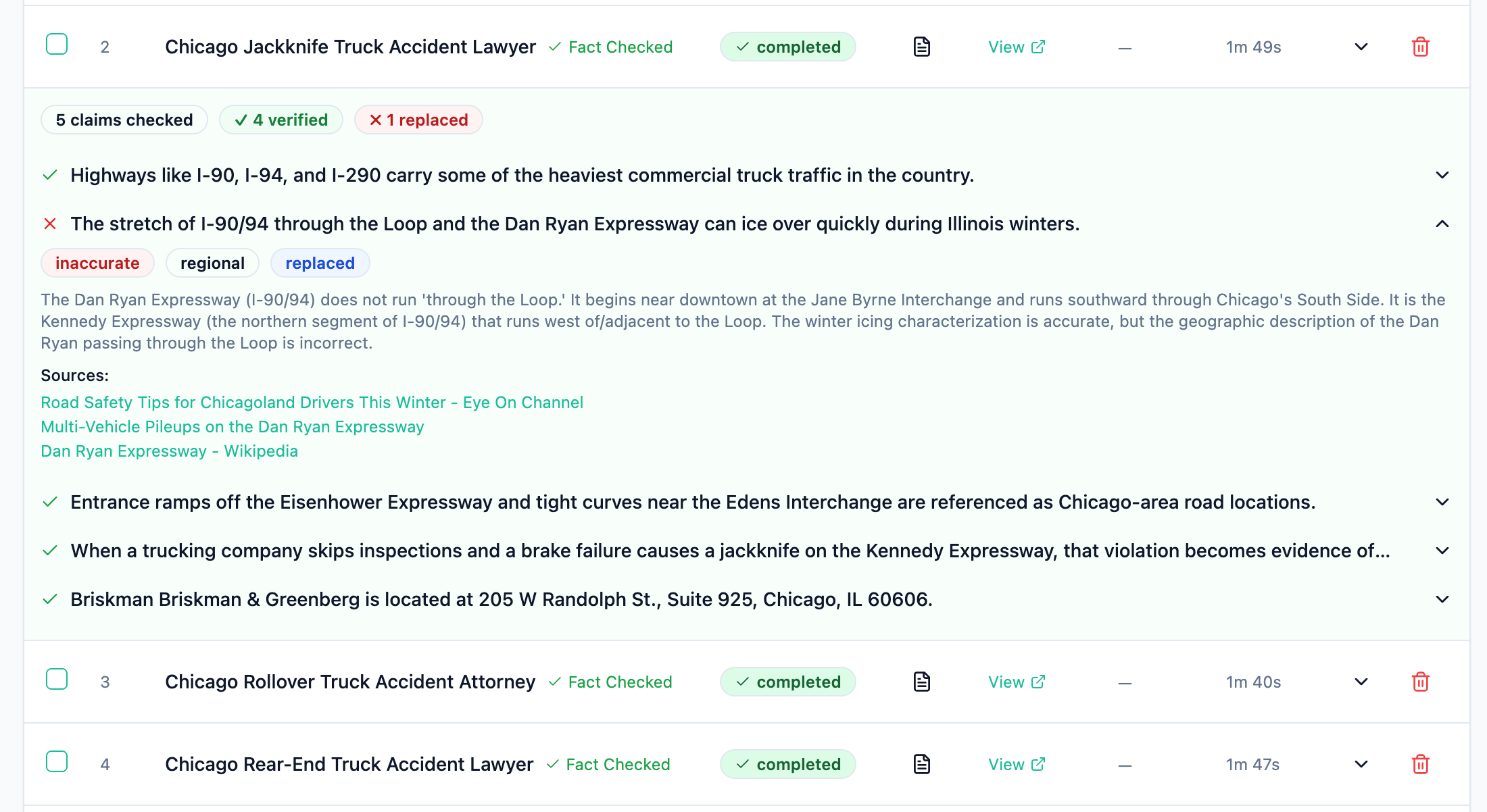
Answer engines were cross-referencing law firm claims long before Google wrote the word "critical" into its documentation. ChatGPT, Perplexity, and AI Overviews test what a firm says about itself and its practice area against the rest of the web before recommending it, and a page with a wrong expressway, a stale office address, or an invented deadline gives them a reason to cite someone else. That is why fact-checking has been part of CLM Sequoia since the platform launched, and why it runs on every page regardless of whether a person or a model drafted it. It's one of many ways Custom Legal Marketing was using law firm AEO to drive new cases to our clients long before the rest of the industry caught up.
Sequoia breaks each page into individual claims and tests every one of them against verified sources and a knowledge base we maintain for that specific firm. Each claim comes back verified, flagged, or replaced, with sources attached so an attorney can see the receipt before the page ships.
That is what manual review looks like at the scale a multi-city practice requires, and it is the difference between content that holds up when an answer engine cross-references it and content that gets quietly skipped. The October study confirms that AI content ranks. Sequoia's fact-checking layer is what makes it safe to publish.
The Prompt Ranking AI Monitor that Drives Cases to Law Firms
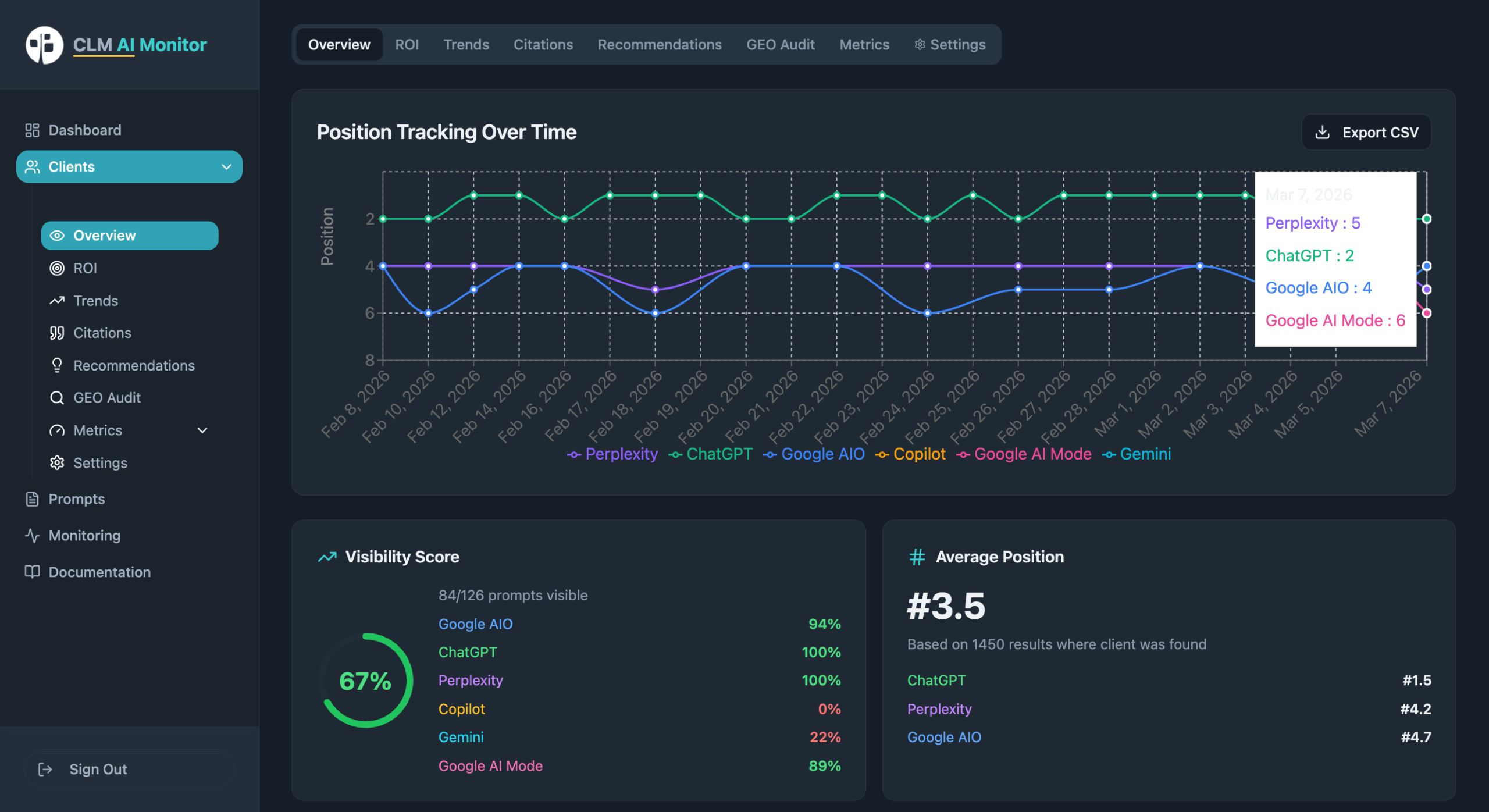
Traditional SEO measurement revolves around keyword rankings, organic traffic, and click-through rates. AEO introduces new dimensions that call for new measurement approaches.
AI Citation Monitoring
The most direct indicator of AEO success is whether your firm shows up in AI-generated answers for your target queries. CLM's Prompt Ranking AI Monitor tracks this across multiple platforms, capturing data on citation frequency, sentiment, and how you stack up against competitors.
Impression and Engagement Analysis
Google Search Console shows which queries trigger AI Overviews that pull from your content. Watching impressions for informational and conversational keywords, the ones most likely to generate AI Overview results, tells you where your content is gaining traction. Click-through rates from AI Overview impressions help you understand how citations translate into actual site visits.
Content Citation Tracking
Because Perplexity attributes its sources, you can track exactly which pages on your site get cited in its answers. Monitoring these citations reveals which content formats, topics, and structures are most effective at earning AI visibility.
Competitive Intelligence
Don't just watch your own AI visibility. Track which competitors show up in AI responses for your target queries, too. Identifying the content, trust signals, and structural choices that separate firms appearing in AI answers from those that don't is one of the most actionable insights we provide.
Continuous Optimization
AEO isn't a project you complete and walk away from. AI platforms update their retrieval methods, retrain their models, and adjust how they evaluate trust on an ongoing basis. Staying visible requires ongoing monitoring, regular content refreshes, and strategic adaptation.
We review client content quarterly to make sure it's accurate, current, and aligned with the latest legal standards. We update schema markup as new structured data types become relevant. We expand content clusters based on emerging queries and evolving client journeys. And we track everything through CLM Sequoia to make sure the work produces measurable returns.
The most important question in AEO: "When someone asks an AI chatbot about a legal issue in my market, does my firm appear in the answer?" CLM's Prompt Ranking AI Monitor gives you the data to answer that question.
The AI Monitor systematically tracks how law firms show up across AI chatbot responses for targeted legal queries. It watches which firms get recommended, how they're described, and which content sources the AI platforms draw from. Most agencies can't measure this channel at all. We can monitor and put the intelligence to work for you.
With the AI Monitor, we track:
- Your firm's citation frequency and sentiment across AI platforms
- Which competitors appear in AI responses for your target queries
- How your AI visibility changes over time as optimization work kicks in
- The specific content and trust signals driving AI citations in your market
There's no guesswork here. This is systematic, data-driven monitoring of a rapidly growing client acquisition channel.
Research That Challenges Conventional Wisdom
CLM's research program produces findings that directly shape our AEO strategy and separate us from agencies that run on assumptions instead of data.
Our AI Content & Rankings study looked at the relationship between AI-generated content and search performance across thousands of law firm pages. What we found: the percentage of AI content on a page doesn't correlate with rankings. What does matter is quality, relevance, and structure, regardless of whether a human or machine wrote the first draft.
Our PageSpeed study examined whether Core Web Vitals scores actually predict search performance. They don't. That doesn't make site speed irrelevant, but it means agencies positioning PageSpeed optimization as a primary ranking lever are spending their clients' money on the wrong things.
We also studied Domain Authority's predictive value. The finding: DA has negligible correlation with actual rankings for law firm websites. Authority matters, but the third-party metrics that most agencies use to measure it don't actually predict performance.
These findings matter for AEO because they clarify which signals drive visibility. AI answer engines put even more emphasis on content quality, structure, and genuine authority, while making vanity metrics even less relevant.
The Six Pillars of CLM's AEO Framework
CLM's AEO strategy runs on six integrated pillars that cover every dimension of AI visibility for law firms.
1. Content Architecture
Interconnected topic ecosystems with pillar pages, supporting content, and strategic internal linking that signal topical authority to AI retrieval systems.
2. Answer-First Content
Every page structured around specific questions, with direct answers in the opening sentences and comprehensive supporting context. Headings that mirror real client queries.
3. Entity and Trust Signals
Consistent entity information across your website, legal directories, bar associations, review platforms, and news sources. Cross-referential trust that AI systems can independently verify.
4. Schema and Structured Data
FAQ, Article, Attorney, LocalBusiness, LegalService, and HowTo schema implemented on every relevant page, validated and maintained as content evolves.
5. Multi-Platform Optimization
Tailored optimization for the retrieval patterns and trust evaluation criteria of each platform: Google AI Overviews, ChatGPT, Perplexity, Claude, and Gemini.
6. Monitoring and Adaptation
Ongoing AI citation tracking, competitive positioning analysis, and content effectiveness measurement through CLM Sequoia's AI Monitor.
Frequently Asked Questions About Answer Engine Optimization for Law Firms
What is the difference between AEO and SEO?
SEO targets traditional ranked search results. AEO targets AI-generated answers, including Google's AI Overviews, ChatGPT, Perplexity, Claude, and Gemini. AEO requires content structured for passage-level extraction, schema markup, entity optimization, and topical cluster coverage that goes beyond what traditional SEO addresses.
Will AEO replace SEO for law firms?
No. AEO and SEO are complementary disciplines. Traditional search rankings still drive traffic, especially for transactional queries where users want to compare firms and click through to websites. AEO captures the growing share of legal research happening in AI Overviews and chatbots. The strongest law firm strategies treat both as integrated components of one program.
How do AI engines decide which law firms to recommend?
AI engines evaluate multiple signals at once: content authority and clarity, entity recognition across the open web, structured data markup, recency, and consistency between the firm's website and external trust sources (bar profiles, directory listings, reviews, press, Reddit, YouTube). For YMYL legal queries, E-E-A-T signals get amplified scrutiny.
Can small or mid-sized firms benefit from AEO, or is it only for large firms?
Small and mid-sized firms often benefit disproportionately from AEO because the playing field has been reset. AI Overview citation overlap with traditional top-ten rankings has dropped from 76 percent to between 17 and 38 percent (Ahrefs, BrightEdge, February 2026). A well-structured page from a 4-attorney firm can get cited above content from a 200-attorney firm if the structural and trust signals are stronger.
How long does it take to see results from AEO efforts?
Expect initial visibility within 30 to 90 days for newly optimized content on lower-competition queries. Citation patterns on competitive terms typically take 3 to 6 months to stabilize. AI engines also reweight signals after major model updates (Gemini 3 in January 2026 reshaped citation pools within 60 days), so AEO is an ongoing program rather than a one-time project.
How does CLM measure AEO performance for clients?
CLM's Prompt Ranking AI Monitor tracks citation frequency, sentiment, and competitive positioning across multiple AI platforms for every client. Each practice area page is scored against the AI Citability Score rubric. Reporting includes citation share-of-voice against named competitors, AIO impression data from Search Console, and qualitative review of how AI engines describe the firm.
What makes CLM's approach to AEO different?
CLM Sequoia is a proprietary AI marketing platform built specifically for legal. It powers content intelligence (per-practice-area citation gap analysis), technical optimization (schema implementation, audit tools), and original research (the Domain Authority correlation study, the PageSpeed correlation study, the AI-generated content rankings study, and ongoing fan-out analysis). The Citability Score and Prompt Ranking AI Monitor are not white-labeled tools.
Is my current law firm content AEO-ready?
Most law firm content was written for human readers and traditional search rankings, with emotional intros, vague language, and minimal structural markup. Pages typically need restructuring around question-format headings, direct lead answers, schema implementation, and topical cluster coverage. The self-audit checklist on this page lets you score a single page against a simplified Citability rubric in about ten minutes.
What is query fan-out, and why does it matter for my firm?
Query fan-out is the retrieval method Gemini uses to break a single user query into multiple parallel sub-queries, retrieve passages for each, and synthesize a final answer across the union. Firms that build content covering the full fan-out surface around their practice areas get cited across many more sub-queries than firms optimizing only for head terms. This is the structural reason topical clusters matter so much more for AEO than for traditional search.
How does ChatGPT decide which lawyer to recommend?
ChatGPT pulls from live web data, structured knowledge, and content licensing partnerships. For "best lawyer" queries, it weighs entity recognition (does the firm appear consistently across directories, bar profiles, reviews?), expertise signals (named attorneys, credentials, case results), review profile depth, Reddit and YouTube presence, and content authority. Firms that show up across multiple verifiable trust sources get recommended more often.
Are AI Overviews replacing organic search results entirely?
Not entirely. Organic results still appear below AIOs and still drive significant traffic, especially for transactional and comparison queries. The change is that informational queries increasingly get fully answered above the fold. For law firms, this means optimizing for both the AIO surface and the organic listings beneath it.
What schema markup do I need for AEO?
The core legal AEO schema set: FAQPage on Q&A blocks, Article on educational content, Person (with attorney credentials and sameAs links), LocalBusiness with full NAP, LegalService for practice area pages, HowTo where applicable, and SpeakableSpecification for voice-search-relevant content. Schema must validate cleanly, and the data in markup must match the visible content on the page.
How do I track citations from AI engines?
AI Overview impressions appear in Google Search Console under the AIO performance filter. ChatGPT, Perplexity, Claude, and Gemini citations require dedicated prompt-rank monitoring, since none of them feed citation data into Search Console or analytics platforms by default. CLM Sequoia's Prompt Ranking AI Monitor runs scheduled prompts across multiple platforms and logs every citation, sentiment shift, and competitive appearance.
What is the difference between an AI Overview and a featured snippet?
A featured snippet pulls a passage verbatim from a single high-ranking page and displays it at position zero. An AI Overview is a synthesized answer generated across multiple sources, with attached citations to the specific passages that supported specific claims. Featured snippets still depend heavily on classic ranking signals. AI Overview citations have decoupled substantially from rankings.
How often should AEO content be refreshed?
The 85th percentile of AIO citations is content published within 24 months. Practical cadence: pillar pages reviewed quarterly, supporting cluster pages reviewed semi-annually, freshness-sensitive practice areas (immigration, mass tort, regulatory) reviewed monthly. Refresh means substantive updates, not just changing the publish date.
Build Your Law Firm's AEO Strategy with CLM
AI answer engines are adding a new, high-value layer to how potential clients find and evaluate law firms. The firms that optimize for both traditional search and AI-powered answers now are building a compounding advantage that gets harder to challenge over time.
Custom Legal Marketing has been developing the tools, running the research, and refining the strategies for this exact moment, long before answer engine optimization became a conference buzzword. Our Sequoia platform, Prompt Ranking AI Monitor, AI Citability Score framework, and ongoing research program give our clients an AEO strategy built on data and original insights, not recycled best practices from a blog post.
If your firm needs to build an AEO strategy from scratch or sharpen an existing digital presence for AI visibility, CLM has the tools, the research, and the track record to get you there.
Schedule a free consultation to find out where your firm stands and what it would take to become the answer AI chooses.

CLM is singularly focused on my firm's success and frequently over-delivers. I don’t think that you could make a better choice.
- Paul Greenberg, Briskman Briskman & Greenberg
We have been using CLM for our websites for a number of years and they have been outstanding! Their entire team has always been highly responsive and met all of our marketing needs.
-Todd J. Leonard, Todd J. Leonard Law

