






for Lawyers
Tools like ChatGPT are acting as search engines, utilizing advanced AI to summarize, cite, and even recommend attorneys to users seeking legal assistance. And the ChatGPT leads are turning into cases.
ChatGPT optimization
ChatGPT Optimizaton Makes Your Frm Discoverable

CHATGPT OPTIMIZATION FOR LAWYERS
What Is ChatGPT Optimization and Why Lawyers Need It (Now!)
ChatGPT optimization for lawyers is involves structuring a law firm's website, authority signals, and digital footprint so ChatGPT cites your law firm when potential clients ask legal questions. The firm cited in ChatGPT's answer reaches the client at the moment of decision. Every other firm in the market gets skipped, regardless of where they rank on Google.
We've spent 4 years building a ChatGPT optimization process and platform. Custom Legal Marketing clients sign cases from ChatGPT and other answer engines every single month.
This page covers what changed in ChatGPT's recommendation engine in 2026, the four trust signals that drive citations, practice-area-specific playbooks, the new ChatGPT Ads channel that opened to law firms today, and why CLM Sequoia is the only AI marketing platform built specifically to convert ChatGPT visibility into signed cases.
Why Legal Queries Are Disproportionately Showing Up in ChatGPT
Four numbers explain why answer engine visibility has become a primary channel for law firm client acquisition.
What ChatGPT Actually Does When Someone Asks for a Lawyer
ChatGPT does not crawl the open web in real time the way Google does. It works from training data, live web retrieval through its browse tools, and a growing set of content licensing partnerships. When a potential client types "best personal injury lawyer in Atlanta" or "what should I do after a car accident in Texas," ChatGPT does three things in sequence: it interprets the intent behind the query, it retrieves and synthesizes information from sources it considers authoritative, and it constructs a response that names a small number of firms or pulls passages from their websites.
The firm that gets cited usually has nothing to do with who has the most backlinks or the highest Domain Authority score. CLM's own research on Domain Authority found near-zero correlation between DA and actual law firm rankings, and ChatGPT pushes that signal even further into irrelevance. What matters is how clearly a firm answers the specific question, how consistently the firm's identity appears across the open web, and whether external sources ChatGPT trusts (bar associations, directories, news outlets, YouTube, Reddit) reinforce the firm's authority on that exact topic.
Why ChatGPT Citations Have Decoupled From Google Rankings
The single most important shift in AI visibility over the past year is that ChatGPT citations and Google rankings have stopped tracking each other. Semrush research found that only 6.82% of ChatGPT citations also rank in Google's top 10 for the same query. Ahrefs found roughly 1 in 3 Perplexity citations overlap with Google's top 10, the highest of any AI platform. Google's own AI Overviews have seen citation-to-rankings overlap drop from 76% in July 2025 to between 17% and 38% in February 2026, depending on which study you reference.
For law firms, this is a structural reset. A firm that has been paying for traditional law firm SEO for a decade and ranks number one on Google for "personal injury lawyer in [city]" is no longer guaranteed to be the firm ChatGPT recommends. A 4-attorney firm that publishes structurally clean, question-format content with strong entity signals can outrank a 200-attorney firm in ChatGPT's response while still sitting on page two of Google.
How Often AI Citations Overlap With Google's Top 10
Share of each AI platform's citations that also rank in Google's top 10 for the same query. Lower numbers mean traditional rankings are a weaker predictor of citation on that platform.
Getting Noticed in AI Snapshots: Use entity-rich content. Mention relevant laws, local courts, neighboring cities, and frequently referenced terms. Provide clear definitions and context, such as “Illinois Comparative Fault Law” or “Texas Drunk Driving Statutes.” AI engines are more likely to reference your site when these details are present and easy to extract.
The Four Trust Signals ChatGPT Uses to Decide Which Lawyer to Recommend
Every ChatGPT response about a legal topic gets built from four signal categories. Firms that score well across all four are the firms ChatGPT cites consistently. Firms that score well in one or two categories appear sporadically and lose the citation as soon as a stronger competitor enters the market.
The Four Signal Categories ChatGPT Weighs
A firm cited consistently in ChatGPT scores well across all four. Strength in one or two categories produces sporadic citations that disappear when a stronger competitor enters the market.
Content Clarity
Direct, question-format answers ChatGPT can extract as a self-contained response. Vague or marketing-heavy intros lose to firms that lead with the answer.
- Question-format H2s mirroring real client phrasing
- 40 to 60 word direct lead answer under each heading
- Statute citations and jurisdictional detail in sentence one
- Self-contained passages between heading boundaries
Authority & Expertise
Named attorney bylines with verifiable credentials. Pages without an author or with stock photo bios get downweighted under YMYL scrutiny.
- Named attorney byline on every practice area page
- Bar admissions, years in practice, notable case results
- Statute and case citations linked to primary sources
- Author credentials matching the topic of the page
External Validation
Consistent identity across the open web. ChatGPT cross-references the firm's name against directories, bar profiles, news, YouTube, and Reddit before citing.
- Filled-out profiles on Avvo, Justia, Martindale-Hubbell, Super Lawyers
- Bar association listings and disciplinary records that match the website
- YouTube channel with attorney explainers and clean transcripts
- Organic Reddit presence post-OpenAI content partnership
Technical Structure
Schema markup, semantic HTML, and clean heading hierarchy that lets retrieval systems parse the page without ambiguity. Strong content with no schema is half-invisible.
- FAQPage schema on Q&A blocks (critical for citation)
- Attorney, LegalService, and LocalBusiness schema
- Logical H1 to H4 hierarchy and semantic landmarks
- Schema markup for lawyers validated and maintained
How ChatGPT Reads a Law Firm Page
ChatGPT does not evaluate a firm's website as a single unit competing against other websites. It evaluates the discrete passages between heading boundaries and looks for the best self-contained answer to each query it processes. A page that opens with two paragraphs of empathetic introduction ("we understand how stressful this time can be") loses to a page that opens with a 50-word direct answer including the statute number, the jurisdiction, and the most common edge cases.
This is why the structural overhaul we run on client sites starts at the heading level and works outward. A practice area page with eight question-format H2s, each followed by a self-contained 40-to-60 word direct answer, has eight independent shots at being cited. The same page rewritten as a single flowing essay has one shot, and probably zero. CLM Sequoia's content audit grades every published page on extractability before anything else.
Generic Law Firm Intro vs. ChatGPT-Optimized Rewrite
Both passages answer "what is the statute of limitations for a car accident in Texas." Only one of them gets cited.
Texas Car Accident Statute of Limitations
- No direct answer in the first 60 words
- Statute number nowhere in the passage
- No jurisdictional specificity ChatGPT can extract
- No question-answer pair the model can lift cleanly
What Is the Statute of Limitations for a Car Accident in Texas?
- 52-word direct lead answer ChatGPT can extract whole
- Statute number cited inline in sentence one
- Texas-specific with extractable edge cases
- Question-format H2 mirrors how clients ask the question
Practice Area Playbooks: Where the ChatGPT Citation Battles Get Fought
Every practice area has its own query fan-out shape, its own dominant trust signals, and its own profile of which platforms ChatGPT cross-references most heavily. A generic optimization playbook applied uniformly leaves citations on the table. Below is the practice-area-specific approach our team runs on every client engagement.
Where ChatGPT's Legal Citations Get Decided
Each practice area has its own fan-out shape, dominant platforms, and trust signal mix. A generic playbook leaves citations on the table.
| Practice Area | Fan-Out Density | Dominant Platforms | Trust Signal Priority |
|---|---|---|---|
| Personal InjuryAuto, motorcycle, truck, slip-and-fall, premises | Highest SOL, fault, settlement values, MMI, lien resolution, plus 12+ accident-type variants |
ChatGPT Perplexity AIO | Verdict references, attorney bar admissions, case-result transparency, Avvo and Google reviews, dense local-court familiarity language. |
| Criminal DefenseDUI, drug charges, assault, federal, white collar | High Charge-specific plus jurisdictional layers across state, county, and municipal courts |
ChatGPT YouTube Reddit | YouTube explainers, Reddit AMA presence, court-specific experience, prior prosecutor credentials, charge-specific landing pages. |
| Family LawDivorce, custody, support, prenups, adoption | High Highest AIO trigger rate in legal because of jurisdictional and procedural complexity |
Claude Gemini AIO | Long-form scenario coverage (high-asset, military, same-sex, business-owner divorce), board certifications, mediator credentials. |
| ImmigrationVisas, asylum, green cards, citizenship, removal | Medium-High Federal policy churn drives constant content refresh requirements |
AIO ChatGPT Perplexity | Freshness signals dominate. Pages over 18 months old drop from citation pools regardless of rankings. Country-of-origin guidance and visa-type landing pages. |
| Estate PlanningWills, trusts, probate, estate tax, guardianship | Medium Research-heavy multi-session journey; long-form pillar pages dominate |
Claude Gemini AIO | CFP and CPA collaborations, board certifications, original tax-strategy content, multi-state authority signals. |
| Mass Tort & MDLPharma, medical device, environmental | Episodic New MDLs and settlements open citation surface fast; 48-hour publishing window matters |
AIO ChatGPT Perplexity | MDL leadership credentials, settlement track record, eligibility intake forms, plaintiff attorney bar memberships. |
The Legal Directories That Matter Most to ChatGPT
ChatGPT does not rank law firms the way Google does. There is no algorithm to game with backlinks or paid placements. ChatGPT synthesizes signals from multiple authoritative sources, weighted by credibility, depth, and consistency. The directories and platforms ChatGPT actually pulls from are not the same ones that drive traditional local SEO for lawyers, and the weighting between them matters as much as the presence on any single one. We covered the full breakdown in our analysis of the legal directories ChatGPT actually cares about.
The Four Tiers ChatGPT Weighs When Recommending Lawyers
Convergence across tiers is the key signal. A firm appearing consistently across Tier 1 and Tier 2 sources gets cited far more often than one ranking on a single high-traffic directory.
The CLM Sequoia AI Citability Score
The most concrete expression of CLM's ChatGPT optimization methodology is the AI Citability Score. Every page on every client website gets scored against a 100-point rubric built around five weighted categories that reflect how ChatGPT, Claude, Perplexity, and Gemini actually select content for citation. Pages that score below the Strong tier do not ship in their current form. Pages already above it rotate through refresh cycles timed to protect standing as platform updates reshape citation pools.
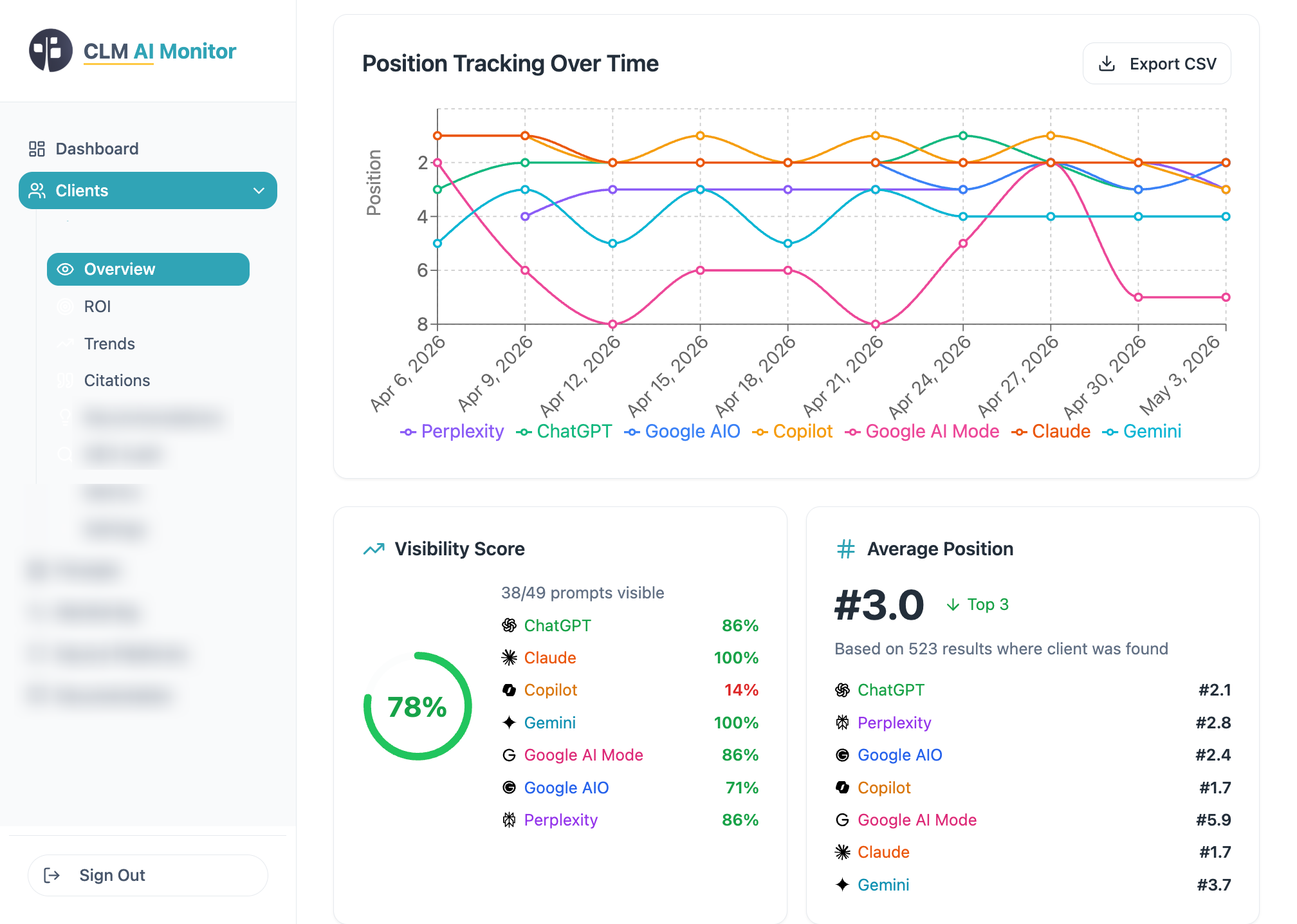
Unlike other scores that are just vanity metrics, the Citability Score directly correlates with the Visibility Score, which means a law firm is verifiably getting clicks and leads from ChatGPT and other answer engines.
Real Client Results From the CLM Sequoia AI Monitor
The CLM AI Monitor has been running inside the CLM Sequoia AI marketing platform since October 2025. The beta version, which a dozen of our law firms were plugged into for testing, supported Google AI Overviews, Perplexity, and ChatGPT. The newest release expanded support to Claude, Gemini, Microsoft Copilot, and AI Mode. The law firms enrolled in the beta program saw measurable lifts in citations, AI-driven traffic, and signed cases within 90 to 120 days.
What ChatGPT Visibility Looks Like in Cases Signed
Three CLM clients enrolled in the AI Monitor beta and the outcomes that followed within 90 to 120 days.
ChatGPT Ads Just Opened to Law Firms
OpenAI announced today that any business in the United States can sign up to advertise directly inside ChatGPT through its new self-serve Ads Manager. The category restrictions that kept law firms out have been lifted for Professional Services. The $50,000 minimum spend requirement is gone. Cost-per-click bidding now sits alongside the existing CPM model, with CPC bids ranging from $3 to $5 per click (that will likely go up rapidly in the legal space.) We covered the full announcement and what it means for firm budgets in our breakdown of ChatGPT ads launched for law firms.
The platform is genuinely early. OpenAI is still hiring its first head of advertising marketing science. Measurement is limited. There is no quality score system, no negative keyword functionality, and no third-party verification partner. But the inventory is cheap, the conversation context is rich (ChatGPT users type three paragraphs where Google searchers type three words), and the firms that test now will have built the conversion data and the campaign structures that competitors will spend years catching up on.
The Economics of ChatGPT Ads vs. Google Ads
OpenAI's self-serve Ads Manager opened to law firms today. The CPC range is roughly an order of magnitude below the typical Google Ads cost per click for personal injury and other high-value legal verticals.
The CPC model means expert management is mandatory. Without quality score, negative keywords, or keyword-level intent data, a firm spending money in ChatGPT Ads with no oversight is buying impressions and very little signal about what those clicks turned into. Our team is already building ChatGPT ad performance tracking into the Sequoia platform alongside the AI Monitor, so client firms see paid ChatGPT placements and organic ChatGPT citations in one dashboard with a real attribution chain.
Why CLM Sequoia Is the Only AI Marketing Platform Built for This
There is no shortage of tools that will tell a law firm whether ChatGPT mentioned their name. Generic citation data outlining where a firm shows up in answer engines does not tell the firm which prompts they should be cited in, where they are ranking for their targeted prompts, or how to capture more leads from AI platforms. CLM Sequoia is the only AI marketing platform purpose-built for ChatGPT optimization for lawyers that closes that gap, with the AI Monitor, Citability Score, Prompt Ranking, and the AI Impact Score working as a single growth loop instead of disconnected reports.
Plus, the AI tool feeds the intelligence of the other parts of the Sequoia ecosystem, keeping your marketing strategy many steps ahead of the competition.
Sequoia's research database and proprietary studies feed the action items. CLM's CLM Sequoia research has produced original findings on PageSpeed correlation, AI-generated content rankings, and Domain Authority correlation that directly shape how the platform prioritizes recommendations. When a firm is absent from a platform, Sequoia looks at which sources that platform tends to cite, identifies where the firm is missing, and turns those gaps into specific items: get listed here, publish this type of content, pursue this PR placement. None of that exists in a generic citation tracker.
Common ChatGPT Optimization Mistakes Law Firms Make
Across CLM Sequoia onboarding client audits, six failure patterns repeat across firms struggling to earn ChatGPT citations. These are the issues most likely to surface on a brand-new audit and the ones we address first.
The Six Failure Patterns That Show Up Most Often
Across CLM Sequoia onboarding audits, these issues account for the majority of ChatGPT visibility losses.
Empathy intros instead of direct answers
"We understand how stressful this time can be" buries the answer ChatGPT needs in sentence one. Lead with the statute, the deadline, the dollar range.
Practice area pages with no question structure
A wall of prose under a single H2 has one shot at citation. Eight question-format H2s, each followed by a 50-word answer, has eight shots.
Missing or invalid schema markup
FAQPage, Attorney, LegalService, and LocalBusiness schema either absent or out of sync with visible content. Half-invisible to retrieval systems.
Inconsistent NAP across the open web
Firm name, address, and phone differ across Avvo, Justia, GBP, bar profiles, and the website. ChatGPT downweights ambiguous entities.
Generic content with no jurisdictional anchoring
"Personal injury claims work like this" loses to "Texas comparative fault under Civil Practice and Remedies Code § 33.001 works like this."
No measurement of AI visibility
Firms cannot improve what they cannot measure. Generic SEO reports do not surface ChatGPT, Perplexity, or Claude citations.
Frequently Asked Questions About ChatGPT SEO for Lawyers
How is ChatGPT optimization for lawyers different from regular law firm SEO? Traditional SEO targets ranked Google search results. ChatGPT optimization targets citations inside AI-generated answers, which a Semrush analysis found overlap with Google's top 10 only about 6.82% of the time. The two disciplines share a foundation (technical performance, authority, content quality) but diverge in the specifics of content structure, schema markup, entity optimization, and the trust signals each platform weighs.
Will ChatGPT optimization replace SEO? No. The strongest law firm strategies treat both as integrated layers of one program. Strong answer engine optimization for law firms builds on top of solid SEO fundamentals, and many of the structural changes that improve ChatGPT visibility also lift Google rankings, AI Overview citations, and Perplexity surfaces.
Can a small firm compete with a 200-attorney firm in ChatGPT? Yes, and the asymmetry is structural. ChatGPT does not weight firm size directly. It weighs content clarity, entity consistency, external validation, and technical structure. A well-structured page from a 4-attorney firm with question-format H2s, named attorney bylines, and clean schema will outrank a thin practice area page from a 200-attorney firm in ChatGPT's response.
How long does it take to see ChatGPT visibility improvements? Initial visibility on lower-competition queries appears within 30 to 90 days for newly optimized content. Citation patterns on competitive terms typically take 90 to 180 days to stabilize. Sommers Schwartz, our Detroit medical malpractice client, saw a 107% increase in leads from ChatGPT, Perplexity, Gemini, and Claude four months after enrolling in the AI Monitor.
Should I run ChatGPT Ads or focus on organic ChatGPT visibility? Both. The two channels coexist and amplify each other. Firms that show up organically in ChatGPT's answers and run targeted ads below those answers get two points of contact with the same user in the same conversation. Running ChatGPT Ads without organic citation work is the same trap as running Google Ads without SEO; you spend money to learn that you spent money.
What schema markup matters most for ChatGPT citations? The core legal schema set: FAQPage on Q&A blocks, Article on educational content, Person with Attorney credentials and sameAs links to bar profiles, LocalBusiness with full NAP, LegalService for practice area pages, HowTo where applicable. Schema must validate cleanly, and the data in markup must match the visible content on the page.
How do I track whether ChatGPT is mentioning my firm? Manual prompt testing across the queries your potential clients ask works for occasional spot-checks. Systematic monitoring requires a dedicated platform. CLM Sequoia's Prompt Ranking AI Monitor runs scheduled prompts across ChatGPT, Perplexity, Claude, Gemini, Copilot, Google AIO, and AI Mode, and logs every citation, sentiment shift, and competitor appearance.
Does ChatGPT pull from Reddit and YouTube for legal questions? Increasingly, yes. OpenAI's content licensing partnerships with Reddit have raised Reddit's citation weight in ChatGPT responses. YouTube transcripts feed into Google AI Overviews disproportionately, with YouTube the most-cited domain in AIO citations overall. For criminal defense and personal injury especially, organic Reddit presence and YouTube attorney explainers are now part of the citation surface, not adjacent to it.
What Comes Next for ChatGPT Optimization
The firms cited by ChatGPT, Perplexity, Claude, and Gemini today are building a structural advantage that compounds. Once an AI platform cites a firm consistently and the recommendations perform well, the platform becomes more likely to cite the same source on related topics. That information asymmetry gets harder to displace with every passing quarter.
If your firm is already running AI legal marketing services with another agency and the reports are limited to citation counts and screenshot mentions, the gap between you and the firms enrolled in the CLM Sequoia AI Monitor is widening every week. The firms that figure out how to show up consistently now, and can prove it is translating into calls, are going to be very difficult to displace once these platforms settle into their recommendation patterns.
Schedule a free consultation with our team and we will pull a Citability audit on your top three practice area pages, run prompt-rank monitoring on the queries your potential clients are asking, and show you exactly which competitors ChatGPT is citing in your market.

CLM is singularly focused on my firm's success and frequently over-delivers. I don’t think that you could make a better choice.
- Paul Greenberg, Briskman Briskman & Greenberg
We have been using CLM for our websites for a number of years and they have been outstanding! Their entire team has always been highly responsive and met all of our marketing needs.
-Todd J. Leonard, Todd J. Leonard Law
