







Law Firms Can Now Sign Up as Advertisers on ChatGPT
Jason Bland | May 6, 2026
OpenAI announced today that any business in the United States can sign up to advertise directly inside ChatGPT through a new self-serve Ads Manager.
While there are still category restrictions like financial services, most other industries are now invited to the ad platform, including Professional Services (law firms.)
We are reaching out to our clients to help them get enrolled. For firms that are working with law firm marketing agencies that are not as awesome as Custom Legal Marketing, here is what you need to know and why this matters for law firm marketing in 2026.
Table of Contents
What OpenAI Actually Launched
OpenAI has been running a small advertising pilot inside ChatGPT since early this year. Until now, the only way to participate was through a handful of large agency partners. There was also a $50,000 minimum spend requirement and the select industries were limited to travel and some retail.
That changed today. OpenAI rolled out a beta Ads Manager. The $50,000 minimum is gone. OpenAI also added cost-per-click (CPC) bidding alongside its existing cost-per-thousand-impressions (CPM) model, with CPC bids currently ranging from $3 to $5 per click.
If your law firm is marketing with Google Ads, you know that a $5 CPC is NOT going to apply to you, especially in practice areas like personal injury.
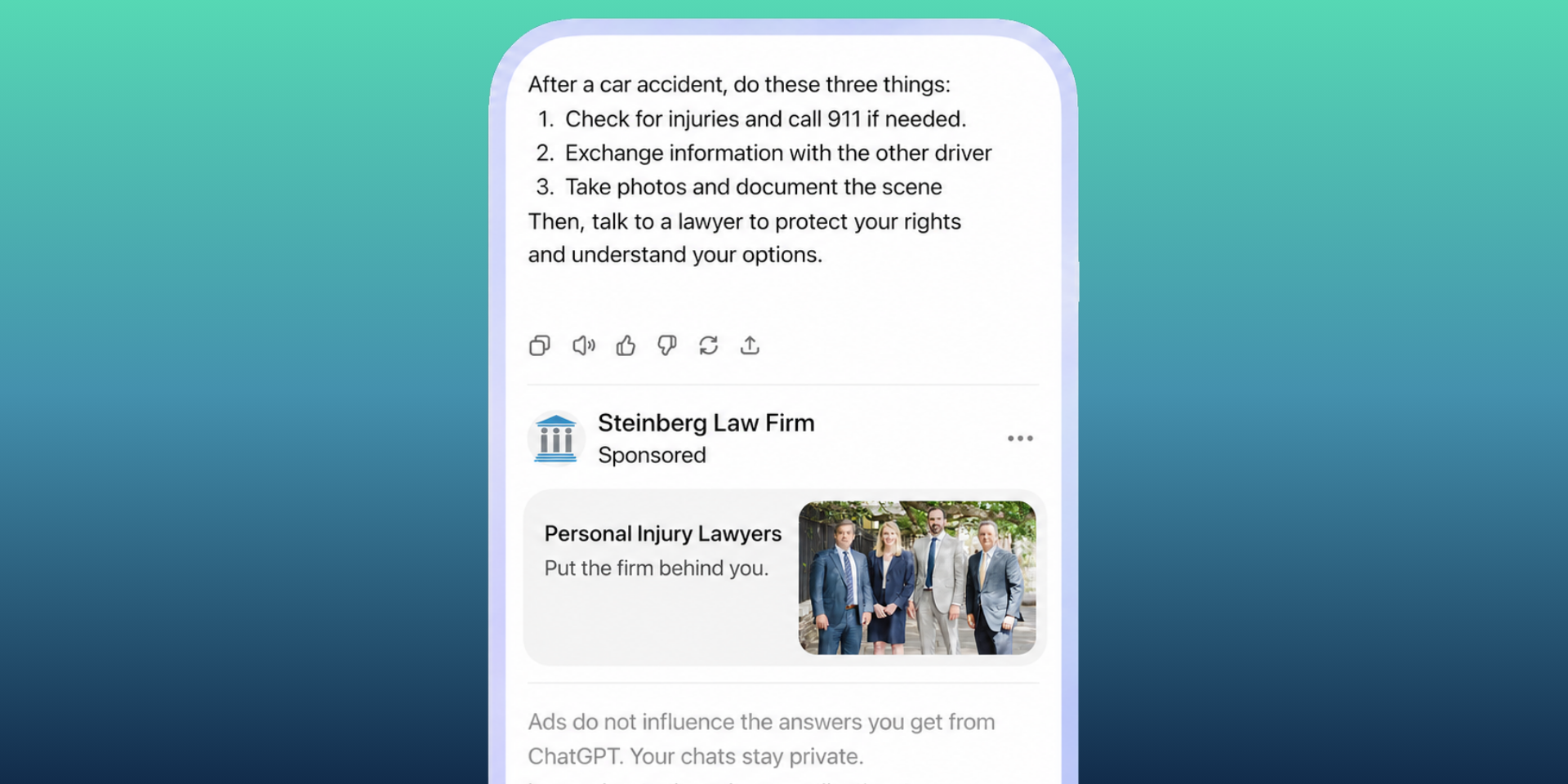
The ads appear at the bottom of ChatGPT’s responses, clearly labeled as sponsored content and visually separated from the AI-generated answer above them. OpenAI has stated publicly that ads do not influence ChatGPT’s responses, which means there will likely be a similar wall between the two as Google has between organic SEO and Google Ads.
Why This Is Relevant for Law Firms
People are already using ChatGPT to research legal questions. And our answer engine optimization results are proving that the platform is capable of sending incredibly qualified leads to our lawyers. When someone asks ChatGPT about what to do after a car accident, who pays medical bills during a lawsuit, or how workers’ compensation claims work, they are in the middle of an active decision. They are evaluating their options. That is exactly the type of high-intent moment that personal injury firms have been paying for on Google for years.
The difference is that ChatGPT conversations tend to be more specific and more detailed than a typical Google search. A person might type three words into Google. They might type three paragraphs into ChatGPT. That level of detail means the platform has a much richer picture of what the person actually needs, which could translate into better ad targeting over time.
OpenAI also rolled out Conversions API and pixel-based measurement tools so advertisers can track what happens after someone clicks an ad, whether that is a form submission, a phone call, or a consultation request. Those tools are still early, but they signal that OpenAI is building toward the kind of performance tracking that PPC-driven law firms already expect from Google Ads.
The Platform Is Early. Very Early.
OpenAI hit $100 million in total ad revenue in March with the release of its very restrictive ad platform. For context, Google made $66.9 billion from search ads in Q1 2025 alone. ChatGPT advertising is a rounding error compared to the platforms law firms are spending the bulk of their budgets on today.
CPM rates have already dropped from $60 at launch to around $25 in some cases. The measurement infrastructure is limited. There is no third-party verification partner yet. OpenAI is still hiring its first head of advertising marketing science, which tells you how early the company is in building the analytics foundation that advertisers need.
What This Means for Your ChatGPT Visibility
Paid ads inside ChatGPT are a separate channel from the organic visibility that answer engine optimization drives. When ChatGPT cites your firm in an organic response, that is earned placement based on your content, your authority, your structured data, and the qualifying factors of the query coming from the user. When you run an ad, that is paid placement that appears below the organic answer and since the platform is shifting to a CPC model, it’s not likely to give the same consideration to its sponsorship recommendations as the organic results.
Both channels will coexist. The firms that show up organically in ChatGPT’s answers and run targeted ads below those answers will have two points of contact with the same user in the same conversation. That is the kind of layered visibility that wins cases.
We have been building ChatGPT SEO strategies for our clients for years. The organic side of this equation takes time, proprietary tools, and a deep understanding of how large language models select and cite sources. That work is already underway for every CLM client, with them being plugged into our Sequoia platform.
ChatGPT’s CPC Model Means Expert Management is a Must
Legal advertising on any platform requires an understanding of how bidding strategies interact with practice area targeting, geographic restrictions, and conversion tracking. Running ChatGPT ads without that context is the same mistake firms make when they set up Google Ads campaigns on their own. You spend money. You see impressions. You have no idea whether the clicks you paid for turned into consultations, or whether you overpaid for every one of them.
The measurement tools OpenAI currently offers are basic. There is no quality score system. There is no keyword-level intent data. There is no negative keyword functionality. The platform is giving you a button to press and very little information about what happens after you press it.
Law firms that want to test ChatGPT advertising should do it with a team that already understands law firm SEO, paid search dynamics, and how AI platforms are reshaping where potential clients find legal help.
Running a test campaign without that foundation is just spending money to find out you spent money.
CLM Sequoia Plus ChatGPT Ads
We are already building ChatGPT ad performance tracking into the Sequoia platform. The goal is to give our clients a single view of how their firm performs across organic AI visibility, paid ChatGPT placements, and traditional search, all in one place.
Right now, OpenAI’s native reporting is limited. You get basic campaign metrics inside the Ads Manager and not much else. There is no easy way to connect what you are spending on ChatGPT ads to what is actually happening on your website, in your intake pipeline, or across your other paid channels. That is the gap we are closing.
Sequoia’s AI Monitor already tracks how and where law firms appear in ChatGPT, Perplexity, Google AI Overviews, and other answer engines. Adding paid ChatGPT performance into that same dashboard means our clients will be able to see organic and paid AI visibility side by side, measure how they influence each other, and make budget decisions based on actual data instead of platform-reported impressions.
We are also working on attribution models that account for the way ChatGPT conversations work. A person might have a ten-message conversation before they ever see an ad. Understanding what prompted the click, and whether the firm was already cited in the organic answer above it, changes how you evaluate what that click was worth. Standard PPC attribution does not capture that. Sequoia will.
What Happens Next
OpenAI is building toward cost-per-action (CPA) bidding, which makes it akin to Google LSA’s pay-per-lead model. The platform will mature. The targeting will improve. The data will get better.
Every major advertising platform in the last twenty years followed the same pattern. Early inventory was cheap and undervalued. Measurement was limited. Most advertisers waited for someone else to prove it worked. Then the data caught up, competition flooded in, and the cost of entry jumped. Google Ads in 2000 and Facebook Ads in 2007 were both dismissed as experiments. The firms that got in early built the conversion data, the audience insights, and the quality scores that gave them a permanent structural advantage over every competitor who showed up later.
ChatGPT advertising is at that same inflection point right now. CPC bids are sitting at $3 to $5. The $50,000 minimum is gone. The platform has 400 million weekly users asking detailed, high-intent questions.
The window where early movers have a cost and data advantage over the rest of the market will not stay open indefinitely. If you want to understand what this means for your firm before your competitors figure it out, reach out.
Jason Bland
Jason Bland is a Co-Founder of Custom Legal Marketing. He focuses on strategies for law firms in highly competitive markets. He's a contributor on Forbes.com, is a member of the Forbes Agency Council and has been quoted in Inc. Magazine, Business Journals, Above the Law, and many other publications.

The Definitive Guide to Law Firm SEO That Works
Law Firm SEO That Works is where we show attorneys what their competitors wish they knew.