






A Law Firm’s Guide to Multilingual Websites, SEO, and AI Search
Jason Bland | June 15, 2026

Most law firms with bilingual or multilingual staff treat language as a phone feature. They put “Se Habla Español” next to the number in the header and consider the box checked. That sign tells a Spanish speaker you can talk to them once they call but it does nothing to help them find you in the first place.
The people you want to reach are searching online before they ever pick up the phone. They are searching in the language they are most comfortable with, on devices set to that language as their computer or browser default, and the firm that shows up with content they can read is the firm that earns the call. If your website only speaks English, you are handing those non-English cases to a competitor.
I wrote about the basics of multi-lingual law firm SEO several years ago on Forbes. At the time, I focused primarily on the SEO benefits but the conversation has grown since then. More communities are searching in their native languages, the technical bar for doing this has gotten clearer, and of course, a brand new channel has opened up: answer engines like ChatGPT are now sending cases to law firms based on multilingual content.
Table of Contents
The Diverse Audiences You Are Already Turning Away
Start with the size of the market. As of the 2024 American Community Survey, about 44.9 million people in the United States speak Spanish at home. That is close to 14% of the population. In California, the share is 28.8%. Five states have at least one in five residents speaking Spanish at home.
Spanish is the largest group by a wide margin, but it is far from the only one. After Spanish, the most common languages spoken at home are Chinese at roughly 3.7 million speakers, Tagalog at 1.9 million, Vietnamese at 1.6 million, and Arabic at 1.5 million. French, Korean, and Portuguese each clear a million. More than 400 languages are spoken across the country.
Languages Spoken at Home in the United States
The most common languages other than English, counted by number of speakers
French, Korean, and Portuguese each have more than one million speakers, and more than 400 languages are spoken across the country. Spanish leads by a wide margin, but it is far from the only community searching in its own language.
Now connect that to your practice. Almost everyone needs a lawyer at some point. A car accident, a workplace injury, a divorce, an arrest, a business that needs forming, an estate that needs planning. Those needs do not check someone’s preferred language first. The members of these communities will need legal help, and when they go looking for it, they search the way they read… in their native language.
That is the entire argument for multilingual content. It is not a nice-to-have for firms that want to seem inclusive. It is a way to reach qualified clients who are looking for exactly what you offer and cannot read the page you put in front of them.
Native Language Content Must Exist to Be Indexed and Found
When someone sets up a phone, a computer, or a browser, the first question is almost always about preferred language. From that point forward, that setting follows them around the web. Apps adjust. Some sites adjust. Search results adjust.
Google tries to match the language of the searcher to the language of the page. If a Spanish speaker runs a search, Google looks for relevant pages it understands to be in Spanish. The same is true for Vietnamese, Mandarin, Armenian, and the rest. If you have given Google native-language pages to work with, you are in that running. Without that content being indexed in those languages, you’re not showing up in the search results. It’s really that simple.
This is why a browser’s built-in translation feature does not solve the problem. When a page loads in a language that differs from the browser default, most browsers offer to translate it on the fly. That is a convenience for the reader. It is not a separate, indexable page that Google can rank. The machine translation happens after the search is already over. It does nothing to get you found.
Google’s own guidance suggests using different URLs for each language version of your content rather than swapping content based on cookies or browser settings, and it tells you to avoid adapting content based on a visitor’s IP address. Google needs a real, crawlable, separate page for each language.
One worry I hear from firms before they start is that all of this translated content is going to get flagged as duplicate content and drag the whole site down. It will not, as long as your hreflang is configured properly. Translated pages are not duplicates to begin with, since the words on them are genuinely different, but the more important point is that hreflang exists precisely to tell Google these pages are language versions of one another rather than copies competing for the same ranking. When the annotation is in place, Google understands that the Spanish page and the English page are two doors into the same content for two different audiences, and it serves the right one to the right searcher instead of treating either as a thin copy of the other.
The Single Page Saying that Support is Available in a Language is Useless
A common middle step is to translate one page into Spanish, usually the homepage or a contact page, and call it bilingual. That single page is useless.
Think about what a Spanish speaker actually needs. They have a workers’ compensation question. They search for it in Spanish. Your one translated homepage does not answer a workers’ comp question, and you have no Spanish-language practice area page for Google to rank for that search or ChatGPT to cite it. Meanwhile, your competitors have built out a dozen quality pages in Spanish covering the exact topics this person is searching. You are not competing. You are absent from the conversation with what could be, your next client.
Search rewards depth and relevance. One page cannot match the scope of a firm that has translated its practice areas, its location pages, and its blog. A single page signals an afterthought. A full section signals that you serve this community.
Whole Site Translation is The Only Real Solution
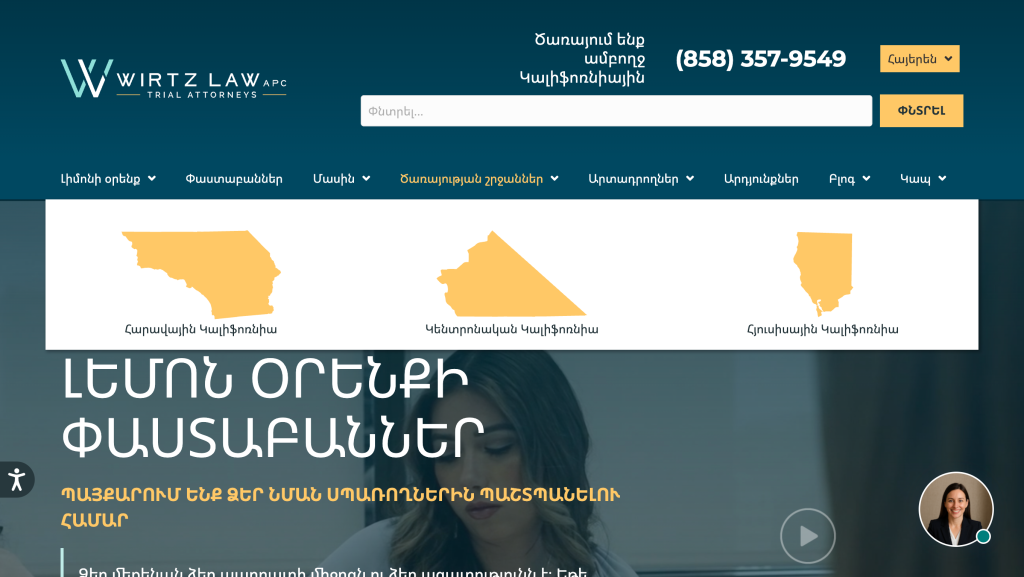
The next step up from one page is translating the body text of a few practice area pages while leaving everything else in English. This is better for law firm SEO than a standalone page but you’re now creating a terrible user experience which will cost you conversions.
If you translate the words in the middle of the page but leave the header, the navigation menu, the sidebar, the footer, and the buttons in English, you have built something disorienting. A reader arrives on a Spanish page, starts reading comfortably, then hits a menu they cannot navigate and a contact form asking for “First Name” and “How were you injured?” in a language they came to your site to avoid. The experience breaks at the exact moment you need them to take action.
Translating the whole site means translating the whole experience. Every theme element on a translated page should be in that language. The menu. The footer. The calls to action. The form fields. If you run live chat, the greeting and the prompts should appear in the reader’s language, and many chat tools let you set a different greeting on translated pages.
The details decide whether a visitor converts. A form that suddenly switches to English right where someone is about to give you their phone number is a form that gets abandoned. Build the entire path in the reader’s language and you remove the friction that was costing you the case.
Three Levels of Translation, and Why Only the Third Works
A single translated homepage or contact page does not answer the question a searcher is actually asking, and leaves Google with no native-language practice area page to rank. It reads as an afterthought.
Translating the text in the middle of the page while the menu, footer, buttons, and form fields stay in English breaks the experience at the exact moment someone is about to give you their phone number.
Every practice area, location page, and blog post in the reader’s language, along with the header, navigation, footer, calls to action, form fields, and chat greetings. The whole path, not just the middle of the page.
Translation Exclusions and What to Leave Alone
There is a flip side to translating the whole experience, and it is the part that automated tools get wrong most often. Some things on the page are supposed to stay exactly as they are in any language, and if you turn a translation plugin loose on the entire site without telling it what to leave alone, it will happily translate the things that were never meant to be translated.
Proper names should be excluded from translation. An attorney named Robert Green should be Robert Green in English, in Spanish, in Mandarin, and in every other language, because a name is a name.
Left unchecked, it can decide that Robert Green should appear as Roberto Verde on the Spanish version of the site. A potential client who calls and asks for Roberto Verde reaches a receptionist who has never heard of him. The state bar database has no record of a Roberto Verde. The firm’s own letterhead, its court filings, and its Google Business Profile all say Robert Green. You have created exactly the kind of mismatch that confuses human visitors and trips the entity verification checks that AI answer engines now run before they recommend a firm.
Addresses should also be excluded from translation. A street name is a navigational instruction, not a phrase to be interpreted. If a translator converts the address on your Spanish page, a client trying to drive to your office may end up with directions that do not match the street signs, the GPS, or the building itself. The same goes for courthouse names, the names of the courts a firm practices in, city and county names that have an official form, and the names of judges or opposing parties in a case writeup. These are fixed labels that point to something specific in the real world, and translating them breaks the connection between your page and the thing it is referring to.
Build an exclusion list before you translate anything, and treat it as part of the project rather than a cleanup task afterward. At a minimum it should cover attorney and staff names, the firm name itself, street addresses and suite numbers, courthouse and court names, city and county names, email addresses, and any branded program or trademark the firm uses. Most professional translation workflows let you flag terms that should pass through untouched, and the good ones let you keep a glossary so the same exclusions apply every time you add a page. If you are relying on a plugin, check its output by hand, because the place these errors hide is the fine print of a bio or the footer of a contact page, which is exactly where nobody looks until a client mentions they could not find the office.
The principle underneath all of this is simple. Translation should change the words a reader has to process while leaving untouched the facts they need to act on. A name, an address, and a courthouse are facts. Translate the sentence around them, and leave them standing.
What to Translate, and What to Leave Fixed
Translate the language a reader processes. Leave the facts they need to act on untouched.
- Practice area copy, headings, and blog posts
- Navigation labels, buttons, and calls to action
- Form field labels and validation messages
- Live chat greetings and prompts
- Footer and sidebar text
- Attorney and staff names
- The firm name itself
- Street addresses and suite numbers
- Courthouse and court names
- City and county names, judges, opposing parties
- Email addresses, trademarks, and program names
Robert Green stays Robert Green. Auto-translated to Roberto Verde, the name no longer matches the state bar, the letterhead, the court filings, or the receptionist who answers the phone. The same break happens when an address gets translated and a client can no longer follow the directions to your office.
Where Your Translated Content Should Live
This is the question that trips up the most firms, and getting it wrong is expensive to fix later. You have three options for where your translated content lives.
✅ Subdirectory: example.com/es/
❌ Subdomain: abogado.example.com
❌ Separate domain: abogadoexample.com
A subdirectory keeps your translated content on the same domain you have already been building. Every link you have earned, every bit of authority your domain has accumulated over the years, sits under one roof. Your Spanish pages benefit from the strength of the whole site, and your Spanish pages add to it. It is also the simplest to maintain, since it is one website with sections rather than separate properties to manage. This is why example.com/es/ is the structure I recommend for almost every firm.
A subdomain, abogado.example.com, is treated by search engines as more separate from your main site. Authority does not flow as cleanly between a subdomain and the root domain. You can make a subdomain work, and some large organizations do for good technical reasons, but for a law firm building a Spanish section, it usually means doing extra work to earn authority that a subdirectory would have inherited for free.
A separate domain, abogadoexample.com, is the worst choice for most firms. You are starting a brand new website from zero. It has no history, no authority, no existing links. You now maintain two completely separate sites, build links to both, and split your effort. Unless you have a specific strategic reason to run a standalone brand, a separate domain throws away the advantage your main site already gives you.
Put your languages in subdirectories under your main domain. example.com/es/ for Spanish, example.com/zh/ for Chinese, example.com/hy/ for Armenian, and so on. One domain, one growing pool of authority, one site to maintain, and every language version pulling in the same direction.
Where Your Translated Content Should Live
All three are valid to Google. They differ in how much of your existing authority you keep.
- Inherits the authority your domain has already built over the years.
- Your translated pages benefit from the whole site and add to it.
- One website with sections, the simplest to maintain.
- Treated by search engines as more separate from your main site.
- Authority does not flow as cleanly to or from the root domain.
- Usually means extra work to earn authority a subdirectory inherits for free.
- Starts from zero with no history, authority, or existing links.
- Two separate sites to build links to and maintain.
- Throws away the advantage your main site already gives you.
The short version: put your languages in subdirectories under your main domain. One domain, one growing pool of authority, and every language version pulling in the same direction.
hreflang and Telling Google Who Each Page Serves
Once your translated content lives in its own URLs, you need to tell Google which version belongs to which language. That is what the hreflang annotation does.
hreflang is a small piece of code that connects the language versions of a page to each other and labels each one. It tells Google that example.com/workers-compensation/ and example.com/es/compensacion-laboral/ are the same content in different languages, and which language each one is. When a Spanish speaker searches, Google has a clear signal about which version to show them.
Without hreflang, you are leaving the matching to chance. With it, you are handing Google the map. Google supports hreflang through the page header, through your sitemap, or through HTTP headers, and its recommendations on this have held steady for years even as other tools have come and gone. It is worth having a developer implement it correctly, because a sloppy hreflang setup can confuse search engines more than no setup at all.
One more piece of housekeeping that goes with this: give visitors a visible way to switch languages themselves. Google specifically advises against relying on IP detection to force a language on someone, partly because it is unreliable and partly because Googlebot mostly crawls from the United States and may never see your other versions. A clear language switcher in the header solves both problems. The reader picks, and the crawler can follow the links.
How hreflang Connects Your Language Versions
A small piece of code links the two versions and labels which language each one serves
The result: when a Spanish speaker searches, Google has a clear signal about which version to show them. Without hreflang you leave the matching to chance. With it, you hand Google the map.
Internal and External Links Matter for Translated Pages Too
Your new translated pages need links pointing to them, the same way your English pages do.
Internal links come first. Your translated pages should link to each other the way your English pages link to each other. The Spanish practice area pages should link to the Spanish location pages and the Spanish blog. If your Spanish section is an island with no internal links connecting its pages, Google has a hard time understanding the structure and the pages struggle to rank.
External links matter just as much. The authority of an individual Spanish page is built the same way as an English page, through quality links from other sites. When you build links to your translated content, relevance is the priority. Find topically relevant, language-appropriate sites and earn links from them. A link from a respected Spanish-language community resource does more for your Spanish pages than a generic English directory listing.
Some diverse regions may have organizations that your law firm can join. For example, in Florida, there is the South Florida Hispanic Chamber of Commerce. When linking to your website from these organizations, you want to make sure that you link to your translated homepage (ie, example.com/es/) to maximize the benefit of that link.
Treat your translated pages as full members of your site, not a bolted-on section. They need the same internal linking, the same link building, and the same care as everything else.
This Was Never Just About Spanish
Spanish is the right place for most firms to start because of its scale, but the strategy applies to any community your firm serves and any language your potential clients search in. The question is not “should we add Spanish.” The question is “which communities are in our market that we can support, and are we showing up for them.”
A firm in a city with a large Vietnamese population, or Korean, or Tagalog, or Arabic, has the same opportunity that a firm in a heavily Hispanic market has. The communities are searching. The competitors usually are not bothering or may not have the personnel capable of supporting a community. A firm that builds genuine native-language content for an underserved community in its area can own that space in a way that is hard to replicate.
The work is the same across languages. Full-site translation, subdirectory structure, hreflang, translated theme and form elements, internal and external links. What changes is which community you are serving and the cultural standing you build with them. That standing is not something a translation plugin gives you. It comes from real presence and real content.
Multi-Lingual Law Firm Sites Work. And Our Clients Have the Cases to Prove It
The firms that take this seriously sign cases they would never have seen otherwise. A few examples from clients we work with.
MyPhillyLawyer, a personal injury law firm in Philadelphia, maintains a Mandarin section of its site at myphillylawyer.com/zh/. The firm regularly signs cases that originate from that Mandarin content. Philadelphia has a substantial Chinese-speaking community, and a serious Mandarin section meets those potential clients where they are searching, instead of hoping they stumble onto an English page and translate it themselves. The firm also has other translated versions of its site supporting multiple diverse communities in the Philadelphia area.
Steinberg Law Firm in South Carolina runs a Spanish version of its site at steinberglawfirm.com/es/ and signs cases from it on a regular basis. The firm’s standing in the Hispanic community is not a marketing slogan, it is a track record. That standing played a real role in getting a $3 million work injury case for a underaged worker from Honduras. Cases like that, full of Spanish-language depositions and interpreters and a family that needed to trust the firm, do not come to a website (or law firm) that only speaks English.
Wirtz Law in Southern California signs lemon law cases from the Spanish version of its site, and the firm went a step further by adding an Armenian version at wirtzlaw.com/hy/ to strengthen the relationships the firm has built with the Southern California Armenian community. The firm signs cases from that community every month.
Built Properly, the Cases Follow
Three firms signing cases from native-language content they took the trouble to build
Regularly signs cases that originate from its Mandarin content, meeting a substantial Chinese-speaking community where it is searching.
Standing in the Hispanic community helped secure a $3 million workers’ compensation settlement for a teenage worker, a case full of Spanish-language depositions and interpreters.
Signs lemon law cases from its Spanish site and added an Armenian version as it built inroads with the Southern California Armenian community.
Multilingual Content and Answer Engine Optimization
AI answer engines have become a real source of legal leads, and multilingual content performs in them just as it does in traditional search.
When someone asks ChatGPT or Google’s AI features a legal question in Spanish, or Mandarin, or any other language, those systems pull from content they can read and understand. Clear, well-structured, native-language pages give an answer engine clean material to draw from and to cite. A firm with a real Spanish section is a candidate to be the source an AI points a Spanish-speaking user toward. A firm with only English pages is not in that conversation at all, the same way it was never in the search results.
We track this directly through our AI Monitor in the CLM Sequoia platform. We see ChatGPT sending leads and cases to clients based on their multilingual content. A potential client asks a question in their language, the AI surfaces a firm whose native-language content answered it well, and that turns into contact. This is the same principle behind Answer Engine Optimization. You structure content so that answer engines can find it, understand it, trust it, and cite it. Doing that in more than one language extends the same advantage across more than one community.
Multilingual content is no longer paying off in one channel. It is paying off in traditional organic search, and it is paying off in AI search. Both reward the same thing: genuine, well-built, native-language pages that serve a real audience. A firm that invests in this now is positioned in both places at once.
Multilingual Content Now Pays Off in Two Places
The same well-built native-language pages serve two channels at once
Google matches the searcher’s language to a real, crawlable native-language page and ranks it for the queries that community is typing.
Answer engines pull from content they can read, then surface and cite the firm whose native-language page answered the question well.
Make Sure You Can Support the Languages in Real Life
Everything up to this point has been about getting found and getting the call but what about supporting the client? If a Spanish-speaking client finds you, reads your Spanish pages, trusts what they read, and picks up the phone, someone on the other end of that phone needs to be able to talk to them. If nobody at the firm speaks the language your content is written in, you have built a very effective way to attract clients you cannot actually serve.
Think about the whole arc of a case, not just the first contact. The intake call, the consultation, the back and forth of gathering documents, the explanation of strategy, the hard conversations when something does not go as planned, the closing. Every one of those touchpoints has to happen in a language the client understands, or the relationship strains at exactly the moments it can least afford to. A client who felt comfortable enough to call because your website spoke their language, and then could not get a straight answer from anyone at the firm, is a client who feels misled. That is worse than never having reached them at all.
This does not mean every firm needs a fully bilingual staff before it translates a single page. Plenty of firms serve clients well with a dedicated bilingual intake person, a trusted interpreter service for consultations and hearings, translated intake forms and engagement letters, and a clear internal process for who handles a call when it comes in. The point is to decide how you are going to support the language before you start marketing in it, rather than discovering the gap after a client is already counting on you.
A one-star review written in Spanish hurts your firm as much as a one-star review written in English. It shows up on the same Google Business Profile. It is read by the next Spanish-speaking client deciding whether to call. A review that says, in any language, that the firm could not communicate with the client or left them confused about their own case does real and lasting damage. You cannot translate your way out of a support problem, and you should not market your way into one.
Serve the community you market to. If you are going to invite people to find you in their language, make sure that when they do, the firm is ready to take care of them in that language all the way through.
The Whole Journey Has to Work in Their Language
Marketing brings them in. Support keeps the case, and the review, from going wrong.
Break the chain at any step and the work that brought the client in is wasted.
A one-star review in Spanish hurts exactly as much as one in English. It lands on the same Google Business Profile, gets read by the next client deciding whether to call, and is weighed by the AI answer engines that now factor reputation into who they recommend. You cannot translate your way out of a support problem.
A Practical Checklist for Law Firm Website Translations
If you are serious about serving a non-English-speaking community, here is what doing it right looks like.
- Have a plan in place for how you will support non-English clients throughout the whole process.
- Translate the entire site, not one page and not just the body text. Every practice area, location page, and blog post that matters in English should have a native-language version.
- Translate every theme element on those pages. Headers, navigation, footers, sidebars, buttons, form fields, and live chat greetings.
- Use a subdirectory structure under your main domain. example.com/es/, not a subdomain and not a separate domain, unless you have a specific reason that outweighs the authority you would give up.
- Add automatic translation exclusions for your law firm name, staff names, addresses, and other proper names.
- Implement hreflang correctly so Google knows which version serves which language.
- Add a visible language switcher and avoid forcing language by IP detection.
- Build internal links among your translated pages and earn relevant external links to them.
- Apply Answer Engine Optimization to your native-language content so it surfaces in AI search, not only traditional search.
Frequently Asked Questions About Multilingual Law Firm Websites
Where should my translated content live: a subdirectory, a subdomain, or a separate domain?
For almost every law firm, a subdirectory under your main domain, for example example.com/es/, is the right choice. It keeps your translated pages on the domain whose authority you have already built, so they benefit from the strength of the whole site and add to it, and it is the simplest structure to maintain. Subdomains and separate domains are both valid to Google, but they sit more apart from your main site and usually mean extra work to earn authority a subdirectory would have inherited for free.
Will my translated pages be flagged as duplicate content?
No, as long as your hreflang is configured properly. Translated pages are not duplicates to begin with, because the words on them are genuinely different, and hreflang exists specifically to tell Google that the versions are language variants of one another rather than copies competing for the same ranking. With the annotation in place, Google serves the right version to the right searcher instead of treating either as a thin copy of the other.
Should attorney names and addresses be translated along with the rest of the site?
No. Proper names and fixed labels should be excluded from translation, including attorney and staff names, the firm name, street addresses, courthouse and court names, and city and county names. An attorney named Robert Green should stay Robert Green in every language, because translating it to something like Roberto Verde breaks the match with the state bar, the firm letterhead, and the receptionist who answers the phone. Build an exclusion list before you translate anything.
Does multilingual content help my firm show up in AI search like ChatGPT?
Yes. AI answer engines pull from content they can read and understand, so clear, well-structured native-language pages give them clean material to draw from and cite. When someone asks ChatGPT or Google’s AI features a legal question in Spanish or another language, a firm with a real section in that language is a candidate to be the source the AI points them toward. A firm with only English pages is not in that conversation at all.
Custom Legal Marketing is Driving Cases from Multiple Languages
Our team has been driving multi-lingual leads and cases to law firms for decades. Talk to us today about how we can expand your reach and connect you to new, diverse communities in your region.

Jason Bland
Jason Bland is a Co-Founder of Custom Legal Marketing. He focuses on strategies for law firms in highly competitive markets. He's a contributor on Forbes.com, is a member of the Forbes Agency Council and has been quoted in Inc. Magazine, Business Journals, Above the Law, and many other publications.

The Definitive Guide to Law Firm SEO That Works
Law Firm SEO That Works is where we show attorneys what their competitors wish they knew.