









Your Homepage Has a Set of Skills. Always Ranking on Top Isn’t One of Them.
Jason Bland | July 21, 2026
I have sat through more lawyer website kickoff meetings than I can count, and they all orbit the same page. The homepage gets the mood boards, the debate about whether the hero image should be the skyline or the partners, the argument about autoplay video, and ninety percent of the meeting. The practice area pages get a line item that says “practice area pages.” Then everyone goes home assuming that when a potential client in their city searches for a lawyer, the page they just spent three months perfecting is the page Google will serve.
Table of Contents
Sequoia Crushes Another Law Firm SEO Myth
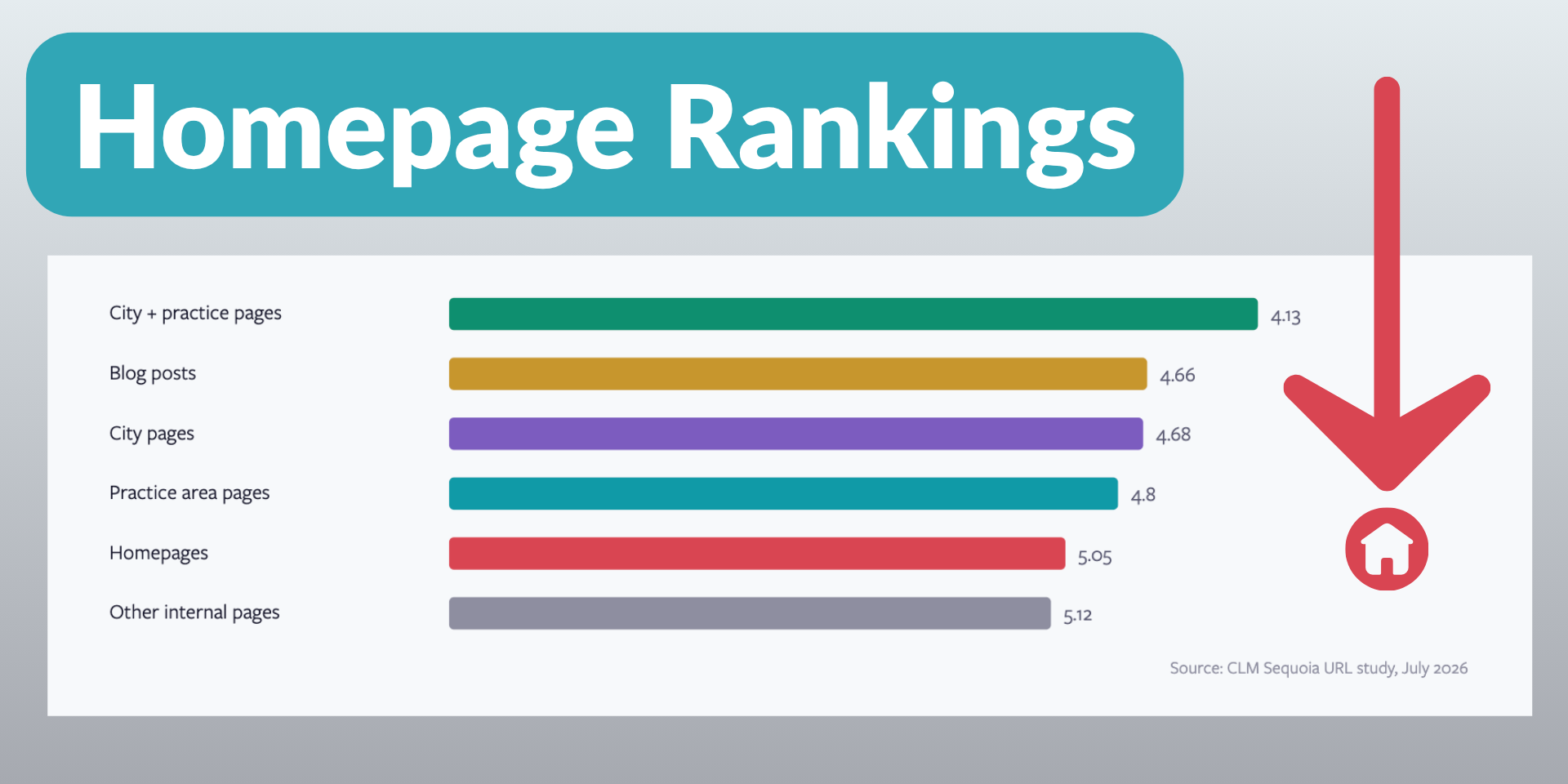
Our AI marketing and research platform, Sequoia, just analyzed 47,271 law firm rankings across 288 U.S. cities, and when a law firm holds the number one organic position for a competitive search like “car accident lawyer” or “divorce attorney,” the page in that spot is an internal page, a practice area page or a city-specific page, almost 89 percent of the time. The homepage that consumed the whole kickoff meeting shows up in the top spot about one out of nine times. If you want the full breakdown, you can read the complete study: Is Your Law Firm’s Homepage Really the Most Valuable for SEO?
The pattern gets stronger the higher you look. Homepages hold about 18 percent of results at the bottom of the page, but only 11 percent at position 1. Homepages are apparently good enough to show up. They are much less frequently good enough to win top placement.
So What Beats the Homepage?
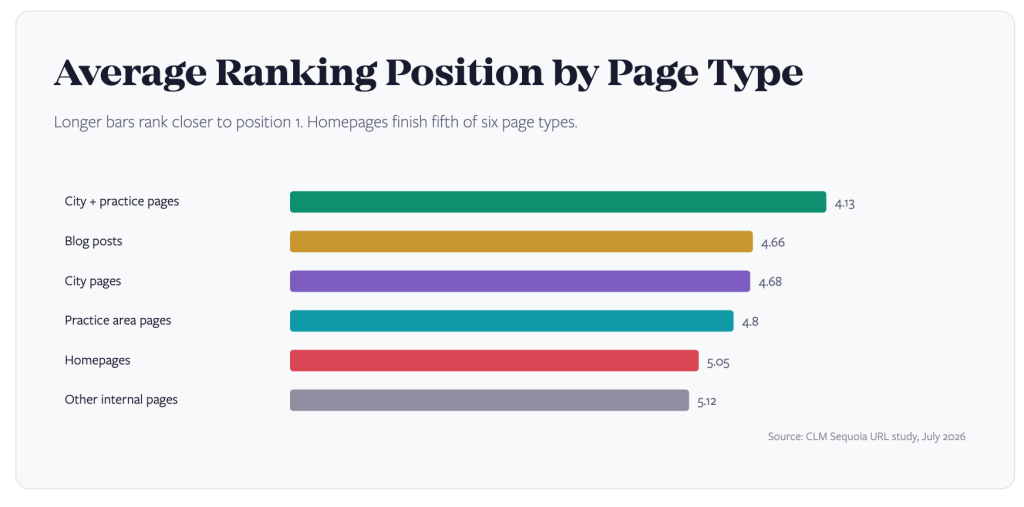
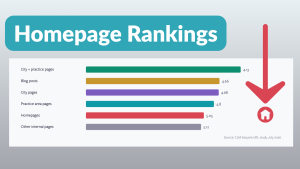
We sorted every ranking law firm page into types, and the results read like a job description for the pages nobody debates in kickoff meetings. Practice area pages, the ones built around a single case type, carry the load at 55 percent of all law firm rankings. But the overachiever of the entire study is the page that combines a case type with a city, something like a Phoenix truck accident page. Those pages average the best position of any page type we measured, and they nearly double their share of results at position 1 compared to everywhere else on the page. When the fight is for the top spot in a specific market, the page built for exactly that market wins it far more than its numbers say it should.
And for everyone who has been told to blog their way to the top of Google: blog posts held 1.1 percent of the rankings for these high-intent searches. Blogs also have a set of skills. Ranking for “car accident lawyer” is evidently not one of them.
Your Homepage Does a Better Job of Carrying Your General Keyword
The homepage does have one legitimate ranking job. If your entire firm is one practice, your homepage effectively is a practice page, and our data shows it. On searches like “criminal defense lawyer” and “family law attorney,” homepages held 30 to 40 percent of law firm results, because a single-focus firm’s homepage naturally answers that search. If that describes your firm, let the homepage carry your defining keyword. Everything narrower still needs its own page, and for personal injury firms, whose clients search by accident type, the homepage’s ranking role is close to zero in most markets. On “motorcycle accident lawyer,” homepages appeared in about one percent of results.
The Map Is the Homepage’s Turf. Everything Else – Including AI Overviews – Is Not.
There is one part of the search results where your homepage still gets top billing. In the map pack, your firm appears as a business profile, and when someone taps the website button on that profile, they usually land on your homepage. If you’re a firm with multiple locations, that may not be the best choice but that’s a blog for a different day.
In the organic results above and/or below the map, position 1 goes to a topically relevant page 89% of the time. And the AI results now sitting above and around the search results aren’t any kinder to the homepage. Answer engines assemble their responses from pages that specifically answer specific questions, so a homepage that gestures at six practice areas gives them little to work with. The trend line of search, from blue links to AI mode, keeps rewarding specificity, and the homepage is the least specific page you own.
What Does This Mean for Your Law Firm’s SEO?
Stop grading your homepage on rankings. Grade it on what it does with a visitor who already knows your name, whether they arrived from a referral, your advertising, or the map pack. Homepage conversion rates matter far more than homepage rankings.
Give those internal pages some design love. The pages winning position 1 in our study are focused, shallow, unglamorous pages built for one case type or one case type in one city. But they need to look great, because for most of the people who find your firm through search, that page is their first impression, and the homepage never enters the picture.
Build a page for every case type you actually want. On specific searches, the data shows homepages ranking somewhere between rarely and never. A case type without its own dedicated page is a case type you have quietly conceded to the firm across town that built one.
Your homepage has a set of skills. It can convert prospects who searched for you by name, saw or heard your commercial, and it can show up in the map pack. But it can’t be everywhere at once. Fortunately, the rest of your website can, and CLM can help you cover those content gaps and compete for more SERP real estate.

Jason Bland
Jason Bland is a Co-Founder of Custom Legal Marketing. He focuses on strategies for law firms in highly competitive markets. He's a contributor on Forbes.com, is a member of the Forbes Agency Council and has been quoted in Inc. Magazine, Business Journals, Above the Law, and many other publications.

The Definitive Guide to Law Firm SEO That Works
Law Firm SEO That Works is where we show attorneys what their competitors wish they knew.


