

A Google Spam Update, New Rules, and AI Content Is Still at the Top of Page 1
Jason Bland | October 22, 2026

On October 1, Google updated its guidelines on AI-generated content to say it is critical to fact-check everything a language model writes before you publish it. A week later, Google’s September spam update finished rolling out. My inbox filled up with the same question in a dozen different phrasings: is this the one where AI content finally gets penalized?
Good questions! And to find the answer, we ran the largest study of law firm AI content we have ever done. Eight days after the spam update completed, CLM Sequoia pulled the top eight Google results for 26 competitive legal searches in 93 metros and scored every law firm page it found. That is 5,182 pages and about six million words. The full report on AI content ranking is here.
Table of Contents
The update changed a document, not an algorithm
Start with what Google did. It added a passage to its help documentation borrowed from the Search Quality Rater guidelines. Generative models predict words rather than retrieve facts. Their output can contain hallucinations. Fact-check it, including the title tags and the alt text. Google almost never uses the word “critical” in its docs, and it used it here.
What Google did not do is add a penalty, change a spam policy, or walk back its position that it judges content by whether it is helpful and original rather than by how it was produced. That position has been consistent since 2023. The October update is a warning label on a product Google already allows.
Our data says the same thing from the other direction. On the 528 searches we ran in both February and October, the share of law firm pages that are 76% or more AI was 19.7% before the year’s updates and 19.8% after. We tracked the firms, too. Firms whose pages averaged 51% or more AI content in February kept their rankings through the spam update at the same rate as firms under 10%. If Google had quietly started punishing machine-written legal pages, that second number would have cratered. It moved by three points in the wrong direction for that story.
There is no middle. Law firms are either using AI content or they’re not.
Here is the part that surprised me. I expected the AI scores to spread out across the range, with a big bulge of lightly edited drafts somewhere in the 40s and 50s. That bulge does not exist. Sixty percent of ranking law firm pages score 10% or less. Twenty-two percent score 76% or more, and 13% score exactly 100%, meaning every word on the page tripped the detector. Fewer than one page in five lands anywhere in between.
Law firms are either writing their pages or generating them. Almost nobody is doing the thing Google just asked for, which is generating a draft and then editing it hard enough that a lawyer’s judgment shows through. The “AI-assisted” page that marketing conferences keep describing is mostly theoretical. In the wild it is a human page or a machine page.
There is no middle
Share of 5,182 ranking law firm pages by AI content score. Green is mostly human, rose is mostly machine, grey is everything in between.
Source: CLM Sequoia, 93 U.S. metros, top 8 results for 26 legal keywords, October 16, 2026.
Where a page ranks tells you nothing about who (or what) wrote it
The share of pages that are mostly AI is 28% at position one and 29% at position eight. Across nearly 12,000 ranking rows, the correlation between position and AI score is zero in any practical sense. A page scored at 95% AI ranks first for competitive terms in this dataset. A page scored at 2% sits at position eight. Both happen constantly.
I want to be careful about what that means. Quality still matters to rankings. A detector simply cannot see it. Google’s systems are evaluating whether a page is useful, accurate, and original, and a statistical read of prose patterns is not a measurement of any of those things. If you have been using an AI detector as a proxy for whether your content will rank, you have been measuring the wrong thing.
The anatomy of a generated page
This is where the study gets more interesting than the update. When you look at the pages that score high, they share a profile, and it is not a flattering one.
They are long. The median mostly-AI page runs 1,149 words. The median mostly-human page runs 704. Pages over 1,500 words are generated 37% of the time; pages under 1,000 words, 21%. We have written before about whether word count matters for rankings, and the answer was no. What this adds is that the long pages are disproportionately the machine ones. Nobody at these firms sat down and wrote 1,800 words about slip and fall liability in Reno. Something produced it, and no one cut it.
They are harder to read. Pages scoring 90% or more AI have a median readability score of 30. Pages under 10% score 36. That is on a scale where lower means more difficult, and it means the generated pages are denser and wordier than the ones lawyers wrote themselves. Generative models lean on long compound sentences and stacked qualifiers because that is what the statistically average legal web page looks like. Humans writing for a scared person with a legal problem tend to get to the point.
They are buried. Homepages are the least AI-heavy page type on law firm sites, at 18%. Interior practice-area and location pages are at 27%. Firms put their own voice on the front door and let the machine fill the rest of the house. We have written about the homepage-versus-interior-page split before, and this fits: the pages Google actually ranks for high-intent searches are the ones firms are paying the least attention to.
Mostly human vs. mostly AI: a side-by-side profile
Median profile of ranking law firm pages, grouped by AI content score. Readability is on a scale where lower means harder to read.
Source: CLM Sequoia, 93 U.S. metros, October 16, 2026.
The search term matters more than the city
I assumed the big markets would look different from the small ones. They do not. Chicago, Boise, and El Paso all showed the same share of generated content once you account for sample size. Market size told us nothing.
The keyword told us a lot. The share of mostly-AI pages runs from 15% for “dwi lawyer” to 40% for “assault lawyer.” Estate planning and trust searches, corporate law, car accidents, and DUI defense are all near the top. And the DUI versus DWI gap is the strangest result in the study. Same offense, different word, and “dui lawyer” pages are more than twice as likely to be generated. My best read is that DWI is the statutory term in a smaller set of states, so those pages get written by a local defense lawyer for one jurisdiction, while DUI pages get mass-produced by national operations that cover every state at once.
Who is actually doing this
That last point leads to the finding I would put on a slide. We counted how many metros each firm ranks in. One hundred fifty-four firms rank in eleven or more of the 93 metros, and between them they hold 37% of every law firm result in the top eight. Those firms are mostly AI on 34% of their pages. Firms that rank in a single metro, 26%. Everyone in between, about 24%.
That is the signature of a template. A firm building practice-area pages for sixty cities is doing it with a language model, and the risk Google described on October 1 concentrates exactly there. One hallucinated statute of limitations in the template becomes sixty hallucinated statutes of limitations. The scaled content abuse policy already covers this, and the spam updates are where that enforcement lives. If you are going to get hit, that is how.
The group is not uniform, and I want to say that clearly. Nearly half of those multi-market firms average under 10% AI across their pages. Some of the biggest names in plaintiff work are still writing their own pages for every city they serve. Scale does not require a machine. The firms using one chose to.
Firms ranking in 11 or more metros carry the most AI content
Share of law firm ranking rows scoring 50%+ AI, grouped by how many of the 93 metros the firm’s domain ranks in. Full October dataset.
154 domains rank in 11 or more metros and together hold 37.2% of all law firm ranking rows in the study. Their 50%+ share is higher than every other group (p < 0.001). The group is split, though: 48.1% of those domains average 10% or less AI content and 29.9% average 50% or more. Source: CLM Sequoia.
One more thing about who is in the results
Law firm websites hold 61% of the top-eight slots for these searches. Directories, platforms, and video hold 36%. At position one, law firms hold 55% and directories hold 44%. More than a third of the real estate for “car accident lawyer” in any given city belongs to Avvo, FindLaw, Justia, YouTube, and the rest, and those sites are not writing their pages for your market either. The competitive set for a competitive legal search is roughly half other firms and half aggregators, and the aggregators are not going anywhere.
Who holds the results? Law firms, directories, or resources?
Share of all 19,138 ranking slots across 2,418 competitive legal searches, by site type.
Source: CLM Sequoia, 93 U.S. metros, October 16, 2026.
CLM Sequoia learned to love facts long before Google made facts “Critical”
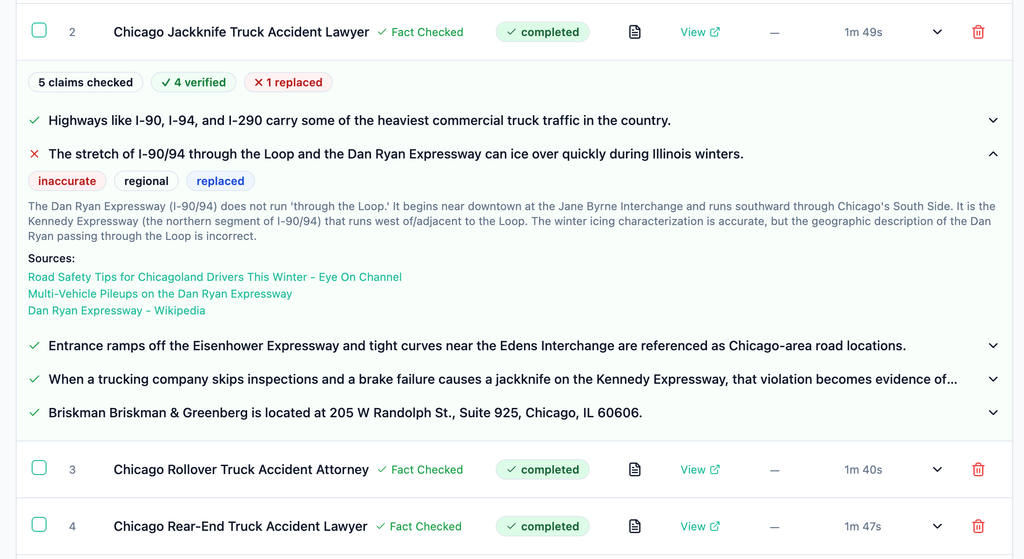
Every page that comes out of CLM Sequoia is fact-checked before it ships, claim by claim. How do we do it? That’s our secret. But what’s not a secret is that Sequoia is damn good at sniffing out errors and making content factual.
It does not matter whether one of our lawyer-writers wrote the page or a model drafted it. Human writers get geography wrong too. The checker runs on everything.
We built the fact-checking layer because the answer engines were already doing the checking. ChatGPT, Perplexity, Claude, and Google’s AI Mode cross-reference a firm’s claims against what the rest of the web says before they recommend it, and a page with a wrong expressway or a stale office address gives them a reason to recommend someone else. Google writing “critical” into its documentation this month confirmed what the recommendation data had been telling us for two years.
So when a firm asks me whether it is safe to use AI for content now, my answer is the same as it was in February. It is safe if every claim is checked. Sequoia does that for every page, every time, and it keeps the receipts.
What to do with our findings and the new “critical” fact check rule
I would stop asking whether AI content gets penalized. The data says no, and I do not expect that to change, because detection is not the mechanism Google uses to judge anything.
I would start asking the questions Google actually raised. Is your content factual? Is it adding new value to the web? Is there a strategy for what you’re publishing or are you telling Claude or ChatGPT to “write something that ranks on Google?” If you’re focused on value and truth, it doesn’t matter who (or what) typed the words.
The full study, including charts by position, keyword, practice area, firm footprint, and page length, is in the CLM research library.

Jason Bland
Jason Bland is a Co-Founder of Custom Legal Marketing. He focuses on strategies for law firms in highly competitive markets. He's a contributor on Forbes.com, is a member of the Forbes Agency Council and has been quoted in Inc. Magazine, Business Journals, Above the Law, and many other publications.

The Definitive Guide to Law Firm SEO That Works
Law Firm SEO That Works is where we show attorneys what their competitors wish they knew.