










Conversations Are the New Keywords for Law Firm SEO
Jason Bland | September 15, 2026
Somebody opens Google tonight and types, “I got rear-ended on the freeway last week, my neck still hurts, and the other driver’s insurance company keeps calling me for a recorded statement. Should I give one?”
That question lands in an AI Overview. They read the answer. Then they ask the next thing on their mind. “Can I still go to a doctor if I already told them I was fine?” Then, “How long do I have to file a lawsuit in California?” Then, “How much does a car accident lawyer cost?” And somewhere around the fourth or fifth question, “Who handles this in San Francisco?”
That person never typed the word “lawyer” until the fourth question. They’re still a potential client, and the firm that gets hired is the one Google (either AIO, Gemini, or AI Mode), ChatGPT, or Claude kept finding as the questions got more specific.
That’s the problem I keep running into with law firm websites that we inherit from new clients. Every page on the site was built to answer the first question. Nobody built anything for the third.
Table of Contents
We’ve Been Here Before. It Was Called Voice Search.
If this sounds familiar, it should. We started writing about voice search for law firms years ago, and the advice then was the same advice I’m giving now. People talking to a phone or assistant like Siri don’t say “San Francisco car accident lawyer.” They ask a full question, in a full sentence, the way they’d ask a person. Our 2017 voice search checklist for attorneys told firms to write in the language clients speak and to answer real questions on the page.
Voice search trained people to ask complete questions. It just never got the second half right. Ask Siri or Google Assistant a follow-up and it usually forgot what you were talking about. The conversation reset every time. So voice search stayed a one-question channel, and most firms treated voice search SEO as a checkbox.
AI prompts are the next step in that same evolution, and the piece voice never delivered is what ChatGPT, Claude, and Google’s AI ecosystem is now capabale of; short term memory. The person asks a question, gets an answer, and asks the next one without repeating any of the context. When somebody asks “how long do I have to file” as their third question, Google already knows the case is a rear-end collision in California with a neck injury and an adjuster pushing for a statement.
How Google Learned to Read a Whole Question
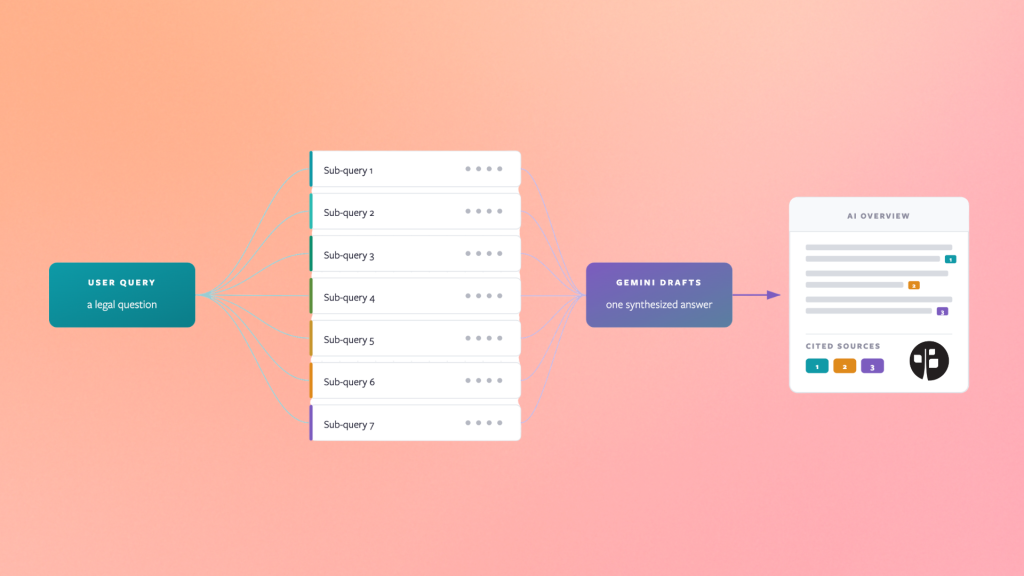
It helps to see how quickly this came together, because the pace explains why so many firms are behind. In 2019, Google announced it had started using a language model called BERT in Search. In that announcement Google admitted that people often typed what it called “keyword-ese,” strings of words they thought a search engine would understand, and said it hoped people could search in a way that felt natural instead.
Two years later, Google introduced MUM. The problem Google described was that people were running eight searches on average to get through a complex task. Google wanted one good question to be enough, and it talked about surfacing subtopics for deeper exploration. That was the follow-up query being designed before the product existed.
The product arrived in stages. When Google shipped Gemini 3 in November 2025, it put the model into AI Mode the same day and said the upgrade let query fan-out run more searches and find content it may have previously missed. In January, Google made Gemini 3 the default model for AI Overviews worldwide and let people ask follow-up questions straight from an Overview into an AI Mode conversation.
Google’s documentation on AI features in Search describes the fan-out technique as running multiple related searches across subtopics and data sources to build one response. Google doesn’t publish which searches it runs, so I treat the specifics as illustration. The mechanism is public, and it doesn’t stop at the AI features. Google’s guide to its ranking systems still lists BERT alongside neural matching, RankBrain, and passage ranking, which lets Google evaluate individual sections of a page. The regular organic results run on the same kind of understanding.
Here’s what that means for a law firm. The first answer is built from pages about recorded statements and neck injuries. The fourth answer is built from pages about legal fees. The fifth is built from pages about lawyers in Oakland. A firm can be nowhere in the first answer and still get hired off the fifth. A firm can be cited in the first answer and vanish by the second because it never wrote anything about the next thing the person asked.
What the Follow-Ups Sound Like for a Law Firm
Your intake team already knows the follow-ups. They hear them in order on every call.
The first question is almost always about the situation. Was I at fault. Should I talk to the adjuster. Is this even a case. The person hasn’t decided they need a lawyer yet. They’re trying to understand what happened to them and they called because they think they might need an attorney.
The middle questions are about process and money. How long do I have. What does this cost. Do I have to go to court. Will this take years. This is where the person starts deciding whether hiring someone is worth it.
The last questions are about you. Who does this near me. Have they handled a case like mine. What do their reviews say. Are they real.
A keyword-era practice area page answers the last set and skips the first two. It says the firm is aggressive, experienced, and located in yoru city, then gives a phone number. That page has nothing to contribute when Gemini is assembling an answer about whether to give a recorded statement, so it never enters the conversation. By the time the person gets to “who handles this in Oakland,” Google has spent four answers building a picture from other firms’ pages.
A page built for the conversation looks different. A DUI page walks through what happens after the arrest, explains the separate administrative license hearing and the deadline to request it, describes what the local court process looks like, answers the questions people ask the morning after, and makes it obvious who the lawyers are. That page still says “DUI” and “Sacramento” plenty of times, because you can’t write about that situation without them. The words show up because the page is about the thing.
The Later Questions Are the Ones That Hire You
We pulled two years of real search terms data from the Google Ads campaigns we manage, thousands of actual queries across practice areas and regions. Searches that named the practitioner, “car accident lawyer” rather than “car accident claim,” converted better than searches that only described the problem. Searches naming an actual city beat searches using “near me.” And “lawyer” outperformed “attorney” in most practice areas. The full breakdown is in our study of the Google Ads search terms that actually convert for law firms.
Look at those findings through the lens of the follow-up. Naming the practitioner and naming the city are what the fifth question sounds like. That’s the query with the highest conversion rate, and in a conversational search it comes at the end of a chain. The person doesn’t start there. They arrive there.
The keyword mindset says to build a page for the high-converting phrase and buy ads on it. Fine. Do that. But the phrase converts because of everything the person learned in the four questions before it, and if your firm contributed nothing to those four answers, you’re competing for the last click against firms that have been in the room the whole time.
Keywords Still Have a Job. It’s a Smaller One.
I want to be careful here, because “write for the conversation” can turn into an excuse to ignore what people type, and our own data says that’s a mistake.
When we looked at which law firm pages rank in Google, homepages made up 41.1 percent of the ranking law firm results for “criminal defense lawyer” and just 0.8 percent for “business formation lawyer.” A criminal defense firm’s homepage is, in effect, a page about criminal defense. Nobody’s homepage is a page about forming an LLC. The keyword decided which page should answer the search. The content decided whether that page deserved to.
That’s the healthiest way I’ve found to think about it. Keyword research tells you what clients call their problem and which pages you need to build. The conversation tells you what goes on those pages.
Where the Old Habits Cost Firms the Conversation
Word count is the one I run into most. For years the advice was that longer pages rank better, so firms padded practice area pages to hit a number. Google’s own helpful content guidance asks whether you’re writing to a word count because you heard Google prefers one, then says it doesn’t. Our word count study of 2,418 ranking law firm URLs across 8 practice areas and the 24 most populated U.S. metros found that word count explained less than 1 percent of ranking position. A page gets long enough when it has answered what the person will ask next, and no longer.
The city list is the second, and I covered why above. What answers “who handles this in Oakland” is a page that knows which courthouse the case goes to and what clients in that community keep asking. That local substance is what separates regional practice area pages that help your SEO from the ones that quietly hurt it.
The third is building near-identical pages for every wording of the same case. “Car accident lawyer,” “auto accident attorney,” and “car crash lawyer” describe one situation, and Google has had systems that understand those phrases are related since well before Gemini. Splitting them across three thin pages gives you three weaker versions of the page you should have built once, and none of them can hold up a conversation.
Writing for the Third Question
Here’s how to draft your content around the third question.
- Map the conversation before you write the page. Sit with your intake team and write down the questions in the order they come. That list is your outline. The keyword tool tells you what to title the page. The call log tells you what goes on it.
- Answer the situation questions on the practice area page itself. Don’t push “should I give a recorded statement” off to a blog post from 2019. That’s the first question in the chain, and it belongs on the page you want Google to associate with the case type. Well-built law firm FAQs on that page give Google clean sections to pull from, and because Google evaluates passages, a well-organized page has more ways in than any amount of repetition.
- Give every case type you want its own page. Your homepage can carry the search that describes your whole firm. Everything narrower needs a dedicated practice area page that is about that case type and nothing else.
- Give the money and process questions real answers. Firms avoid writing about fees and timelines because every case is different. Say that, then explain how contingency works, what a typical case in your court takes, and what the deadlines are. The person is going to ask, and Google is going to answer with somebody’s page.
- Write the way people talk to their phones. The voice search advice from years ago still holds, and it holds harder now. Full questions as headings. Plain answers underneath. No keyword-ese.
- Keep your firm’s story the same everywhere the last question gets answered. In our study of how ChatGPT, Claude, and Google AI Mode recommend law firms, we used CLM Sequoia to run 3,200 “recommend a lawyer” prompts across all three platforms. They cited 19,692 distinct domains, and only 578, 2.9 percent, showed up on all three. That was one run and AI answers shift, so I wouldn’t read much into any single firm’s result. The pattern is hard to miss, though. Each platform builds its own picture of your firm from different sources. Your website, your business and legal directories, your bar listings, and your Google Business Profile need to describe the same firm doing the same work in the same place. That’s a big part of why answer engine optimization makes trust more valuable than keywords.
- Keep using keyword data for the job it’s good at. Search terms reports remain the best window into how clients describe their problem and what they call you when they’re ready to hire. Use them to name pages and read intent, and let the content prove the page belongs.
The Conversation Is the Keyword
When Google announced BERT in 2019, it said it hoped people could drop the keyword-ese and search in a way that felt natural. Voice search had already started that. AI search finished it. Now people don’t stop at one natural question. They ask, read, and ask again, and every question after the first is a question most law firm websites never tried to answer.
The firms that will do well in this version of search are the ones whose pages can hold up a conversation. They’re in the first answer because they explained the situation. They’re in the fourth because they were honest about cost and time. And they’re in the fifth because everything Google found about them, everywhere it looked, said the same thing. That’s the firm the person calls, and by then they feel like they already know who they’re calling.

Jason Bland
Jason Bland is a Co-Founder of Custom Legal Marketing. He focuses on strategies for law firms in highly competitive markets. He's a contributor on Forbes.com, is a member of the Forbes Agency Council and has been quoted in Inc. Magazine, Business Journals, Above the Law, and many other publications.

The Definitive Guide to Law Firm SEO That Works
Law Firm SEO That Works is where we show attorneys what their competitors wish they knew.