










Online Directories &
Strong local search visibility is the product of carefully built authority, clear signals of trust, and a network of reputable citations. Business and legal directories act as both verification points and amplifiers for your digital footprint.
Business citations reinforce your firm’s expertise and relevance.
How Business and Legal Directories Help with Local Law Firm SEO


ONLINE DIRECTORIES
Why Online Directories Remain Foundational for Law Firm SEO
When prospective clients need a local lawyer and turn to the internet for answers, search algorithms cross-reference a variety of data sources to verify which law firms are legitimate and well-established in their area. Google is looking for consistency in each reference bots uncover. If a firm has a one-star rating on one platform and a five-star rating on another, or lists disparate address or hours of operation information across platforms, that indicates to search engines that the law firm cannot be trusted. That firm's rankings will suffer.
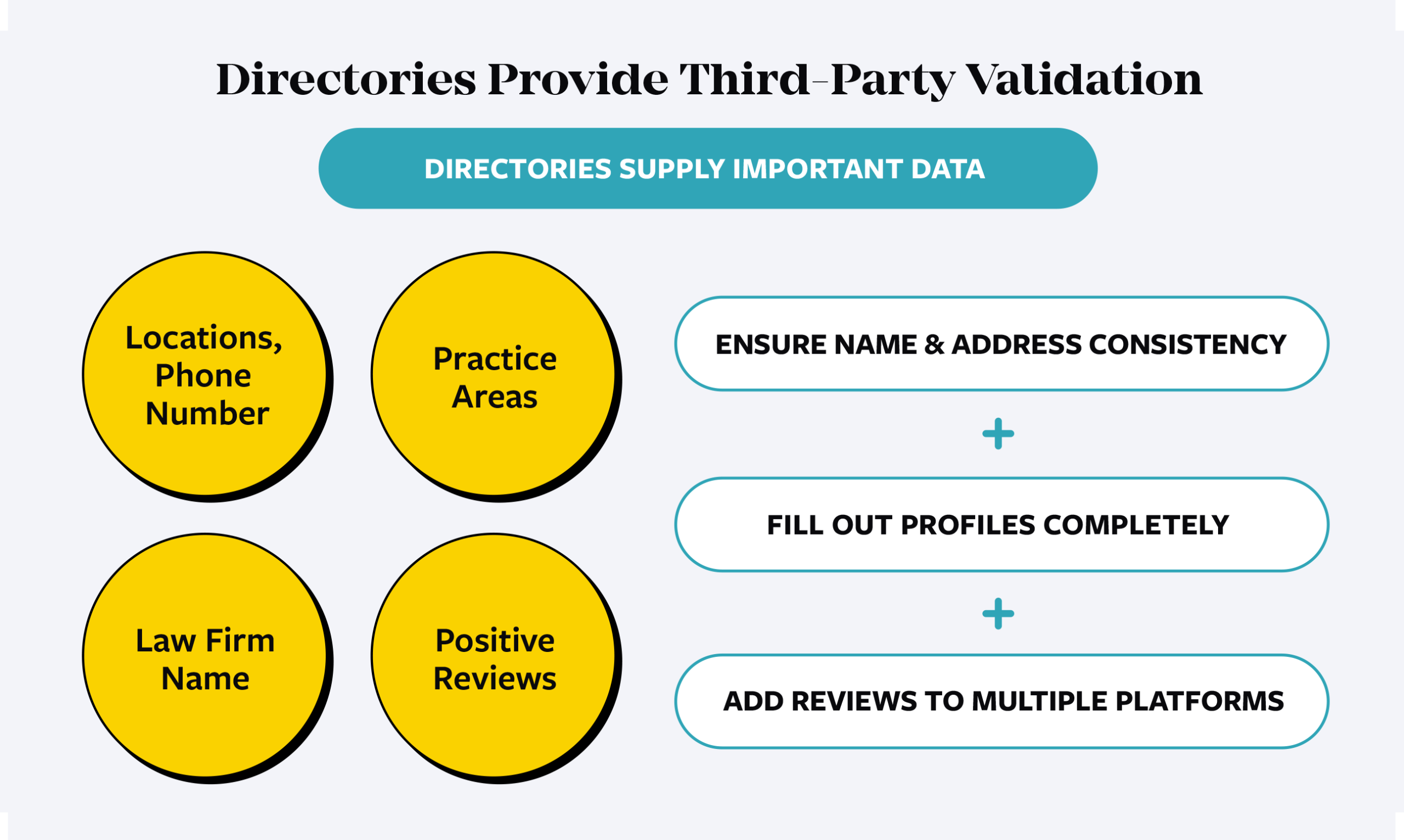
Directories ranging from major aggregators like Yelp and Yellow Pages to niche legal directories such as Avvo, FindLaw, and Justia provide third-party validation for law firms. Listings in these directories demonstrate that your firm is active in the region and recognized within the legal sector. They also supply multiple proof points for data like locations, hours, practice areas, and reputation signals like reviews.
Beyond Google’s local packs, directories supply the data that powers various AI engines and chatbots. These systems draw on both structured and unstructured sources to answer questions about “best law firms near me” or “top-rated personal injury lawyer near me.” Law firms with consistent, accurate directory listings are much more likely to be cited in those conversational results.
Directories Provide Trust Signals
Trust is at the heart of legal marketing. Potential clients want to see proof that you are who you say you are and that you are licensed, reputable, and respected by your peers and community. Directories play a crucial role in creating these trust signals for both traditional search engine algorithms and new AI technologies.
Trust signals occupy a somewhat strange, liminal space between being essential and being noise. That is, people tend to expect to see badges and links to directory profiles on attorney websites, so they don't give them much thought. They are prolific. What gets noticed is when such trust signals are absent. Therefore, utilizing directory services is non-negotiable. Without them, your firm may fall behind in the rankings race to firms that are using such third-party validation.
When potential clients see a law firm listed across Avvo, Super Lawyers, Martindale-Hubbell, and the local Chamber of Commerce, that gives the firm instant credibility. Most legal directories allow firms to create detailed profiles, add attorney photos, display peer reviews, and highlight practice areas, all of which help promote confidence in clients who are considering legal representation.
AI models and chatbots, when answering detailed questions about "lawyers near me" or "best law firm for [practice area] in [city]," rely on structured data from directories to synthesize accurate, up-to-date answers. Being present in these directories increases the chances that your law firm will be featured, name-checked, or linked in AI-generated results.
Importantly, many generative AI chatbots cite their sources or provide direct links to directory profiles. This creates an additional referral path that is growing as users seek quick answers from AI instead of traditional web searches.
Optimizing Directory Profiles for Local and AI-Driven Search
Not all directory listings deliver the same value. For law firm marketing, you want more than just your name and phone number floating around the internet. You need a strategy for profile optimization that aligns with both classic law firm SEO and emerging AI search best practices.
NAP Consistency
The foundational information about your firm is is your Name, Address, and Phone Number. These details must match exactly across every directory and your website to avoid penalization for inconsistency.
Category & Practice Area Precision
Choose the most precise categories and practice areas available. AI engines, as well as Google’s local algorithm, use these fields to match you to appropriate queries.
Compelling Descriptions & Attorney Bios
Write conversational bios that highlight your expertise, case results, and unique value propositions. AI models parse this information for context when suggesting firms for nuanced queries.
Photos, Awards, and Reviews
High-quality imagery of attorneys and office locations, along with verified awards and client reviews, reinforce your firm's authority and professionalism.
Where possible, use directories that support rich markup or integrate schema to help highlight your credentials, accreditations, and affiliations. This can directly influence how AI models categorize and recommend your law firm. AI tools, like ChatGPT or Perplexity, crawl structured directory data and synthesize it into direct answers, meaning your law firm’s directory presence is a trusted point of contact in those systems.
Directory Links and Citations: Powering Authority Beyond Rankings
Directories play a role in one of the oldest SEO tactics in the game: link building. The first iterations of Google's algorithm relied heavily on links to determine a page's quality and authority. In theory, pages with more links, especially those from reputable sources such as universities, are more likely to contain accurate and trustworthy information.
Ranking factors have become considerably more complicated, but high-quality links still matter. Directories are among the most authoritative external links a law firm’s website can earn. And since they’re curated specifically for business or legal professionals, they send strong signals about your topical authority and geographic relevance. Google and other search engines read these citations to reinforce trust, but so do AI-powered search assistants, which use them to verify claims about your expertise, location, and legal focus.

For some searches, the first organic search results listings are directories.
Moreover, directories often appear on page one themselves for high-intent legal queries, sometimes above law firm websites. By ensuring robust and complete profiles, you increase the odds of receiving leads directly from those directory pages, as well as secondary benefits via AI chatbots that reference directory data and reviews.
A smart law firm marketing strategy also recognizes that directories are frequently cited in local press, bar association resources, and legal publications, expanding your reach and authority through numerous digital channels.
Boosting Visibility in Both Search Engines and AI Chatbots
Getting your law firm listed in directories is just the start. To maximize visibility, a law firm's SEO strategy should include ongoing directory management, regular monitoring of its online reputation, and adaptation to new AI-driven search platforms. Directory management includes:
- Actively Monitoring Reviews: Respond to client feedback on legal directories and general review platforms. Both Google and AI engines weigh client sentiment and responsiveness in their ranking and recommendation algorithms. If false or fake reviews are posted, challenge them to have them removed.
- Answer Questions on Legal Forums: Many legal directories allow attorneys to answer legal questions. Providing useful answers boosts your authority for both searchers and the algorithms that power AI chatbots, which often pull from these Q&A sections.
- Monitor for New Directory Opportunities: New aggregators, specialty legal directories, and even local business networks continue to emerge and serve as data sources for chatbots and search engines alike. Stay alert to ensure your law firm is listed wherever your competitors are, and, ideally, stay a few steps ahead.
- Update Content Regularly: Refresh your directory listings with new photos, case wins, and accolades. Recent achievements or media mentions can be cited by AI chatbots, helping to maintain your firm’s status as the “best answer” for location-based queries.
Staying visible and relevant means approaching directories as dynamic assets. As search engines and AI chatbots continue to evolve, your law firm’s comprehensive, up-to-date presence in authoritative directories will help you stand out.

CLM is singularly focused on my firm's success and frequently over-delivers. I don’t think that you could make a better choice.
- Paul Greenberg, Briskman Briskman & Greenberg
We have been using CLM for our websites for a number of years and they have been outstanding! Their entire team has always been highly responsive and met all of our marketing needs.
-Todd J. Leonard, Todd J. Leonard Law
