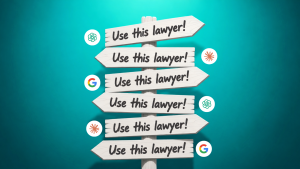








Do Recommend the Same Law Firms?
CLM Sequoia analyzed 107,716 citations to see if these AI chatbots and answer engines were recommending the same law firms to users.
Law Firms Recommended by AI Platforms
LAW FIRM RECOMMENDATIONS BY AI
ChatGPT, Claude, and Google AI Mode Rarely Recommend the Same Law Firms
This CLM Sequoia study asked three AI assistants the same 3,200 questions. We used the phrasing a real person would use, some version of "recommend a personal injury lawyer in Orlando," across 100 U.S. metros and 32 legal practice areas. Then we recorded every website each assistant cited, in the order it cited them.
The result was 107,716 citations. Of those, 71,701 pointed at an actual law firm website rather than a directory, a bar association, or a government agency. Those citations named 19,692 distinct law firms.
Only 578 of those firms were named by all three assistants. That is 2.9 percent.
Put a different way: when you ask ChatGPT, Claude, and Google AI Mode the identical question about the identical city, they agree on which firm to name first 0.9 percent of the time.
What we found
- Across the full study, 19,692 unique law firm websites were recommended. Just 578 appeared on all three platforms.
- Google AI Mode recommended 9,778 firms that neither ChatGPT nor Claude mentioned once.
- For any given prompt, the average overlap between two platforms ranged from 2.8 percent to 8.6 percent.
- In 70.6 percent of prompts, Claude and Google AI Mode named no firm in common at all.
- All three platforms named at least one firm in common in 17.0 percent of prompts.
- The three platforms agree far more about directories than about firms. Overlap on directory citations between ChatGPT and Claude was 37.5 percent, more than four times their agreement on law firms.
The practical consequence is that answer engine optimization is not one thing a firm can win. A firm that ChatGPT recommends is, on the evidence here, no more likely than chance to be a firm Google AI Mode recommends for the same query.
Three platforms, three almost separate rosters
Start with the full universe of firms. Every law firm website cited by any platform, anywhere in the study, sorted by which platforms cited it.
19,692 law firms recommended. 578 recommended by all three.
19,692 law firms recommended. 578 recommended by all three. Unique law firm websites cited across 3,200 prompts per platform, 100 U.S. metros, 32 practice areas
Google AI Mode carries the widest roster by a large margin. It recommended 11,670 distinct firms, nearly double ChatGPT and more than double Claude. It also names far more firms per answer, which we return to below. But breadth is not the explanation for the disagreement, because the firms it adds are almost entirely firms the other two never mention. Of its 11,670 firms, 9,778 are exclusive to it.
The pattern repeats on the other two. ChatGPT recommended 4,083 firms that Claude and Google AI Mode both ignored. Claude recommended 3,453 that the other two ignored.
Agreement Among ChatGPT, Claude, and Google AI Mode On Any Single Request for a Lawyer is Low
The universe view is generous, because two platforms count as agreeing if they both cited a firm anywhere across 3,200 prompts. It says nothing about whether they cited it for the same question.
So we narrowed to the 2,566 prompts where all three platforms named at least one law firm, and measured how much their answers to that exact prompt actually overlapped. The measure is the share of firms common to both lists out of all firms in either list.
Overlap between two platforms answering the same question
Because Google AI Mode returns far more firms per answer, an overlap measure that divides by the combined list penalizes it. So we also ran the comparison in one direction at a time, asking what share of one platform's firms show up somewhere in another platform's answer to the same prompt. That framing is more forgiving and the picture barely improves. At best, 16.6 percent of the firms Claude names also appear in ChatGPT's answer. At worst, 3.5 percent of the firms Google AI Mode names also appear in Claude's.
Across all 2,566 prompts, the three platforms shared an average of 0.20 firms. All three named at least one firm in common in 17.0 percent of prompts.
AI Platforms Almost Never Agree on Which Law Firm to Rank First
Position matters more than presence. Being the fifth firm mentioned in a long list is not the same as being the first name a person reads. So we isolated the single highest ranked law firm in each answer and asked how often two platforms picked the same one.
How often two platforms name the same firm first
name the same firm first
name the same firm first
name the same firm first
name the same firm first
Twenty four prompts out of 2,566 produced the same top firm on all three platforms. For a firm, that means winning the lead position on one assistant carries almost no information about the lead position anywhere else.
They Don't Agree on Law Firms. But They Do Agree on Directories.
Here is where the disagreement gets easier to explain. We ran the identical overlap measure on lawyer directory citations instead of firm citations, using the same prompts. Agreement jumps.
Platforms agree about directories more than about law firms
ChatGPT and Claude agree about directories at more than four times the rate they agree about firms. Claude and Google AI Mode are the exception, and for a reason that becomes obvious the moment you look at which directories each platform actually leans on.
Each AI Platform Has a Preferred Directory or Resource
This is the finding with the most direct application. The three assistants are not drawing from a shared pool of legal directories. They each have favorites, and the favorites barely overlap.
Where each assistant looks for a directory
| Directory | ChatGPT | Claude | Google AI Mode |
|---|---|---|---|
| Avvo | 29.2% | 87.1% | 5.4% |
| Super Lawyers | 1.2% | 0.0% | 62.8% |
| Justia | 20.5% | 2.1% | 60.2% |
| Martindale | 6.9% | 55.5% | 0.1% |
| Google Business listings | 4.2% | 2.8% | 36.8% |
| Yelp | 0.0% | 0.0% | 25.4% |
| 0.0% | 0.0% | 17.9% | |
| FindLaw | 11.3% | 9.3% | 1.7% |
| Thumbtack | 0.0% | 0.1% | 12.8% |
Martindale shows up in more than half of Claude's answers and in one prompt out of a thousand on Google AI Mode. Super Lawyers is the mirror image, present in 62.8 percent of Google AI Mode answers and in none of Claude's. Reddit and Yelp appear regularly on Google AI Mode and never on either chat assistant.
That explains the low Claude and Google AI Mode number in the previous chart. Their directory rosters are close to disjoint, so their directory agreement is even worse than their firm agreement.
Answer Engine Agreement by Practice Area
Not every question produces the same level of disagreement. We measured how often all three platforms named at least one firm in common, broken out by practice area.
Where the three platforms are most and least likely to agree
Personal injury and corporate law produce the most agreement, and they are also the areas where optimizing for ChatGPT is most likely to carry over. Estate planning produces none at all. Across every estate planning prompt in the study, in 100 metros, the three platforms never once converged on a single common firm.
The 578 Firms That Appear on All Three Platforms
A small group of firms did break through on all three platforms. Those 578 firms account for 13,069 citations, or 18.2 percent of every law firm citation in the study, despite being 2.9 percent of the firms.
What separates them is geographic reach. A firm in that group appears in an average of 3.9 different metros. A firm outside it appears in 1.4. The most cited members are HKM Employment Attorneys with 383 citations across 56 metros, Morgan and Morgan under its forthepeople.com domain with 283 citations across 52 metros, and Carabin Shaw with 150.
The wider picture is that this is a very thin layer. Of the 19,692 firms recommended anywhere in the study, 15,308 appeared in exactly one city. Only 98 appeared in ten or more, and only 16 appeared in twenty or more. There is no dominant national name that AI assistants default to. There is a long tail of local firms and a handful of multi market outliers on top of it.
AI Visibility For Law Firms is Not a Single Metric
AI visibility is not a single metric. A firm that checks ChatGPT and finds itself recommended has learned something about ChatGPT. On this data it has learned almost nothing about Claude or Google AI Mode. Any AI visibility monitoring that covers one platform is covering roughly a third of the surface, and the two thirds it misses are not similar to the third it sees. Not to mention the less popular AI platforms like Perplexity and Grok which weren't included in this study.
Practice area determines how hard the problem is. Personal injury and corporate queries produce genuine convergence, which means there is a recognizable set of firms the systems agree are relevant. Estate planning, probate, and trust queries produce no convergence at all, which suggests the systems have no shared basis for evaluating those firms and are effectively guessing from different pools.
Being first somewhere is not being first anywhere. Nine out of ten prompts produced three different lead firms. If a competitor tells you they are the top AI recommendation in your market, that claim is almost certainly true of one platform and almost certainly false of the others.
Methodology for Our Study of Law Firm Recommendations in ChatGPT, Claude, and Google AI Mode
We built a set of 3,200 prompts covering 100 of the largest U.S. cities and 32 legal practice areas, phrased in the recommendation form a person would naturally use, such as "recommend a car accident lawyer in Chicago." Each prompt was submitted once to ChatGPT, once to Claude, and once to Google AI Mode, for 9,600 total queries. Data collection ran on July 28 and 29, 2026. Analysis was completed in July 2026.
For every answer we recorded each cited URL and the order in which it appeared. That produced 119,350 raw citations. We then removed image and API assets that appeared in the Google AI Mode capture rather than being genuine citations, and a small number of malformed URLs, leaving 107,716 citations for analysis.
Each cited domain was classified into one of six categories: law firm website, directory or aggregator, bar association or lawyer referral service, government, other nonprofit, and university. Classification was performed by pattern rules and reviewed by hand for the most frequently cited domains. Law firm websites accounted for 71,701 citations naming 19,692 distinct firms.
Overlap between two platforms on a given prompt is calculated as the number of law firm domains present in both answers divided by the number present in either answer. Prompt level figures are averaged across prompts rather than pooled, so a prompt with many citations does not outweigh a prompt with few. Overlap comparisons are restricted to the 2,566 prompts where all three platforms named at least one law firm, so that a platform declining to name any firm is not counted as disagreement.
Because Google AI Mode returns substantially more citations per answer than the other two platforms, at 20.6 against 7.0 and 6.3, we also computed one directional containment rates, which do not penalize larger answer sets. Those rates ranged from 3.5 percent to 16.6 percent and did not change any conclusion.
FAQ's Law Firm Recommendations from ChatGPT, Claude, and Google AI Mode
Why do the three AI platforms recommend different law firms?
They draw on different underlying sources and weight them differently. The clearest evidence in this study is the directory data. Claude leans heavily on Avvo and Martindale, while Google AI Mode leans on Super Lawyers and Justia, and those preferences barely overlap. When the source material differs that sharply, the recommendations that come out of it differ too.
How many law firms do AI assistants recommend in total?
Across 3,200 questions per platform covering 100 metros and 32 practice areas, the three assistants named 19,692 distinct law firm websites. Google AI Mode named 11,670, ChatGPT named 6,190, and Claude named 4,788.
If I am recommended by ChatGPT, will Claude recommend me too?
Usually not. For the same question, ChatGPT and Claude named no law firm in common in 59.2 percent of cases, and their average overlap was 8.6 percent. Visibility on one platform is a poor predictor of visibility on another.
Which legal directories do AI assistants actually use?
It depends entirely on the assistant. Avvo appeared in 87.1 percent of Claude's answers but only 5.4 percent of Google AI Mode's. Super Lawyers appeared in 62.8 percent of Google AI Mode's answers and none of Claude's. Martindale appeared in 55.5 percent of Claude's answers and 0.1 percent of Google AI Mode's.
Which practice areas produce the most consistent AI recommendations?
Corporate law had the highest three way agreement at 45.2 percent, followed by car accident at 32.0 percent and personal injury at 29.9 percent. Estate planning had the lowest, with the three platforms never converging on a common firm across any of the 100 metros tested.
Do AI assistants agree on which firm to recommend first?
Rarely. All three named the same top firm in 0.9 percent of questions. The best any two platforms managed was ChatGPT and Claude at 8.8 percent.
The Fine Print (Disclaimers)
Each prompt was run once per platform. We did not measure how stable these answers are over time, and AI assistants are known to return different results to identical prompts on different occasions. Some portion of the disagreement measured here may be run to run variance rather than a durable difference between platforms. Establishing that split requires repeated collection and is the natural next study.
Results reflect a single phrasing style, and our other published research covers different query conditions. Our earlier testing found that phrasing has a very large effect on whether an assistant names firms at all, so these figures should not be read as applying to every way a person might ask.
Queries were issued without a logged in user profile or personalization signals, and without location signals beyond the city named in the prompt. A real user's results may differ.
Entity classification is rule based. The most cited domains were verified by hand, but a small share of classifications in the long tail may be imperfect.
© 2026 Custom Legal Marketing, an Adviatech Company. All rights reserved. This research was conducted using proprietary CLM Sequoia technology and methodology.



Jason and his team are the best. He has solid ideas that produce results for the long term. We had tried other companies, but none of them produced the quality results we received from CLM.

- RICHARD WIRTZ
Wirtz Law APC