











Google Reviews for Personal Injury Firms

LAW FIRM SEO THAT WORKS®
Our Focus: Your Firm
The best law firm marketing comes with a No Competition™ Guarantee.
Personal injury clients make high-stakes decisions under stress, and Google reviews are often the first filter they apply. 71% of shoppers begin their consumer research with Google reviews, and for someone searching terms like “car accident lawyer near me” or “top rated personal injury attorney,” the star rating and review volume on your Google Business Profile can determine whether they call you or scroll past entirely. For personal injury firms competing in crowded local markets, reviews are one of the few ranking signals you can build systematically and ethically, starting the day you close a case.
Table of Contents
- Why Google Reviews Carry More Weight for Personal Injury Firms Than Most Practice Areas
- How Google Reviews Directly Affect Local Search Rankings for Personal Injury Attorneys
- Proven Tactics for Asking Personal Injury Clients to Leave Google Reviews
- Responding to Reviews: What Personal Injury Firms Get Wrong
- Protecting Your Review Profile From Fake and Malicious Reviews
- FAQs About Google Reviews for Personal Injury Firms
Why Google Reviews Carry More Weight for Personal Injury Firms Than Most Practice Areas
Hiring a personal injury attorney is a high-trust, high-stakes transaction. Injured clients are often in pain, financially stressed, and unfamiliar with the legal process. They turn to reviews the same way they would turn to a trusted friend. Almost 53% of consumers trust online reviews as much as personal recommendations, and for personal injury matters, that figure reflects real behavior: people want outside validation before they pick up the phone.
88% of customers read Google reviews to determine the status and quality of a local business before interacting with it. Personal injury falls squarely into the category of services where this behavior is most intense. Clients are evaluating whether you win cases, how you treat people, and whether you communicate clearly, all before they ever speak with your intake team.
The volume of reviews also matters, not just the rating. Businesses that have more than 200 reviews on Google are more likely to appear in one of the top three positions on search engine results pages, with those businesses averaging almost 250 reviews, while businesses in positions four through ten have fewer than 200 reviews on average. For a personal injury firm targeting competitive keywords like “personal injury lawyer [city]” or “car accident attorney [city],” getting into that top tier requires a sustained review generation program, not a one-time push.
The recency of reviews matters as much as the count. 73% of consumers only trust reviews written in the last month. A firm with 300 reviews but none posted in six months looks stale. Clients assume an inactive review profile means the firm has slowed down, changed, or stopped caring about client experience. Consistent new reviews signal an active, successful practice.
Negative reviews carry outsized consequences in this practice area. 94% of online consumers say a negative online review has convinced them to avoid a business. One unaddressed complaint about poor communication or a missed deadline can cost a firm dozens of potential clients. In personal injury law firm marketing, reputation management is not optional.
How Google Reviews Directly Affect Local Search Rankings for Personal Injury Attorneys
Google has stated publicly that local results are based on relevance, distance, and prominence. Prominence means how well-known a business is, and prominent places are more likely to show up in search results. This factor is also based on information Google has about a business from across the web, including links, articles, directories, and reviews. More reviews and positive ratings can help your business’s local ranking. For a personal injury firm, that means your Google Business Profile review profile feeds directly into your ability to appear in the Local Pack for high-value searches.
The 2026 Whitespark Local Search Ranking Factors Survey, which surveyed approximately 50 local SEO experts, found that Google Business Profile signals account for 32% of ranking influence for the Local Pack and Maps results, making it the single most important factor. Reviews sit at the core of those GBP signals.
Review signals matter enormously, dictating discovery across the Google Local Pack, organic search, and AI discovery results. This extends beyond traditional search. The same Whitespark research found that many of the same signals that influence traditional local rankings, including reviews, also impact AI visibility, and improving local SEO can enhance how a business appears in AI-powered search results. With Answer Engine Optimization becoming a growing factor in how clients discover attorneys, reviews now feed into AI recommendation systems as well.
For personal injury firms pursuing law firm SEO that competes at the city and neighborhood level, the review signal compounds. Recency of reviews, the sustained influx of reviews over time, and the quantity of reviews on industry-specific sites are all local ranking factors. A firm that collects five reviews in a week and then goes quiet for three months will see that momentum fade. Steady, consistent review velocity matters more than periodic surges.
Star rating thresholds also affect conversion, not just ranking. 92% of consumers will use a business with at least 4 stars. Dropping below that threshold in a competitive personal injury market removes a firm from serious consideration for the majority of potential clients searching for representation.
Proven Tactics for Asking Personal Injury Clients to Leave Google Reviews
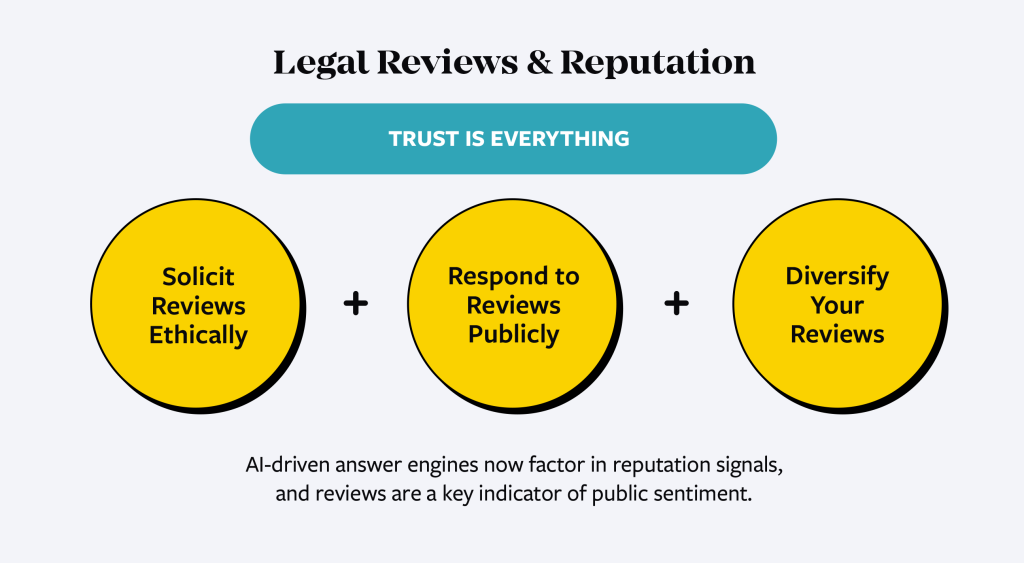
Most satisfied clients will leave a review when asked directly. 68% of all consumers provide a review for a local business after being asked to do so. The problem for most personal injury firms is that they ask inconsistently or not at all. A structured request process, built into your case-closing workflow, is the fastest way to build review volume.
The case settlement or verdict meeting is the single best moment to ask. The client is relieved, grateful, and emotionally engaged. A direct in-person request, paired with a card that includes a QR code linking to your Google Business Profile review page, removes every barrier between their goodwill and a posted review. Keep the ask simple: tell them that reviews help other injured people find your firm, and that their experience matters.
Email follow-up is the highest-volume channel for review generation. 41% of customers report that they were asked to leave a review via email. A personalized email sent within 24 to 48 hours of case closure, with a direct link to your review page, captures clients while the experience is fresh. Automated sequences can extend this, but they need a stop trigger so clients who have already posted a review stop receiving requests.
Text messages reach clients faster than email, and most personal injury clients prefer text communication. A brief thank-you text with a direct link to your Google review page takes seconds to send and often converts at a higher rate than email alone. Attorneys who record a short thank-you video and embed it in their follow-up email add a personal touch that makes the request feel genuine rather than automated.
Multiple tactics used together produce the best results. A firm that combines an in-person ask at case close, a same-day email with a direct review link, and a follow-up text three days later will consistently outpace competitors who rely on a single channel. The goal is to make leaving a review as frictionless as possible.
Responding to Reviews: What Personal Injury Firms Get Wrong
Response rate is a ranking signal and a conversion signal simultaneously. Around 9 in 10 consumers expect businesses to respond to their reviews, and more than half expect a fast response within three days of the review being posted. Most personal injury firms respond to almost nothing, which is a visible gap that prospective clients notice when scanning a profile.
Every response is read by future clients, not just the reviewer. 70% of individuals who read reviews are more inclined to write a review when they see that the manager takes the time to respond to customer feedback. Responding to positive reviews signals that your firm values client relationships beyond the case. It also creates a feedback loop: engaged responses encourage more clients to post.
Negative reviews require a measured, professional reply. Acknowledge the concern, express a willingness to resolve it, and move the conversation offline by providing a direct contact. Never argue or reveal case-specific details. A thoughtful response to a one-star review often reads more favorably to prospective clients than the negative review itself, because it demonstrates how your firm handles conflict.
Responding to Google reviews has become a key part of customer service, with 59% of consumers expecting businesses to respond to their reviews, both positive and negative, within 48 hours. Building a weekly or bi-weekly review response routine into your firm’s operations keeps response times within that window without requiring daily attention.
One practical note on star ratings: the optimal trust range is 4.2 to 4.5 stars, and research from Northwestern University’s Spiegel Research Center shows this range performs better than perfect 5.0 ratings for building consumer trust and long-term loyalty. A profile with 180 reviews averaging 4.4 stars reads as more credible than one with 20 reviews at 5.0. Volume and authenticity together outperform perfection.
Protecting Your Review Profile From Fake and Malicious Reviews
Fake and malicious reviews are a documented problem for attorneys. Competitors, disgruntled non-clients, and bad actors occasionally leave reviews that have nothing to do with actual representation. Google blocked 240 million fake or policy-breaking reviews in 2024. Even at that scale, problematic reviews still reach live profiles before they are caught.
In 2024, the FTC introduced a long-awaited law regulating fake and misleading reviews, making buying and writing fake reviews illegal, with any business or individual caught facing significant fines. This rule applies to businesses that purchase reviews as well as those that write them on behalf of others. Personal injury firms should never pay for reviews or offer client incentives in exchange for positive feedback. Google’s own policies prohibit incentivized reviews, and violations can result in profile suspension.
When a fake or malicious review appears, flag it through Google Business Profile’s reporting tools immediately. Document the report. If the review comes from someone who was never a client, that context can support your flagging request. Google does not guarantee removal, but reviews that violate its policies, including those that are spam, off-topic, or represent conflicts of interest, are eligible for removal.
A strong base of authentic reviews is your best defense against occasional negative outliers. 76% of consumers are more likely to trust that reviews are genuine when they are mixed, as opposed to only 5-star reviews. A profile with 200 reviews, including a handful of 3-star ratings and thoughtful responses to each, reads as far more credible than a profile with 20 uniform 5-star reviews and no responses.
Monitoring your profile consistently matters as much as building it. Set up Google alerts or use your Google Business Profile dashboard to catch new reviews quickly. A negative review that sits unanswered for two weeks does more damage than one answered within 48 hours. Personal injury firms that treat review monitoring as a weekly operational task rather than a reactive one maintain stronger profiles over time. If you want expert help building and protecting a review profile that converts, law firm marketing specialists at Custom Legal Marketing can build that system for your practice.
FAQs About Google Reviews for Personal Injury Firms
How many Google reviews does a personal injury firm need to rank in the Local Pack?
There is no fixed number, but data from an analysis of 2 million Google Business Profile pages found that businesses appearing in the top three Local Pack positions average nearly 250 reviews, while those in positions four through ten average fewer than 200. For competitive personal injury markets, a firm with fewer than 100 reviews will face a meaningful disadvantage against established competitors. The goal is consistent growth toward that upper tier, not a single campaign to hit a target number.
Can a personal injury firm ask clients for Google reviews without violating ethics rules?
In most jurisdictions, asking satisfied clients to leave an honest review is permissible. The key restrictions are that you cannot offer anything of value in exchange for a review, you cannot ask clients to write false or misleading content, and you cannot instruct clients to post reviews from your office’s IP address or devices. Bar rules vary by state, so confirm with your state bar’s ethics guidance before implementing any review solicitation program. The request itself, made honestly and without incentives, is generally allowed.
What should a personal injury attorney say when responding to a negative Google review?
Keep the response brief, professional, and offline-focused. Acknowledge that the reviewer had a difficult experience, express that client satisfaction matters to your firm, and invite them to contact you directly to discuss their concerns. Never identify the person as a former client, never discuss case details, and never argue publicly. A calm, professional response signals to every future reader that your firm handles conflict with professionalism, which often matters more than the negative review itself.
Do Google reviews affect how personal injury firms appear in AI-generated search results?
Yes. According to the 2026 Whitespark Local Search Ranking Factors Survey, reviews, citations, and links all have a significant impact on local AI search visibility. Large language models and AI overview systems pull from the same signals that influence traditional local rankings. A personal injury firm with a strong, well-maintained review profile is better positioned to appear in AI-generated recommendations, which increasingly appear above traditional organic results for high-intent legal queries. Firms investing in law firm SEO and Answer Engine Optimization should treat review building as a foundational part of that strategy.
How often should a personal injury firm be getting new Google reviews?
Consistently, rather than in bursts. 73% of consumers only trust reviews written within the last month, which means a firm that collected 50 reviews two years ago and stopped has a largely stale profile in the eyes of most prospective clients. The right cadence depends on case volume, but even smaller firms should aim for at least two to four new reviews per month. Building the review request into your standard case-close process, rather than running periodic campaigns, is the most reliable way to maintain steady velocity.
More Resources About Local SEO for Personal Injury Firms
- Google Business Profile for Personal Injury Firms
- GBP Categories for Personal Injury Firms
- GBP Services and Attributes Setup
- GBP Photo and Video Strategy
- Google Business Profile Posts for Personal Injury Law Firms
- Q&A Management on Google Business Profile for Personal Injury Lawyers
- Local Citations for Personal Injury Law Firms
What Our Clients Are Saying
