








Anatomy of a Personal Injury Website

LAW FIRM SEO THAT WORKS®
Our Focus: Your Firm
The best law firm marketing comes with a No Competition™ Guarantee.
Your personal injury website has one job: turn a frightened, injured person into a client before they click to the next firm. Every element on every page either helps that happen or gets in the way. Understanding which components carry weight, and which create friction, is the difference between a site that generates cases and one that generates traffic reports with nothing to show for them. Custom Legal Marketing has spent years building and optimizing personal injury sites across the country, and the patterns are clear. Here is what a high-performing personal injury website actually looks like, layer by layer.
Table of Contents
- The Homepage Must Establish Authority in Seconds
- Practice Area Pages Are Where Rankings and Cases Are Won
- Case Results Pages Prove What Your Marketing Claims
- The Contact Experience Determines Whether You Sign the Case
- Technical Foundation: What Visitors Never See but Always Feel
- Attorney Bio Pages and Trust Signals That Convert Skeptics
- FAQs About Anatomy of a Personal Injury Website
The Homepage Must Establish Authority in Seconds
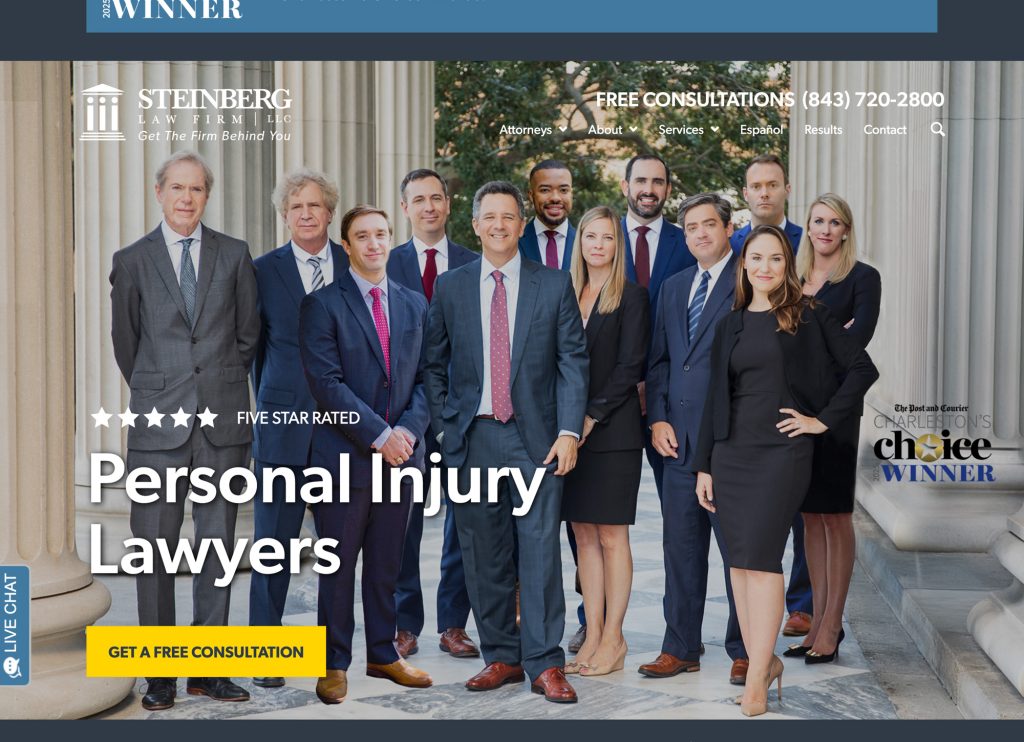
A personal injury homepage has roughly three seconds to answer two questions every visitor is silently asking: Can this firm handle my case? And can I trust them? Miss either one, and the visitor is gone.
The hero section, the first thing a visitor sees without scrolling, carries most of that weight. It needs a headline that speaks directly to the client’s situation, a subheadline that names the types of cases the firm handles, and a phone number that is impossible to miss. Aggregate settlement figures belong here too. A statement like “Over $500 million recovered for injured clients” does more persuasive work in five words than three paragraphs of attorney biography ever could.
Below the hero, the homepage should present a short proof stack. Case results, client video testimonials, and media logos all belong in this zone. According to the Legal Marketing Association’s ATL CMO Survey 2025, 57% of law firm CMOs rate written content development as “very effective,” the highest rating of any marketing tactic surveyed. Content earns attention, but proof converts it.
Practice area navigation also belongs on the homepage, clearly organized. A visitor who suffered a slip and fall needs to find that page immediately. One who was hit by a truck needs to see truck accident cases called out by name. Generic “personal injury” language without specifics forces visitors to work harder than they should.
The homepage should also feature a prominent contact form above the fold or anchored to the screen as a sticky element. Phone, form, and live chat should all appear as options. 36% of people would prefer to contact an attorney in a way other than phone, which is a significant share, so providing all contact avenues matters.
Finally, page speed is not optional. Research by Google shows that even a one-second delay in page load can reduce conversions by approximately 7%. A homepage that loads slowly on a mobile device is a homepage that loses clients before they ever read a word.
Practice Area Pages Are Where Rankings and Cases Are Won
Every distinct case type your firm handles deserves its own dedicated page. Car accidents, truck accidents, slip and falls, dog bites, wrongful death, medical malpractice: each one needs its own URL, its own content, and its own conversion path. A single umbrella page titled “Personal Injury” cannot rank competitively for any of those terms, and it gives a visitor searching for a truck accident lawyer no reason to believe your firm specializes in their situation.
Each practice area page should open with a direct explanation of what the claim involves, what the injured person is entitled to recover, and why your firm is the right choice for that specific case type. This is not the place for generic legal boilerplate. A page about premises liability should explain duty of care, the specific conditions that create liability, and what the claims process looks like, all in plain language.
The page structure that performs best follows a consistent pattern: a headline targeting the primary keyword, a brief empathetic opening that acknowledges what the client is going through, a substantive explanation of the law and the process, a section on what damages are recoverable, case results specific to that case type, and a strong call to action. That structure serves both the visitor reading the page and the search engine indexing it.
Strong law firm SEO for personal injury firms is built largely on the depth and quality of these practice area pages. A page that comprehensively covers car accident claims, from comparative negligence to the statute of limitations in your state, signals genuine expertise to Google. Thin pages that repeat the same three paragraphs across every practice area do the opposite.
Internal linking between practice area pages also matters here. A visitor reading your truck accident page may have been a passenger, not the driver, which means your rideshare accident or passenger rights content is directly relevant. Connect those pages intentionally.
Case Results Pages Prove What Your Marketing Claims

Telling a prospective client you are a winning firm costs nothing. Showing them a $4.2 million verdict in a construction accident case is a different conversation entirely. Case results pages are where your firm’s track record becomes a persuasion tool.
The most effective case results sections do more than list dollar amounts. They tell a brief story: what happened to the client, what the defense argued, what your firm did to counter it, and what the outcome was. A case where your firm hired an accident reconstruction expert to prove liability at a dangerous intersection is more compelling than a bare settlement figure, because it shows strategy and effort, not just luck.
Organize results by case type so visitors can find outcomes relevant to their situation. A parent whose child was injured in a dog attack wants to see dog bite settlements, not a general list sorted by dollar amount. Filtering or categorizing by case type takes minimal development effort and significantly improves relevance for every visitor segment.
Case results also serve a secondary function in Answer Engine Optimization, where AI systems and search engines pull structured data from pages to answer user queries. A well-formatted case results page, with clear headings and structured data markup, can appear in featured snippets or AI-generated answers when users search queries like “what is the average settlement for a truck accident.” That visibility brings in traffic that no paid ad can buy.
One important note: every jurisdiction has its own bar rules governing the use of past results in attorney advertising. Your case results page must include the required disclaimers that results vary and past outcomes do not guarantee future results. Compliance is not optional.
The Contact Experience Determines Whether You Sign the Case
A personal injury prospect who reaches your contact page has already done the hard work. They found you, read your content, looked at your results, and decided to reach out. Losing them at this stage, because the form is too long, the phone number is buried, or no one answers, is the most expensive mistake a firm can make.
Contact forms on personal injury sites should ask for the minimum information needed to qualify the lead. Name, phone number, a brief description of what happened, and when it occurred. Anything beyond that is friction. Save the detailed intake for the follow-up call.
Response speed is critical. According to the Martindale-Avvo Legal Consumer Report 2024, 85% of consumers expect a response within 48 hours or less, and 40% will move on to contact another attorney if they have not heard back within 24 hours. For personal injury prospects, who are often dealing with urgent medical and financial pressure, that window is narrow.
The contact page should also feature the firm’s phone number in click-to-call format, a live chat option, and, where possible, a text messaging option. Different clients prefer different channels. 36% of people would prefer to contact an attorney in a way other than by phone. A firm that only offers a phone number is already excluding more than a third of its potential clients from the first interaction.
After-hours coverage matters too. Personal injury incidents happen at all hours. A prospect who fills out a form at 10 PM and receives an automated acknowledgment followed by a call the next morning is far more likely to still be available than one who waits two days. Automated intake workflows, even simple ones, protect cases that would otherwise fall through the gaps overnight.
Technical Foundation: What Visitors Never See but Always Feel
Mobile performance, page speed, and site architecture are invisible to most visitors, but every visitor feels their effects. A site that loads slowly, shifts content while loading, or presents a desktop layout on a phone creates friction that kills conversions before a single word is read.
Personal injury prospects are overwhelmingly on mobile devices. They search from hospital waiting rooms, from the side of the road after an accident, from their couch while icing an injury. Law firm websites that load in one second have a conversion rate three times higher than those that load in five seconds. That gap is not marginal. It is the difference between a signed case and a missed opportunity.
Site architecture, meaning how pages are organized and linked together, directly affects how search engines crawl and rank your content. A flat, logical structure where every important page is reachable within two or three clicks from the homepage performs better than a deeply nested site where practice area pages are buried four levels deep. This connects directly to how your site builds topical authority across your full range of personal injury case types.
Schema markup is another technical layer that separates high-performing personal injury sites from average ones. LegalService schema, Attorney schema, and FAQ schema all help search engines understand what your pages are about and surface them in rich results. A practice area page with properly implemented FAQ schema can appear in the People Also Ask section of Google results, putting your firm’s answers in front of prospects who are still in research mode.
Accessibility matters both legally and practically. Personal injury clients often include people with disabilities, elderly individuals, and those recovering from serious injuries. A site that meets WCAG accessibility standards serves a broader audience and reduces the risk of ADA-related complaints. Custom Legal Marketing builds accessibility into every site we design, not as an afterthought, but as a foundational requirement.
If you are ready to build a personal injury website that performs at every level, from the homepage hero to the technical schema layer, law firm marketing done right starts with a conversation. Contact Custom Legal Marketing to talk through what your firm’s site needs to compete and convert in your market.
Attorney Bio Pages and Trust Signals That Convert Skeptics
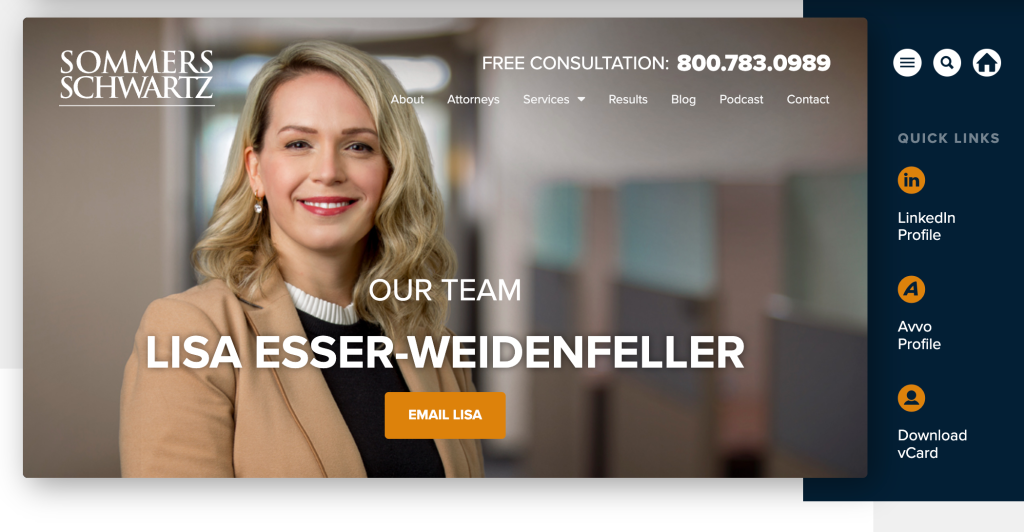
Injured people do not hire law firms. They hire lawyers. A personal injury website that presents the firm as a faceless entity, without real photos, real names, and real credentials, leaves a critical gap in the trust sequence that most prospects need to complete before they call.
Each attorney bio page should include a professional photograph, ideally taken specifically for the website rather than pulled from a phone camera or a bar association directory. Real photography outperforms stock images in every user testing scenario Custom Legal Marketing has run. Visitors respond to actual people, and a photo that shows the attorney as approachable and confident does more for conversion than any headline.
The bio itself should cover what the attorney handles, how long they have practiced, notable results, bar admissions, and any relevant recognition. But it should read like a person wrote it, not a resume. A sentence that says “John has spent 18 years fighting insurance companies on behalf of seriously injured clients in the Chicago area” is more persuasive than “John has 18 years of experience in personal injury litigation.”
Client reviews belong on or near the attorney bio page, not just on the homepage or a standalone testimonials page. A prospect who has read the bio and is almost ready to call needs that final confirmation from people who have been in their position. 80% of people said they would seek out and read an attorney’s online reviews before hiring them. Give those reviews a prominent home where they appear at exactly the right moment in the decision process.
Media appearances deserve a place on bio pages as well. If an attorney has been quoted in a local news story about a dangerous intersection or interviewed on television about a product liability case, that coverage carries real weight. Branding and profile building are rated “very effective” by 62% of law firm CMOs, reinforcing that consistent positioning matters more than one-off campaigns. Attorney bio pages are where that positioning becomes personal.
FAQs About Anatomy of a Personal Injury Website
How many practice area pages does a personal injury website need?
Every distinct case type your firm actively handles should have its own page. At minimum, that means separate pages for car accidents, truck accidents, slip and falls, dog bites, wrongful death, and medical malpractice if you take those cases. Combining multiple case types onto one page dilutes your keyword targeting and gives visitors no reason to believe you specialize in their specific situation. Firms that operate in multiple cities also need location-specific versions of those pages to compete in local search.
What should appear above the fold on a personal injury homepage?
The area visible before scrolling should include a headline that speaks directly to an injured person’s situation, a subheadline naming the types of cases you handle, a phone number in large type, a contact form or click-to-call button, and a trust signal such as an aggregate recovery figure or a recognizable media logo. Every element above the fold should serve one purpose: giving a frightened, injured visitor a reason to stay on the page and reach out.
Why do personal injury websites need schema markup?
Schema markup communicates your site’s content to search engines and AI systems in structured, machine-readable language. LegalService schema identifies your firm’s practice areas, location, and contact information. FAQ schema allows your question-and-answer content to appear in Google’s People Also Ask results. Attorney schema supports E-E-A-T signals by linking attorney credentials to your pages. Without schema, you rely entirely on search engines to infer that context from unstructured text, which is less reliable and less competitive.
How does a personal injury website support Answer Engine Optimization?
Answer Engine Optimization positions your content to be cited by AI systems like Google’s AI Overviews, ChatGPT, and Claude when users ask legal questions. Personal injury websites support this by structuring content around specific questions, using clear definition sections, providing direct answers at the top of each section, and implementing FAQ schema. Case results pages formatted with structured data can also surface in AI-generated responses to queries about settlement values. Firms that structure their content for AI citation gain visibility in a channel that organic rankings alone cannot capture.
What is the biggest conversion mistake personal injury websites make?
The most common and costly mistake is a slow, friction-heavy contact experience. This includes forms that ask for too much information, phone numbers that are hard to find on mobile, no live chat option, and no after-hours intake process. A prospect who reaches the contact stage has already decided your firm is a candidate. Losing them because the form was confusing or no one responded until the next business day is a case that cost nothing to win and everything to lose. Speed, simplicity, and multiple contact channels are the fix.
More Resources About Website Design for Personal Injury Firms
What Our Clients Are Saying
