










Contact Pages for Personal Injury Firms
LAW FIRM SEO THAT WORKS®
Our Focus: Your Firm
The best law firm marketing comes with a No Competition™ Guarantee.
Your contact page is doing more work than you think. For a personal injury firm, it sits at the end of every marketing channel you run: organic search, law firm SEO, paid ads, Google Business Profile, and referrals. Every dollar you spend bringing someone to your site passes through this single page before it becomes a case. Yet most personal injury contact pages are an afterthought — a form, a phone number, and a map dropped onto a blank template. That gap costs firms real cases.
Table of Contents
- Why the Contact Page Is a Conversion Bottleneck for Personal Injury Firms
- What Every Personal Injury Contact Page Must Include
- Trust Signals That Turn Visitors Into Callers
- Form Design and Technical Requirements That Affect Conversions
- How Answer Engine Optimization Changes the Contact Page Equation
- FAQs About Contact Pages for Personal Injury Firms
Why the Contact Page Is a Conversion Bottleneck for Personal Injury Firms
Contact forms across all industries carry a sobering baseline: only 38% of users who interact with a contact form actually submit it, and the view-to-completion rate drops to just 9% once you account for everyone who lands on the page but never touches the form. Personal injury is a high-intent category, so your numbers will run higher — but the structural problem remains. Most firms bleed leads at the form itself.
The reason is almost always friction. Injured people are stressed. They may be in pain, worried about money, and unsure whether they even have a case. A form that asks for too much too soon, or one that loads slowly on a phone, loses those people before they ever type a word.
90% of U.S. adults now own a smartphone, and a significant share of them use it as their primary internet device. Your contact page will be visited on a phone by someone sitting in an urgent care waiting room or pulled over on the side of the road after a crash. If the form is hard to tap, if the phone number requires zooming in, or if the page takes four seconds to load, that person is gone.
The fix starts with understanding what the page actually needs to accomplish: remove every reason a qualified visitor might hesitate, and make the act of reaching out feel immediate and safe.
What Every Personal Injury Contact Page Must Include
A phone number displayed prominently at the top of the page is non-negotiable. Injured people often want to talk to a human. Your number should be click-to-call on mobile, large enough to read without zooming, and visible before the visitor scrolls an inch. Burying it below the fold loses callers who are ready to act right now.
The contact form itself should ask for the minimum required to qualify the lead. Name, phone number, and a brief description of the incident cover everything your intake team needs to make a callback. Each additional field you add increases the chance that the visitor abandons. Research on form design consistently shows that reducing required fields improves completion rates — and for personal injury intake, the form’s job is to start the conversation, not complete it.
Office address and hours matter more than most firms realize. Someone who was just in a car accident wants to know where you are and whether they can reach you today. A map embed confirms you’re a real, local firm. Hours of operation, especially if you offer after-hours intake or 24/7 call answering, should be stated explicitly rather than implied.
Live chat or a chat widget gives visitors a third contact option. Some people won’t call and won’t fill out a form, but they will type a quick question. Capturing that person with a chat interaction can move them into your intake pipeline without requiring them to commit to a phone call upfront.
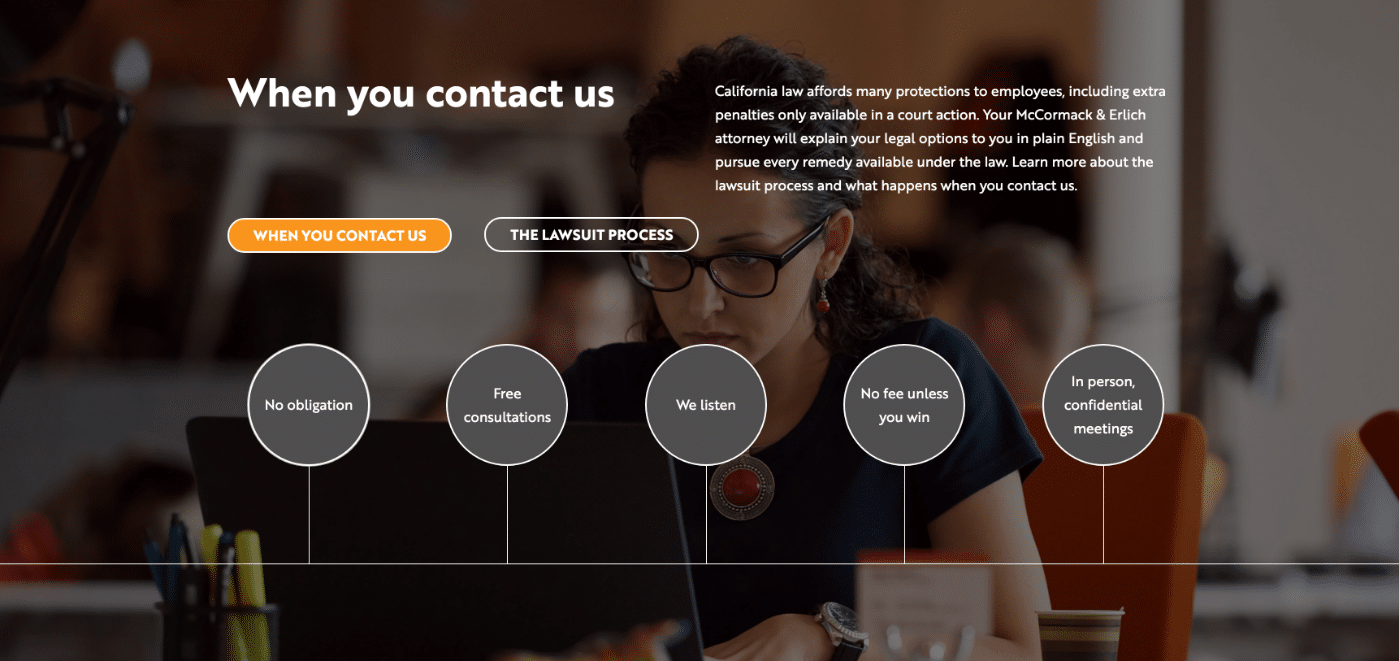
Finally, a brief statement about confidentiality reduces hesitation. Injured people are sharing personal details about accidents, injuries, and insurance. One sentence confirming that their information is private and protected removes a real barrier to submission.
Trust Signals That Turn Visitors Into Callers
Personal injury clients are making a high-stakes decision under stress. They are choosing someone to handle what may be the most financially significant event of their life. Your contact page has to do more than collect information — it has to convince a frightened person that they are in the right place.
Case results belong on this page. A short row of settlements or verdicts placed near the form reminds the visitor that your firm wins. You don’t need to list every case — two or three representative results with dollar amounts are enough to establish that you have a track record. Firms that have recovered significant amounts for clients should say so clearly, the way Sommers Schwartz leads with their billion-dollar recovery figure. That number answers the question every injured person is silently asking: “Can this firm actually help me?”
Client reviews placed near the contact form carry real weight. A short quote from a former client who was in a similar situation creates an immediate sense of recognition. It tells the visitor that someone who felt exactly what they’re feeling right now chose this firm and was glad they did.
Attorney photos humanize the page. A face next to a form makes the firm feel approachable. The visitor is about to trust you with sensitive information — seeing who they’ll be working with reduces the psychological distance between “stranger on the internet” and “my lawyer.”
Bar membership badges, peer recognition, and media appearances also belong here. As Custom Legal Marketing’s own research shows, media coverage signals that a firm’s attorneys have been vetted by outside parties. That carries weight with people who are still deciding whether to reach out at all. These elements connect directly to the E-E-A-T signals that also influence how Google evaluates your site’s authority across your broader personal injury SEO strategy.
Form Design and Technical Requirements That Affect Conversions
Form field count is the single most controllable factor in contact form conversion. Research on form abandonment shows that eliminating even one unnecessary field can meaningfully lift submission rates. For personal injury intake, three to four fields is the target: name, phone, email, and a brief case description. Anything beyond that — date of birth, case type dropdown, referral source — belongs in the intake call, not the contact form.
Field labels should sit above the input, not inside it as placeholder text. Placeholder text disappears the moment someone starts typing, and injured people who are filling out a form for the first time on a phone screen need the label to stay visible. Small UX details like this reduce the cognitive load on someone who is already dealing with a stressful situation.
The submit button copy matters. “Submit” is generic and passive. “Get a Free Consultation” or “Tell Us What Happened” connects the button to the outcome the visitor actually wants. That distinction is small in terms of pixels but meaningful in terms of psychology.
Page speed is a technical requirement, not a preference. A slow-loading contact page loses mobile visitors before the form even renders. This connects to the broader technical SEO foundation that personal injury sites need across every page, not just the contact page. If your site has Core Web Vitals issues, the contact page is where those problems cost you the most — because it’s the last page a motivated visitor sees before deciding to reach out or leave.
Schema markup on your contact page, specifically LocalBusiness or LegalService schema that includes your phone number, address, and hours, helps search engines surface your contact information directly in results. This is part of the same structured data strategy that applies across your entire site’s schema implementation.
How Answer Engine Optimization Changes the Contact Page Equation
AI-powered search tools and answer engines are changing where legal consumers get their first answers. When someone asks an AI assistant “how do I find a personal injury lawyer near me,” the response often pulls from pages that are structured to answer questions directly and clearly. Your contact page can participate in that ecosystem if it’s built correctly.
Adding a brief FAQ section to your contact page — answering questions like “How quickly will someone contact me?” or “What information should I have ready?” — gives AI systems and featured snippet algorithms something to cite. This is the same principle behind the broader answer engine optimization strategy that personal injury firms are using to appear in AI-generated responses, not just traditional search results.
The contact page FAQ also serves a direct conversion function. A visitor who is hesitating because they don’t know what happens after they submit the form is more likely to submit if that question is answered right there on the page. “We respond within one business day” or “A member of our team will call you within two hours” removes a specific uncertainty that many injured people have.
Structured, question-based content on the contact page also signals to Google that the page is informative rather than purely transactional. That distinction matters for YMYL (Your Money or Your Life) content evaluation, where Google applies stricter quality standards to pages that deal with legal matters. A contact page that includes helpful, accurate answers to genuine questions about the intake process demonstrates the kind of expertise and trustworthiness that YMYL guidelines reward.
If your firm offers services in multiple languages, your contact page is where that commitment becomes concrete. A Spanish-language contact option — whether a separate form, a bilingual intake team, or a clearly stated “Se habla español” — signals inclusion to a significant portion of personal injury clients who might otherwise assume the firm won’t be able to help them. This connects directly to the multilingual SEO considerations that high-growth personal injury firms are building into their site architecture.
Custom Legal Marketing builds contact pages for personal injury firms that are designed around every one of these factors. If your current contact page isn’t converting the traffic your law firm marketing is generating, that’s a problem we can fix. Reach out to our team to talk through what your contact page is currently doing and what it should be doing instead.
FAQs About Contact Pages for Personal Injury Firms
How many fields should a personal injury contact form have?
Three to four fields is the optimal range for a personal injury intake form: name, phone number, email, and a brief description of the incident. Each additional field increases the likelihood that a stressed, injured visitor will abandon the form before submitting. The intake call is the right place to gather detailed information — the form’s job is simply to start the conversation.
Should a personal injury contact page include case results?
Yes. Two or three representative settlements or verdicts placed near the contact form remind visitors that the firm has a history of winning. Injured people are making a high-stakes decision, and concrete results — specific dollar amounts tied to real case types — answer the unspoken question of whether the firm can actually deliver. Generic claims of experience don’t carry the same weight as a verified outcome.
Does contact page schema markup help with local SEO?
It does. Adding LegalService or LocalBusiness schema to your contact page with accurate name, address, phone number, and hours data helps search engines surface your contact information directly in local results. This reinforces the NAP consistency that local citation building depends on, and it gives AI-powered search tools a structured, machine-readable version of your firm’s contact details to pull from.
What should a personal injury firm do after someone submits a contact form?
The response speed matters as much as the response itself. A confirmation message should appear immediately on the page after submission, telling the visitor exactly what happens next and when they can expect to hear from someone. Your intake team should follow up by phone within the timeframe you promise. Delays between form submission and first contact reduce the likelihood that the prospect will still be available and interested when you reach them.
How does answer engine optimization apply to a personal injury contact page?
Including a brief FAQ section on your contact page — answering questions about response times, what to have ready, and what the intake process looks like — gives AI search tools structured content to cite when users ask related questions. It also reduces hesitation for visitors who are on the fence about submitting. A contact page FAQ serves both the human visitor who needs reassurance and the AI system that is looking for clear, direct answers to surface in generated responses.
More Resources About Content Marketing for Personal Injury Firms
What Our Clients Are Saying
