











Conversion-Focused Design for Personal Injury Firms

LAW FIRM SEO THAT WORKS®
Our Focus: Your Firm
The best law firm marketing comes with a No Competition™ Guarantee.
Personal injury firms operate in one of the most competitive online markets in law. Accidents & Personal Injury Law carries the lowest paid-search conversion rate of any legal category, sitting at just 5.45% according to LocaliQ’s legal advertising benchmark data. That number reflects a hard truth: getting traffic to your site is only half the problem. The other half is what happens once someone lands on a page. Conversion-focused design solves that second half by building every element of a site around a single goal — turning a visitor into a call, a form submission, or a signed case.
Table of Contents
- Why Personal Injury Visitors Behave Differently Than Other Legal Clients
- Mobile-First Design Is the Starting Point, Not an Afterthought
- Trust Signals That Convert Injured Clients
- Page Architecture That Guides Visitors to Contact
- Continuous Testing Turns Good Design Into Great Performance
- FAQs About Conversion-Focused Design for Personal Injury Firms
Why Personal Injury Visitors Behave Differently Than Other Legal Clients
Someone searching for a personal injury attorney is rarely in a calm, deliberate mindset. They just got hit by a car, suffered a fall, or lost a family member to someone else’s negligence. The emotional state of that visitor shapes every design decision a personal injury firm should make. Pain, fear, and financial stress are the context in which your website loads.
That emotional context creates an urgent decision cycle. These visitors are not comparison-shopping over weeks the way a business client might evaluate a corporate attorney. They need help now, and they often contact the first firm that makes them feel understood and capable of winning. Your site has seconds to establish that.
The design response to this behavior is empathy-forward messaging paired with frictionless contact options. Headlines should acknowledge what the visitor is going through. Copy should focus on outcomes, not credentials. And every page should make it impossible to miss a phone number, a chat option, or a contact form. When Custom Legal Marketing redesigned the Briskman Briskman & Greenberg website, the team prioritized conversational language that moved away from standard injury lawyer copy — specifically because generic messaging fails to connect with someone in crisis.
Personal injury visitors also tend to research firms on mobile devices at the moment of need. Design that ignores mobile behavior is design that ignores the majority of your actual audience. The emotional urgency of the visit and the device it happens on are inseparable design constraints.
Mobile-First Design Is the Starting Point, Not an Afterthought
Mobile devices now account for roughly 62 to 63% of all global website traffic, according to StatCounter data and confirmed by SQ Magazine’s 2026 analysis. For personal injury firms, that figure likely runs even higher — accident victims reach for their phones first. A site that performs well on desktop but struggles on mobile is effectively broken for the majority of its visitors.
Mobile-first design means building the phone experience first, then scaling up to desktop — not the other way around. Clickable phone numbers at the top of every page, contact forms with minimal required fields, and text that reads clearly on a small screen are baseline requirements. Navigation should collapse cleanly. Buttons need to be large enough to tap without frustration.
Speed is equally critical. According to Think with Google, 53% of mobile visits are abandoned when a page takes longer than three seconds to load. Google’s own data confirms that bounce rate increases by 123% when speed drops from one second to ten seconds. For a personal injury firm spending heavily on paid search or law firm SEO, a slow site is a direct drain on marketing ROI.
Core Web Vitals — Google’s framework for measuring load speed, interactivity, and visual stability — directly affect both search rankings and user experience. Firms that pass these thresholds rank better and convert better. Those that fail on both fronts pay more per lead for worse results.
Trust Signals That Convert Injured Clients
A personal injury visitor arrives with a specific set of fears: fear of being ignored, fear of hiring the wrong attorney, and fear that their case isn’t worth pursuing. Conversion-focused design addresses each of those fears with specific visual and content elements placed at the right points in the page.
Case results are the most direct trust signal available to a personal injury firm. Displaying specific settlement amounts and verdicts — with enough detail to feel real — tells a visitor that this firm wins. Sommers Schwartz, for example, leads with the fact that the firm has recovered over $1 billion for clients. That single figure answers the most important question a visitor has before they ever read a practice area description.
Client testimonials carry similar weight, especially in video form. A written review is easy to dismiss. A real client on camera, describing their experience in their own words, removes the skepticism that legal marketing often triggers. The Custom Legal Marketing team has consistently found that video testimonials and attorney introduction videos reduce visitor anxiety in ways that text copy cannot replicate. This aligns with how good law firm SEO treats E-E-A-T signals — real experience, demonstrated by real people, presented in formats that are hard to fake.
Attorney profile pages matter more than most firms realize. A photo, a brief biography that sounds human rather than formal, bar admissions, and a few words about why the attorney chose personal injury work — these details make a firm feel approachable. Visitors are not just evaluating credentials. They are deciding whether they trust this person with one of the worst moments of their life.
Badges, awards, and peer recognitions add credibility, but placement matters. Stacking them at the bottom of a page where few visitors scroll wastes their value. Integrating them near contact forms or within attorney bios puts them where they can actually influence a decision.
Page Architecture That Guides Visitors to Contact
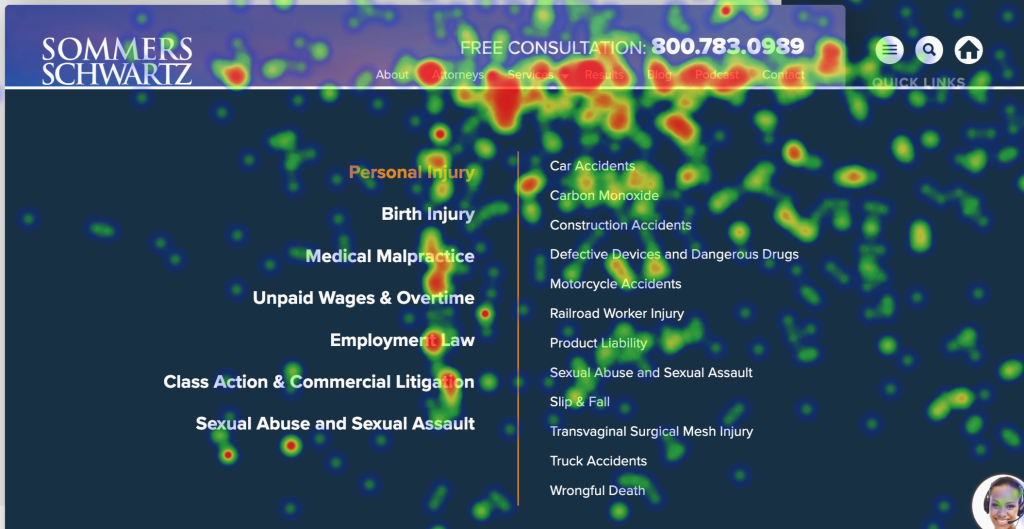
The structure of a personal injury website — how pages connect, where CTAs appear, and what a visitor sees first — determines whether design converts or simply decorates. Every page has a job. A practice area page for car accident claims should answer the visitor’s core questions, establish credibility, and make contacting the firm the obvious next step. Pages that wander through legal history or load up with keyword-stuffed paragraphs fail at all three.
The anatomy of a high-converting personal injury page follows a predictable hierarchy. A strong headline that names the injury type and implies a result. A brief empathy statement acknowledging what the visitor is going through. A clear explanation of what the firm does and what the client can expect. Case results or testimonials specific to that injury type. A contact form or prominent phone number. That sequence is not arbitrary — it mirrors the decision process a stressed visitor actually goes through.
Contact forms should appear above the fold on mobile and multiple times on longer pages. The form itself should ask for the minimum information needed to initiate a conversation. Name, phone number, and a brief description of what happened. Every additional required field is friction, and friction costs conversions. Firms that also offer live chat give visitors another low-barrier option — research consistently shows that a large share of potential clients prefer messaging over email when they want quick answers.
Internal page structure connects directly to how search engines and AI systems understand a site’s topical depth. A well-organized personal injury site — with practice area pages that link logically to related content, FAQ sections that answer real questions, and clear navigation — performs better in organic search and keeps visitors engaged longer. This is why Answer Engine Optimization for personal injury firms treats page structure as both a conversion tool and a visibility strategy: a page organized for humans tends to be organized for AI retrieval as well.
Sticky navigation bars that keep the phone number and a “Free Consultation” button visible as a user scrolls are a simple, proven tactic. The goal is to eliminate the moment where a visitor decides to call but cannot immediately find the number. That moment of friction, however brief, costs cases.
Continuous Testing Turns Good Design Into Great Performance
A personal injury website launched and left alone will gradually underperform. Visitor behavior shifts. Search patterns change. What converted well two years ago may not convert as well today. The firms that consistently outperform their competitors treat their websites as living systems, not finished products.
Conversion rate optimization for personal injury sites involves systematic testing of specific elements: headline copy, CTA button color and placement, form length, page layout, and the presence or absence of trust signals above the fold. Each test produces data. That data informs the next iteration. Over time, incremental improvements compound into meaningful gains in lead volume.
Custom Legal Marketing’s approach to law firm marketing includes ongoing UX monitoring after launch. Heatmaps, session recordings, and conversion tracking reveal exactly where visitors drop off, which elements they engage with, and where friction is costing the firm cases. When Briskman Briskman & Greenberg launched their redesigned site in April 2024, sitewide conversion rates jumped 47% within the first two months — a result that came from intentional design decisions tested against real visitor behavior, not guesswork.
Testing also applies to contact channel mix. Some visitors prefer calling. Others want to fill out a form at midnight when they cannot sleep after an accident. A smaller but meaningful segment will use live chat. Firms that offer all three options — and make each one easy to find — capture leads that single-channel sites lose. The right mix varies by market and audience, which is why monitoring matters more than any single “best practice.”
Schema markup, structured content, and answer-formatted FAQ sections also feed into conversion performance by helping the site appear in featured snippets and AI-generated search results. A visitor who finds a clear, direct answer to “how long do I have to file a personal injury claim in [state]?” on your site is already engaged before they read a single word of your practice area copy. That pre-visit trust carries into the conversion decision.
FAQs About Conversion-Focused Design for Personal Injury Firms
What makes a personal injury website different from other law firm websites in terms of design?
Personal injury visitors arrive in a state of stress or crisis, often searching from a mobile device immediately after an accident. That emotional context demands design that leads with empathy, makes contact options impossible to miss, and establishes trust through case results and real client voices — all within the first few seconds of a page load. Other practice areas may allow for more deliberate, research-oriented visitor journeys. Personal injury does not.
How many contact options should a personal injury website offer?
At minimum, three: a clickable phone number, a short contact form, and a live chat option. Each channel captures a different type of visitor. Someone who just left an emergency room may call immediately. Someone researching at 11 p.m. may prefer a form. A visitor with a quick question before committing may use chat. Offering all three and making each easy to find on mobile removes the friction that costs firms cases.
Does page load speed actually affect how many personal injury leads a site generates?
Yes, directly. Think with Google’s data shows that 53% of mobile visits are abandoned when a page takes longer than three seconds to load. Conversion rates drop by an average of 4.42% for each additional second of load time in the zero-to-five-second range. For a personal injury firm spending thousands per month on paid search, a slow site means a large portion of that spend produces no return at all.
What trust signals convert personal injury visitors most effectively?
Specific case results tied to injury types matching the page topic, video testimonials from real clients, attorney photographs with humanizing bios, and clear statements about free consultations and contingency fee arrangements. Generic claims like “experienced attorneys” or “aggressive representation” carry little weight. Specificity — a named settlement amount, a client’s own words on camera, an attorney explaining why they chose personal injury law — is what actually reduces visitor hesitation.
How often should a personal injury firm update or test its website design?
Conversion testing should be ongoing, not periodic. Headline copy, CTA placement, form length, and page layout should all be subject to regular A/B testing based on real visitor data. Beyond testing, design elements should be reviewed whenever the firm’s case mix shifts, when a major Google algorithm update affects traffic patterns, or when analytics show a meaningful change in bounce rate or time on page. A site that performed well at launch can drift into underperformance without active monitoring and adjustment.
More Resources About Website Design for Personal Injury Firms
What Our Clients Are Saying
