









Hub and Spoke Content Architecture for Personal Injury Firms

LAW FIRM SEO THAT WORKS®
Our Focus: Your Firm
The best law firm marketing comes with a No Competition™ Guarantee.
Personal injury law firms compete in one of the most expensive keyword markets online. A single practice area page, no matter how well written, cannot carry enough topical weight to dominate that market. Hub and spoke content architecture solves that problem by organizing your entire website around interconnected topic clusters, where a central hub page anchors a network of supporting spoke pages, each one deepening your authority on a specific subtopic.
Table of Contents
- What Hub and Spoke Content Architecture Means for Law Firms
- How Google and AI Systems Read Your Content Cluster
- Building the Hub: What a Personal Injury Pillar Page Must Cover
- Designing Spoke Pages That Do Real SEO Work
- Measuring Cluster Performance and Expanding Over Time
- FAQs About Hub and Spoke Content Architecture
What Hub and Spoke Content Architecture Means for Law Firms
The hub and spoke model is a content architecture where a central overview page on a broad topic links to many detailed subpages, which in turn link back to the hub. For a personal injury firm, the hub might be your main “Personal Injury Lawyer” practice area page. The spokes are the pages that surround it: car accident claims, slip and fall liability, traumatic brain injuries, wrongful death, insurance bad faith, and so on.
Hub pages serve as an opportunity to provide your audience a single page targeting a general topic, typically a top-of-funnel search intent or head term. Your hub pages provide an overview of an entire topic while pointing to in-depth concepts that are broken down into spokes. A prospective client searching “personal injury lawyer Chicago” lands on your hub. A client searching “what to do after a slip and fall at a grocery store” lands on a spoke. Both paths lead to your firm.
Writing a strong article on a single keyword and hoping it climbs the rankings is no longer enough. Search engines and AI-powered tools like ChatGPT and Google AI Overviews now evaluate whether your site demonstrates deep, connected expertise on a subject. That evaluation happens at the site level, not the page level. A firm with 40 tightly connected pages on personal injury topics sends a fundamentally different signal than a firm with 40 isolated blog posts.
The architecture also shapes how your URLs are structured. Research from Custom Legal Marketing’s site architecture studies shows that 70% of all law firm rankings come from pages with one to two path segments. Your hub lives at that shallow depth. Spokes can go one level deeper without penalty, particularly for the long-tail, conversational queries that AI-driven search surfaces constantly.
How Google and AI Systems Read Your Content Cluster
Strategic internal linking signals a strong thematic connection to Google and establishes your website as an expert source for a specific subject area, a crucial factor for E-E-A-T (Experience, Expertise, Authoritativeness, Trustworthiness). Every link between your hub and its spokes is a declaration of topical relationship. Google reads those declarations at scale.
Google has moved well beyond keyword matching. Its algorithms now evaluate E-E-A-T. A single blog post, no matter how well written, struggles to demonstrate all four signals. A content cluster does it systematically. The hub demonstrates broad expertise. A spoke on “Illinois comparative negligence” demonstrates the kind of specific, jurisdictional knowledge that builds genuine authority.
Large language models cross-reference claims across multiple pages and sources before surfacing them in an answer. Sites with well-developed topic clusters give these models more context to confirm that information is accurate, which increases the odds of being cited. That citation behavior is why Answer Engine Optimization and hub and spoke architecture are inseparable strategies in 2026. ChatGPT, Perplexity, and Google’s AI Overviews all favor sources that cover a topic from multiple connected angles.
The clear structure of hub-and-spoke articles, with direct answers at the beginning of each section, lists, and tables, increases the chance of being featured as a Featured Snippet or in an AI-generated answer. Hub-and-spoke clusters have a better chance of being featured in Google’s AI Overviews because they offer comprehensive, interconnected information. For personal injury firms, that means your cluster on car accident claims can appear in AI Overviews for dozens of related queries simultaneously.
Building the Hub: What a Personal Injury Pillar Page Must Cover
Your hub page carries the entire cluster. Every spoke page earns some of its authority from the hub, which means the hub must be the most comprehensive, well-structured page on your site for that practice area. Thin hub pages produce thin clusters.
A personal injury hub page for a firm practicing in a specific state should cover the foundational legal framework: the statute of limitations, the state’s comparative negligence rules, the types of damages available, and the general claims process. These are the questions a prospective client asks before they ever call. The hub answers them at a high level, then points to spokes for depth.
Keyword-rich headings, jump links, and FAQ sections all matter here. The hub-and-spoke model is ideal for capturing conversational queries. Spoke articles are perfectly suited to use specific W-questions (“How…”, “What is…”, “Why…”) as the main keyword. Your hub sets up those questions; your spokes answer them in full. That division of labor keeps the hub from becoming bloated while giving each spoke a clear, rankable purpose.
Schema markup reinforces the structure. BreadcrumbList schema on every spoke page tells Google the exact path from your homepage to that spoke, which helps AI bots locate the most specific, relevant page on your site when answering a narrow query. Pair that with LegalService schema on the hub and FAQ schema on spoke pages, and you have a machine-readable map of your entire cluster.
One practical rule: keep hub pages at a URL depth of one or two segments. Research consistently shows that practice area pages perform best at this depth. Spokes can sit one level deeper without issue, particularly for long-tail targets like “what to do after a rideshare accident in Houston.”
Designing Spoke Pages That Do Real SEO Work
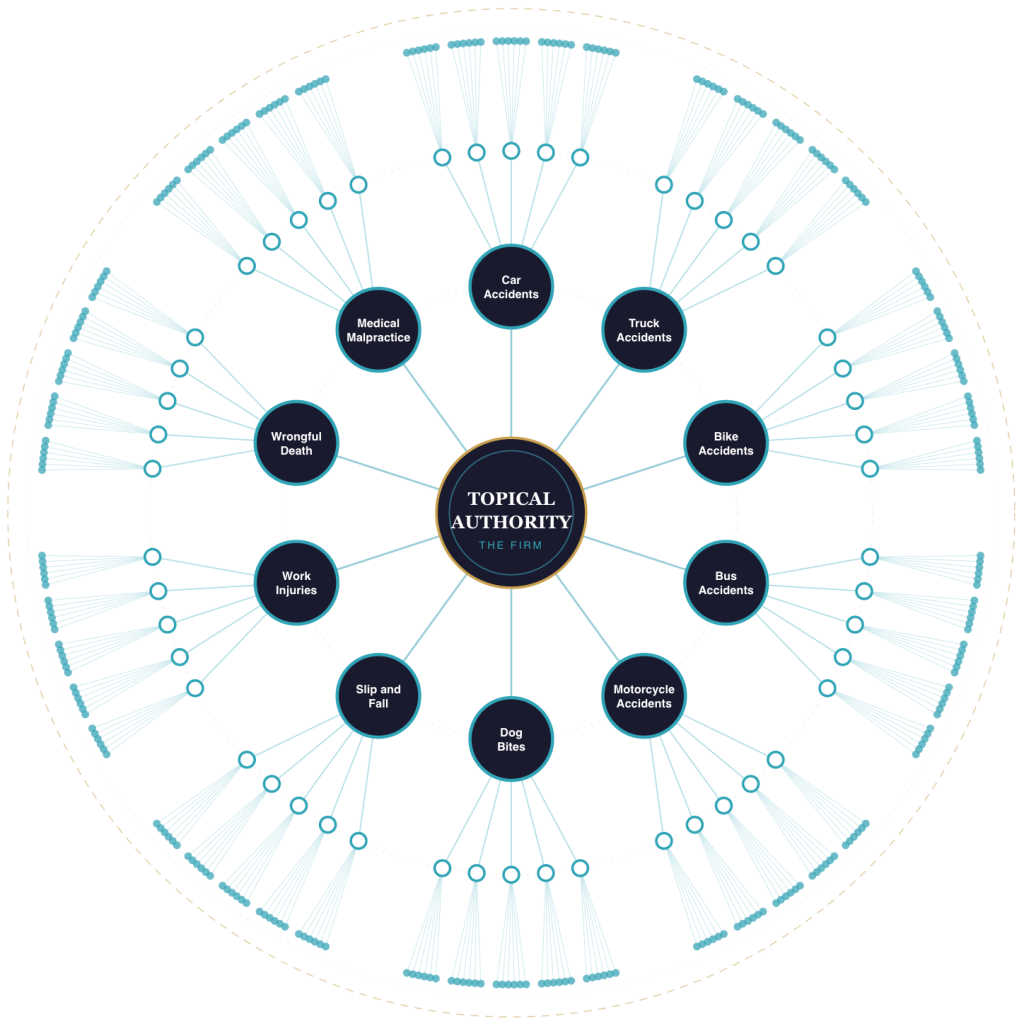
By grouping related content into clusters, the model minimizes redundant pages and keyword cannibalization, signals depth of coverage through internal link networks, and enables targeted ranking for both broad and long-tail queries. Each spoke has one job: answer one specific question better than any other page on the web.
For a personal injury cluster, spoke topics might include: how liability is determined in a multi-vehicle accident, what “serious injury” means under your state’s no-fault threshold, how to calculate lost wage damages, or what to expect at a deposition. Each of these is a real question a real client types into Google or asks an AI assistant. Each deserves its own page.
Spokes under 800 words rarely rank. Each spoke should be a genuinely complete answer to its specific sub-topic question. That means real legal detail, not a paragraph and a call to action. A spoke on “comparative fault in Texas personal injury cases” should explain how Texas Civil Practice and Remedies Code Section 33.001 works, what the 51% bar rule means for a client’s recovery, and how juries apportion fault. That depth is what separates rankable content from filler.
If spokes link to the hub but the hub does not link back to spokes, the PageRank loop is broken. Both directions are required. Every spoke links back to the hub with descriptive anchor text. The hub links out to every spoke. Related spokes link to each other where the connection is genuine. A spoke on traumatic brain injuries should link to the spoke on medical expense damages, because a reader researching TBIs will naturally want to understand what those injuries are worth.
Avoid creating two spokes that target essentially the same question from slightly different angles. Two spokes covering essentially the same sub-topic from slightly different angles create cannibalization. Map your spokes before you write them. One spoke per distinct user question. No overlap.
Measuring Cluster Performance and Expanding Over Time
Cluster performance is measured differently than individual page performance. A single spoke ranking on page two for its target keyword is not a failure if the hub is ranking on page one and the cluster as a whole is driving qualified traffic. Measuring topical authority is less about a single score and more about watching several signals move in the right direction over time. Watch how your pillar page and its supporting articles rank as a group rather than judging each page in isolation. When the whole cluster climbs, that’s a sign your topical authority strategy is paying off.
Sites that publish well-structured cluster content consistently typically start seeing meaningful ranking improvements within 60 to 90 days. Stronger authority in competitive niches can take six to twelve months to compound into consistent results. Personal injury is one of the most competitive niches in law firm SEO, so that longer timeline is realistic. The compounding effect, though, is real. Each new spoke that earns rankings sends additional authority back to the hub.
Schedule quarterly reviews to expand, retire, or reorganize spokes based on evolving user needs or search trends. A spoke on “COVID-19 premises liability” that drove traffic in 2021 may need to be merged into a broader negligence spoke today. A new statute, a high-profile local verdict, or a shift in how AI assistants answer injury questions can all create opportunities for new spokes.
Google Search Console is your primary measurement tool. Track impressions and clicks at the cluster level by filtering for all URLs that share the hub’s path. Watch for spokes that are gaining impressions without clicks, which often signals a ranking that could move to page one with a content update. Watch for the hub page gaining impressions for long-tail queries that belong on a spoke, which signals an opportunity to build that spoke and relieve the hub of queries it was never designed to answer.
The firms that win in personal injury law firm marketing are the ones that treat their website as a knowledge base, not a brochure. Hub and spoke architecture is the structural commitment that makes that knowledge base rankable, citable by AI, and genuinely useful to the people who need a lawyer. Custom Legal Marketing builds these systems for personal injury firms every day. Contact us to talk about what your cluster strategy should look like.
FAQs About Hub and Spoke Content Architecture
How many spoke pages does a personal injury hub need to build real topical authority?
There is no universal minimum, but a practical range for an established practice area is 8 to 20 spoke pages. Fewer than five usually means the topic is not being covered with enough depth. More than 30 can signal over-segmentation unless each page targets a genuinely distinct user question with its own search demand. Quality matters more than quantity. A cluster of 10 thorough spoke pages will outperform a cluster of 30 thin ones.
Does hub and spoke architecture help with Google AI Overviews for personal injury queries?
Yes. Google’s AI Overviews favor sources that cover a topic from multiple connected angles. When your hub and spokes collectively address a legal question from several directions, including the legal standard, the damages calculation, the procedural steps, and the jurisdiction-specific rules, AI systems have more context to verify accuracy and more reason to surface your firm as a cited source. A single page cannot provide that breadth of verification signals.
Should every practice area on a personal injury firm’s website have its own hub?
Yes. Each major practice area, car accidents, slip and fall, wrongful death, product liability, and others, should anchor its own hub page with its own cluster of spokes. These hubs can also cross-link where the legal concepts genuinely overlap. A spoke on spinal cord injuries, for example, might naturally link to both a car accident hub and a product liability hub if the injury type appears in both contexts.
What is the difference between a hub page and a practice area page?
In most cases, they are the same page serving two functions. Your “Car Accident Lawyer” practice area page is also your hub for the car accident content cluster. The difference is how you build it. A practice area page designed only to convert visitors describes your services. A hub page designed for topical authority also covers the legal concepts, links out to supporting spokes, and includes structured content that AI systems can parse and cite. The best practice area pages do both.
How does internal linking between spokes affect the cluster’s overall rankings?
Spoke-to-spoke linking creates a denser topical network that passes relevance signals across the entire cluster, not just between each spoke and the hub. When a spoke on traumatic brain injuries links to a spoke on medical expense damages, Google understands that these two topics are related within your firm’s content ecosystem. That relationship reinforces the hub’s authority on personal injury as a whole. The links also give users a logical path deeper into your content, which improves engagement signals that factor into rankings over time.
More Resources About Topic Clusters and Pillar Content
What Our Clients Are Saying
