











Data Visualization in Personal Injury Content

LAW FIRM SEO THAT WORKS®
Our Focus: Your Firm
The best law firm marketing comes with a No Competition™ Guarantee.
Charts, timelines, and data tables do more than decorate a law firm’s website. They answer questions in a format that both human readers and AI systems can extract, cite, and surface in search results. For personal injury firms competing in high-stakes markets, data visualization in legal content is a practical tool for building authority, reducing bounce rates, and earning the kind of structured citations that drive visibility in Google AI Overviews and large language model responses.
Table of Contents
- Why the Human Brain Responds Differently to Visual Data Than to Text
- How Data Visualization Strengthens Law Firm SEO and AI Visibility
- The Right Formats for Legal Data: Charts, Tables, Timelines, and Infographics
- Producing Visualizations That Earn Citations from AI and Human Publishers
- Integrating Data Visualization Into a Personal Injury Content Strategy
- FAQs About Data Visualization in Legal Content
Why the Human Brain Responds Differently to Visual Data Than to Text
MIT neuroscience research published in 2014 found that the human brain can identify images seen for as little as 13 milliseconds. That speed advantage has direct consequences for how prospective clients process a law firm’s website. A visitor scanning a personal injury page will absorb a well-designed timeline or comparison chart before they finish reading the first paragraph.
Even for equal initial encoding of data, graphics facilitate long-term retention. A peer-reviewed study published in the National Institutes of Health journal system found that for the digital visualization group, the average pre-test accuracy was 31.25%, which increased to 78.13% immediately after use. That is a dramatic jump in comprehension driven entirely by the format of the information, not its content.
Research from Fischer et al. states that information retention is significantly related to visualizations, as they can influence how information is encoded, stored, and retrieved in memory. By presenting quantitative data in visual formats like images, signs, maps, graphs, and charts, communicators can deliver information quickly, helping individuals to encode information more effectively.
For a personal injury firm, this matters at every stage of the client journey. A prospective client trying to understand the difference between comparative and contributory negligence will absorb a side-by-side comparison card faster than a three-paragraph explanation. A client reviewing settlement timelines will retain a visual flowchart longer than a bulleted list. The format shapes what gets remembered.
Data visualization has two primary purposes: analysis and communication. Summary statistics may miss important trends that visualization will reveal, thus highlighting areas ripe for analysis. In legal content, that communication function is the one that matters most. Your readers are not researchers. They are people in stressful situations looking for fast, credible answers.
The implication for law firm marketing is straightforward. Pages that present legal information visually give visitors a reason to stay longer, understand more, and trust the firm behind the content. Pages that present the same information as dense paragraphs lose that opportunity entirely.
How Data Visualization Strengthens Personal Injury SEO and AI Visibility
Search engines and AI systems both reward content that delivers clear, structured answers. Data visualization accelerates that process by organizing information into formats that crawlers and language models can parse without ambiguity. A table showing average settlement ranges by injury type, for example, gives an AI Overview a discrete, citable data point. A wall of prose describing the same information gives it nothing to extract.
For firms investing in law firm SEO, this creates a compounding advantage. Pages with embedded data visuals tend to attract more backlinks because publishers and journalists want ready-to-use resources. Visualizations can deliver information quickly, helping individuals to encode information more effectively. Graphics in lectures or data visualizations in infographics can facilitate the initial encoding of information into working memory. That same ease of encoding is what makes visual content worth sharing and citing.
AI systems including ChatGPT, Perplexity, and Claude increasingly pull from structured, visually organized content when generating answers to legal queries. A personal injury firm whose page includes a clearly labeled timeline of the claims process, with defined stages and timeframes, is far more likely to be cited in an AI-generated response than a firm whose page covers the same topic in narrative form only.
Schema markup amplifies this effect. When a data table or FAQ visualization is paired with the appropriate structured data, such as Table schema or FAQPage schema, search engines can index the content at a granular level. Every practice area page, case results summary, and settlement data table becomes a discrete citation opportunity rather than a page-level reference.
The connection to Answer Engine Optimization is direct. AEO for personal injury firms depends on formatting content so that AI systems can identify, extract, and present it as an authoritative answer. Data visualizations, when properly structured and labeled, are among the highest-value formats for that purpose because they combine specificity with clarity.
The Right Formats for Legal Data: Charts, Tables, Timelines, and Infographics
Each visual format serves a distinct function in legal content, and choosing the wrong one undermines the clarity you are trying to create. A pie chart showing the distribution of case outcomes communicates something fundamentally different from a timeline showing the stages of a personal injury claim. The format should match the shape of the data.
Tables work best when readers need to compare multiple attributes across multiple categories. A table showing average jury verdicts by injury type across five states, for example, lets a reader scan horizontally and vertically to find the specific comparison they need. That same information presented as prose forces the reader to hold multiple numbers in working memory simultaneously, which is a task most people abandon quickly.
Timelines are the most effective format for process-oriented legal content. The personal injury claims process, from the date of injury through settlement or verdict, involves a defined sequence of events with approximate timeframes at each stage. A horizontal timeline with labeled milestones answers the question “how long will this take?” more directly than any paragraph can. Prospective clients ask that question constantly, and a visual answer reduces the uncertainty that keeps them from calling.
Infographics earn their place when the goal is distribution and link acquisition. A well-designed infographic summarizing accident statistics for a specific metro area, or illustrating the legal standard for proving negligence in a state, gives local news outlets and legal education sites a ready-to-embed resource. That embed typically carries a dofollow attribution link back to the firm’s page. The infographic functions as both educational content and a link-building asset simultaneously.
Data visualization is a way to present data in a graphical or illustrative format to allow for greater comprehension of the concepts you are seeking to demonstrate. For personal injury content specifically, that means converting complex liability standards, damage calculation methods, and procedural requirements into formats that a client without legal training can absorb in under a minute.
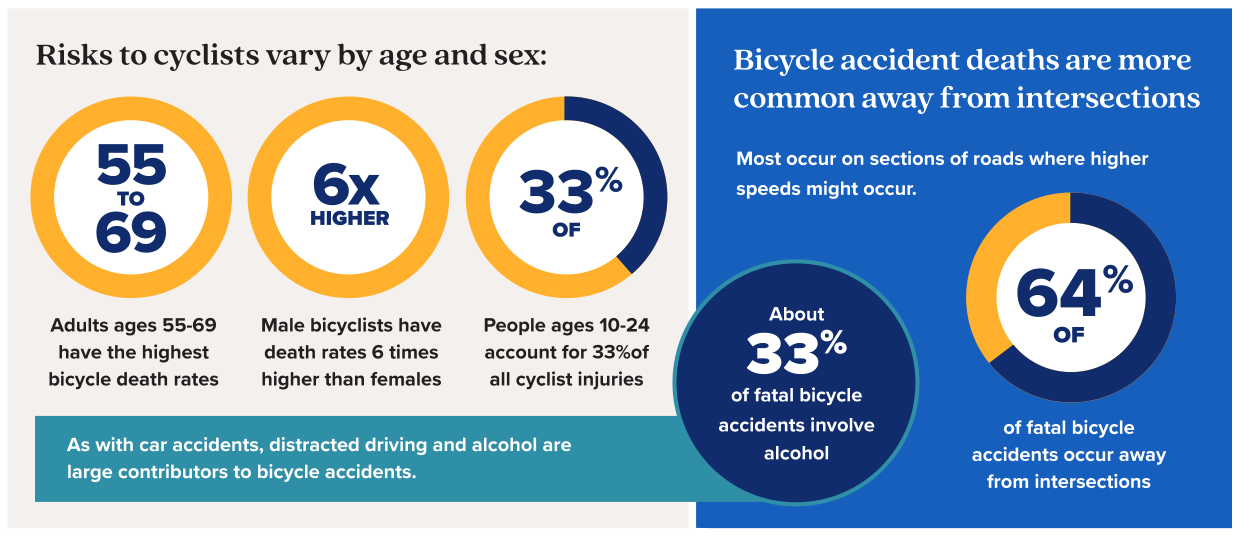
Stat cards, the kind used throughout this page, are the right choice for discrete percentages and single high-impact numbers. A card showing that a state’s statute of limitations for personal injury claims is two years communicates that fact more memorably than a sentence buried in a paragraph. When that card is paired with FAQPage schema or structured data markup, it also becomes a candidate for AI extraction.
Producing Visualizations That Earn Citations from AI and Human Publishers
A data visualization earns citations when it presents original, specific, verifiable information in a format that is easy to reference. Generic charts built from publicly available data without unique analysis rarely attract links. Visualizations built from a firm’s own case data, local accident statistics from government sources, or original research findings are the ones that get cited by journalists, legal educators, and AI systems alike.
The sourcing strategy matters as much as the design. Every data point in a legal visualization should trace back to a verifiable source: a state court system’s published statistics, a federal agency’s injury report, or a government transportation database. When the source is credible and the data is specific to a geography or practice area, the visualization becomes a primary reference rather than a secondary summary of information found elsewhere.
Publishing with structured embed code is a distribution mechanism that is consistently underused by law firms. When a personal injury firm publishes an infographic about truck accident fatality rates in their state, adding an HTML embed snippet below the image gives other publishers a one-click way to feature that content on their own pages, with a dofollow link back to the source. That process turns a single piece of visual content into a recurring link acquisition asset.
Video schema and transcript markup extend the same principle to video content. An attorney explaining the elements of a negligence claim on camera, with a structured transcript published on the same page, gives AI systems two layers of content to index: the visual explanation and the textual record. Visualizations such as graphics in lectures or data visualizations in infographics can facilitate the initial encoding of information into working memory. Video with a transcript captures that encoding effect while also satisfying the text-based indexing requirements of search engines.
Outreach to local media, bar association resource pages, and legal education platforms completes the distribution cycle. A firm that produces a data visualization about pedestrian accident trends in their city and pitches it to the local newspaper’s digital team has created a citation opportunity that no amount of keyword optimization can replicate. That kind of earned reference signals authority to both human readers and AI ranking systems in ways that self-published content alone cannot.
Integrating Data Visualization Into a Personal Injury Content Strategy
Data visualization works best when it is planned at the content strategy level, not added as an afterthought to existing pages. Every practice area page, blog post, and FAQ section should be evaluated for visual opportunities before writing begins. The question to ask is simple: does this information have a shape that a chart, table, or timeline would communicate more clearly than prose?
Practice area pages for personal injury firms are natural homes for process timelines and comparison tables. A page covering car accident claims benefits from a timeline showing the sequence from accident report to settlement. A page covering slip-and-fall liability benefits from a table comparing the legal standards across multiple states where the firm practices. These visuals answer the questions that prospective clients bring to the page, which is the primary goal of any practice area page.
Case results pages gain credibility from data visualizations that aggregate outcomes rather than listing individual verdicts. A chart showing the distribution of settlements by injury category, drawn from the firm’s own published results, tells a more compelling story than a list of dollar amounts. It also gives AI systems a structured dataset to reference when generating answers about what personal injury cases are worth in a given market.
Blog content and seasonal posts benefit from visualizations tied to timely data. A post about summer motorcycle accidents in a specific state, supported by a stat card showing the relevant year’s fatality count from the National Highway Traffic Safety Administration, earns more credibility and more links than a post making the same point without sourced data. The visual anchors the claim to a verifiable fact, which is exactly what both human editors and AI systems look for when deciding whether to cite a source.
Custom Legal Marketing builds visual content strategies for personal injury firms that treat every chart, table, and infographic as a search asset. If your firm’s pages rely on prose alone to communicate complex legal information, you are leaving both reader engagement and citation opportunities on the table. Contact our team to discuss how data visualization can become a core part of your content and SEO program.
FAQs About Data Visualization in Legal Content
What types of data visualizations work best on personal injury law firm websites?
Timelines, comparison tables, stat cards, and infographics are the most effective formats for personal injury content. Timelines communicate the claims process clearly. Tables let readers compare variables like state-specific statutes of limitations or damage caps. Stat cards highlight single high-impact numbers, such as filing deadlines or average case durations. Infographics work best for distributable content designed to earn backlinks from news outlets and legal education sites.
How does data visualization affect a law firm’s rankings in Google and AI search results?
Structured visual content gives search engines and AI systems discrete, extractable data points to index and cite. Pages that present legal information in tables, labeled charts, or structured stat formats are more likely to appear in Google AI Overviews and in citations from large language models like ChatGPT and Claude. When visualization is paired with appropriate schema markup, such as Table or FAQPage structured data, the citation potential increases further because the content becomes machine-readable at a granular level.
Does a law firm need proprietary data to create effective legal visualizations?
Proprietary data produces the strongest citation assets because it cannot be replicated by competitors. However, effective visualizations can also be built from government sources, such as NHTSA accident statistics, state court system data, or CDC injury reports. The key requirement is that every data point traces back to a verifiable, credible source. Visualizations built on vendor-published surveys or unattributed statistics carry less authority with both human publishers and AI systems.
How should a law firm distribute data visualizations to earn backlinks?
Publish the visualization on the firm’s website with an HTML embed code that includes a dofollow attribution link. Then pitch the content to local news outlets, bar association resource pages, and legal education platforms that cover the same topic. Video visualizations should be uploaded to YouTube with a full transcript on the same page, making the content indexable in both video search and text-based AI retrieval. Outreach to journalists covering local accident trends or legal reform issues can turn a single visualization into multiple earned citations.
Can data visualization help a personal injury firm’s content qualify for Google featured snippets?
Yes. Tables and structured stat formats are among the most commonly featured content types in Google’s featured snippet positions. A table comparing personal injury filing deadlines by state, or a numbered list of steps in the claims process, matches the format that Google’s algorithm pulls into position-zero results. Pairing that content with clean HTML structure and relevant schema markup increases the probability that Google will extract and display it above the standard organic results.
More Resources About Video, Audio, and Visual
What Our Clients Are Saying
