









Schema Markup for Personal Injury Websites

LAW FIRM SEO THAT WORKS®
Our Focus: Your Firm
The best law firm marketing comes with a No Competition™ Guarantee.
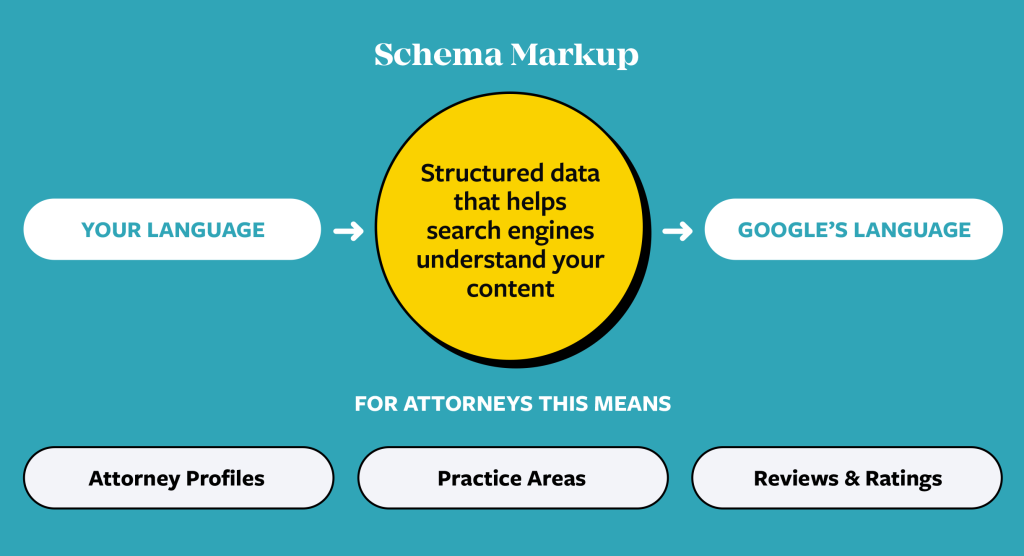
Personal injury marketing is one of the most competitive categories of law firm marketing and SEO. A firm’s website can have strong content and solid backlinks and still lose visibility to competitors who have given search engines and AI systems a clearer picture of who they are, what they handle, and where they practice. Schema markup is how you give machines that picture. Implemented correctly on a personal injury website, it feeds Google’s Knowledge Graph, powers rich results, and increasingly shapes which firms get cited in AI Overviews and answer engines.
Table of Contents
- Why Schema Markup Matters More for Personal Injury Firms Than Most Practice Areas
- The Core Schema Types Every Personal Injury Website Needs
- LegalService Schema Implementation for Personal Injury Practice Areas
- How Schema Connects to AI Visibility and Answer Engine Optimization
- Validating and Maintaining Schema on a Personal Injury Website
- FAQs About Schema Markup for Personal Injury Websites
Why Schema Markup Matters More for Personal Injury Firms Than Most Practice Areas
Personal injury queries are high-intent and hyper-local. Someone searching “car accident lawyer near me” at 9 PM on a phone is ready to call. Google uses structured data to understand the content on the page and show that content in a richer appearance in search results, which is called a rich result. For personal injury firms, those richer appearances, including star ratings, address details, and practice area labels, directly affect whether an injured person calls your firm or the one listed below you.
The stakes extend beyond traditional search. In 2026, structured data has taken on a second critical role beyond traditional SEO: it directly influences whether your content gets cited in Google AI Overviews, featured in ChatGPT browsing results, and surfaced by answer engines. A personal injury firm without clean schema is asking AI systems to guess at its identity, its services, and its geography. That guesswork produces inconsistent citations and missed opportunities.
The adoption gap in this space is real. A systematic analysis of 500 personal injury law firm websites in the United States examined the prevalence of key schema types including LegalService, Attorney, Organization, FAQPage, BreadcrumbList, and WebPage. The findings reveal that 67.6% of sampled firms implement some form of JSON-LD markup, yet only 40.0% deploy the LegalService schema type. That gap represents an opening. Firms that implement schema correctly right now hold a real advantage over the majority of competitors still running generic or incomplete markup.
Effective law firm SEO treats schema as infrastructure, not an afterthought. The firms winning featured snippets, local pack placements, and AI citations have structured data that tells a complete, consistent story across every page type on their site.
The Core Schema Types Every Personal Injury Website Needs
Schema.org defines LegalService as a business that provides legally-oriented services, advice, and representation, such as law firms, and as a LocalBusiness it can be described as a provider of one or more services. That definition makes LegalService the correct starting point for any personal injury firm, and it should be the first schema type deployed before anything else.
LegalService schema lets you declare your practice areas explicitly. Vague entries like “legal services” do not help search engines match your firm to specific queries. Specific entries like “personal injury,” “motor vehicle accidents,” or “premises liability” create precise match opportunities when AI systems answer location-based legal questions. Each practice area you name becomes a potential citation opening.
Person schema belongs on every attorney bio page. Each attorney at your firm should have their own profile page with Person schema markup, which allows you to highlight individual credentials, bar admissions, years of experience, areas of specialization, and professional affiliations. Person schema is especially powerful when paired with Article schema on blog posts, because it creates a direct connection between the author’s credentials and the content they’ve written. This supports Google’s E-E-A-T signals, which are critically important for legal content.
FAQPage schema deserves a place on practice area pages and blog posts that answer common questions. FAQPage schema is structured data that helps search systems understand a law firm website’s frequently asked questions and answers. Google discontinued FAQPage rich results for most sites, but the schema still communicates structured question-and-answer content to AI systems and knowledge graphs, which is increasingly where personal injury clients start their search.
BreadcrumbList schema rounds out the core set. BreadcrumbList schema helps AI systems understand content hierarchy and topical authority structure. For a personal injury firm with practice area pages nested under a main services section, breadcrumb schema communicates that site architecture directly to search engines and AI crawlers.
Proper schema for lawyers goes beyond dropping a single JSON-LD block on the homepage. Each page type on your site, from practice area pages to attorney bios to blog posts, calls for a different combination of schema types working together.
LegalService Schema Implementation for Personal Injury Practice Areas
Your homepage should include both Organization schema and LegalService schema. The Organization schema establishes your firm’s identity, logo, social profiles, and founding details. The LegalService schema specifies your practice areas, office location, contact information, and service areas. Together, these give search engines a complete picture of who you are, where you’re located, and what services you provide.
The areaServed property is particularly important for personal injury firms. A firm serving multiple counties should list each one explicitly. Geographic service area fields tell AI tools exactly where your firm operates, and without that specificity, AI tools default to the narrowest interpretation of your reach. A firm in a major metro that serves surrounding counties but omits them from schema will miss location-based queries from those areas entirely.
Each major practice area, car accidents, slip and fall, medical malpractice, wrongful death, deserves its own LegalService entry connected to the firm’s Organization schema via the hasOfferCatalog or makesOffer property. The 40.0% adoption rate for LegalService schema suggests that the vast majority of PI law firms are missing an opportunity to explicitly declare their practice areas, jurisdictions, and service attributes in a machine-readable format.
Entity disambiguation is the piece most firms skip entirely. The @id property assigns a unique, persistent identifier to your firm as an entity. The sameAs property links that entity to your Google Business Profile, your state bar listing, your LinkedIn page, and other authoritative profiles. Entity disambiguation through @id and sameAs properties should be treated as a priority, particularly as AI-driven search systems increasingly depend on entity resolution.
JSON-LD is the format to use. JSON-LD is a script that sits in the header of your web page and provides structured data without interfering with your visible page content or HTML structure. It is cleaner, easier to maintain, and less prone to errors than other formats.
How Schema Connects to AI Visibility and Answer Engine Optimization
Search behavior among personal injury clients has shifted. AI Overviews, ChatGPT, Perplexity, and voice assistants now answer questions that used to send people directly to a firm’s website. The firms that appear in those AI-generated answers are the ones whose structured data gave AI systems enough context to cite them confidently.
AI-driven search features, such as Google’s AI Overviews, rely on multiple signals including high-quality content, relevance, and authority to generate summaries and answers. While structured data is not the sole driver, schema markup provides clarity that helps search engines interpret your content more accurately. Implementing the LegalService schema reinforces signals about practice areas and location, supporting discoverability for queries like “personal injury lawyer near me” within AI-enhanced search environments.
Brands with clean, comprehensive schema markup are measurably more likely to appear in AI-generated answers than those without it. For a personal injury firm, that means the connection between your LegalService schema, your attorney Person schema, and your Article schema on blog posts creates a chain of machine-readable authority that AI systems can follow.
A firm that pairs strong schema with a deliberate Answer Engine Optimization strategy is positioned to appear not just in traditional search results but in the AI-generated answers that are increasingly the first thing an injured person sees. The structured data layer is what makes that content attributable to your firm specifically, rather than a generic answer pulled from an unnamed source.
The connection between schema and Answer Engine Optimization is direct. When your FAQ content is wrapped in FAQPage schema and your attorney credentials are marked up with Person schema, AI systems have a clear, citable source. Without that structure, even excellent content can be absorbed into an AI answer without attribution.
Validating and Maintaining Schema on a Personal Injury Website
Schema errors are common and often invisible until they cost you rich results. Check your structured data using the Rich Results Test during development, and the Rich result status reports after deployment, to monitor the validity of your pages, which might break after deployment due to templating or serving issues. A personal injury firm that deploys schema once and never revisits it will accumulate errors as pages are updated, attorneys join or leave, and Google’s requirements evolve.
It is more important to supply fewer but complete and accurate recommended properties rather than trying to provide every possible recommended property with less complete, badly-formed, or inaccurate data. A LegalService block with accurate NAP data, a correct @id, and properly listed practice areas outperforms a bloated schema block full of missing or mismatched fields.
Google’s structured data policies include a firm rule: do not mark up content that is not visible to readers of the page. For example, if the JSON-LD markup describes a performer, the HTML body must describe that same performer. For personal injury firms, this means your schema must match what appears on the page. Attorney credentials listed in schema must appear in the attorney’s visible bio. Practice areas declared in LegalService schema must exist as actual pages or visible content on the site.
The mean Schema Completeness Index score across sites with structured data was 11.8 out of 25, indicating predominantly superficial implementations. Most personal injury firms that have schema are running it at less than half its potential. A full audit, covering homepage schema, practice area page schema, attorney bio schema, and blog post schema, typically reveals gaps that are straightforward to fix once identified.
Effective law firm marketing integrates schema maintenance into the same workflow as content updates. When a new attorney joins, their Person schema goes live the same day as their bio page. When a new practice area page is published, LegalService schema is added before the page is indexed. That discipline is what separates firms with clean, citation-ready structured data from the majority running outdated or incomplete markup.
FAQs About Schema Markup for Personal Injury Websites
What is the most important schema type for a personal injury law firm website?
LegalService schema is the highest-priority type for any personal injury firm. It is the schema.org type specifically built for legal service providers and lets you declare your practice areas, geographic service area, contact information, and business hours in a format search engines and AI systems read directly. It should be implemented on your homepage before any other schema type is added.
Does schema markup directly improve Google rankings for personal injury keywords?
Schema does not function as a direct ranking signal. Google has confirmed that structured data eligibility for rich results does not affect how a page ranks in web search. What schema does is make your pages eligible for rich results, which increase click-through rates, and it provides the machine-readable context that AI systems use when generating answers. A higher click-through rate from a rich result does feed back into how Google perceives user engagement with your listing.
Should each personal injury practice area page have its own schema?
Yes. Each practice area page, whether it covers car accidents, slip and fall injuries, or medical malpractice, benefits from its own LegalService schema entry that specifies the service type, the geographic area served, and a link back to the firm’s Organization schema. Generic schema applied site-wide does not communicate the same specificity as page-level schema tied to a particular service. AI systems matching queries to sources favor the more specific, page-level declaration.
Is FAQPage schema still worth implementing on a personal injury website?
Yes, even though Google discontinued FAQPage rich results for most websites. The schema still communicates structured question-and-answer content to AI systems, knowledge graphs, and answer engines that increasingly serve as the first point of contact for injured people researching their options. FAQPage schema on practice area pages and blog posts gives AI systems citable, attributed answers they can surface in response to common personal injury questions.
How often should a personal injury firm audit its schema markup?
At minimum, a full schema audit should happen whenever a significant site change occurs: a new attorney joins, a practice area page is added or removed, or office information changes. Beyond event-driven audits, a quarterly review using Google’s Rich Results Test and the Search Console Enhancement reports catches errors introduced by site updates, plugin changes, or shifts in Google’s structured data requirements. Schema that was valid six months ago can develop errors without any intentional change to the markup itself.
More Resources About Personal Injury SEO
What Our Clients Are Saying
