









Knowledge is Law Firm Marketing Power

Real research to help law firms stop wasting money on bullsh*t and start investing in real legal marketing.

Are you ready to stop wasting time and money chasing vanity metrics?



"Vanity metrics are a waste of time and a distraction from effective law firm marketing. The reason we run smarter marketing plans is because we rely on millions of data points generated by CLM Sequoia - our AI law firm marketing platform. That means, we're constantly testing "common wisdom" by running hundreds of thousands of searches and prompts and processing in-depth analysis on empirical data. Most of that data becomes part of CLM Sequoia's brain, giving the law firms that trust us yet another competitive advantage. But sometimes, we run a report that is just too good to keep to ourselves. It is my sincere hope that the knowledge we share in these reports helps you and your marketing team ignore the distractions and focus on what matters... getting more clients!"
- Jason Bland / Custom Legal Marketing Co-Founder
This is the most comprehensive study of law firm URL structures ever published. We break down keyword-in-path rates, homepage vs. inner page performance, ideal URL length and depth, technical standards like hyphens and trailing slashes, and the exact URL patterns that are over-represented at the top of Google's results.
Every finding is segmented by practice area and ranking position, with specific recommendations for personal injury, criminal defense, family law, estate planning, business law, workers' compensation, medical malpractice, and employment law. If your firm's site architecture was built without a plan, this is the data to rebuild it on evidence.


Before your law firm starts thinking about using AI to produce content at scale, you should see how Google is ranking AI-generated content in real legal searches.
Custom Legal Marketing deployed our proprietary CLM Sequoia platform to analyze 2,435 law firm rankings across 8 practice areas, 28 keywords, and 24 major U.S. cities. Then, we turned to Winston AI to measure AI-generated content on every page, we found a distribution that surprised us, a correlation that challenged conventional wisdom, and a hidden cost that most firms are not accounting for.
Every law firm SEO expert has developed their own theories on word count and rankings. Plenty of opinions exist on this. Real data is harder to find. So we ran the numbers.
CLM Sequoia analyzed 2,418 ranking law firm URLs across 8 practice areas and the 24 most populated U.S. metro areas, measuring the actual relationship between word count and Google ranking position across nearly 3 million words of competitor content. The patterns vary sharply once you slice the data by practice area, by metro, and by where a page sits in the SERP. Some of what we found confirmed what we expected. Most of it did not.
Domain Authority is one of the most cited metrics in SEO, and one of the most common talking points in cold emails to law firms. But does it actually predict where your website ranks? Custom Legal Marketing's CLM Sequoia platform analyzed 12,794 search results across 32 keywords, 8 practice areas, and the 50 most populous U.S. cities to find out.
The results challenge one of the legal marketing industry's most persistent assumptions. We tested DA as a ranking predictor from every angle: position-by-position averages, quartile analysis, practice area breakdowns, pairwise head-to-head comparisons, and even a side-by-side comparison of how Moz and Ahrefs score the same 1,360 legal websites. What we found has significant implications for how law firms evaluate their SEO investments, choose their agencies, and measure success.
Every "seo expert" says the same thing: faster websites rank higher in Google. We decided to test it to see if it really mattered for law firms. CLM Sequoia analyzed 1,750 real Google search results across 50 U.S. cities and 11 high-value personal injury keywords — the largest study of its kind in legal marketing. What we found challenges one of the industry's most deeply held assumptions, and the data isn't even close to ambiguous.
The findings have direct implications for how law firms should be allocating their marketing budgets and where the real ROI from site performance actually lives. If you're spending money on SEO, you owe it to yourself to read this before your next strategy conversation. The answer isn't what you've been told.

Most law firms still publish a "Testimonials" page in their main navigation. The word made sense once, back when it lived in print brochures and Yellow Pages ads.
The problem is nobody searches for testimonials anymore. When clients want to know whether your firm is any good, they search the word "reviews." Yet the legal industry has held onto the older language at scale, and the gap shows up in everything from menu labels to the URLs Google indexes. This is what happens when industry vocabulary stops matching consumer vocabulary, and the fix is more involved than swapping a menu label.
The legal industry has its own domain extensions, and the registrars behind .law, .legal, and .lawyer have spent a decade telling firms that a domain describing exactly what you do is a smarter choice than a crowded .com. We put that pitch to the test at a scale nobody has attempted before, analyzing 47,271 law firm ranking appearances across 9,216 competitive searches in 288 U.S. cities to find out what these extensions actually do in Google's results.
The study measures how many ranking firms have made the switch, which practice areas are adopting fastest, and what happened in 555 search results where a legal TLD firm and .com firms fought for the same positions in the same city. It also uncovers the one advantage of these extensions that shows up unmistakably in the data, and it is one the registrars rarely lead with. If your firm has ever debated a domain change, or dismissed one, this is the evidence to weigh first.

Your law firm's homepage gets the redesign budget, the partner debates, and the assumption that when someone searches for a lawyer in your city, it's the page Google will show. We put that assumption to the test.
Using CLM Sequoia, we analyzed 47,271 law firm rankings across 9,216 competitive searches in 288 U.S. cities to find out which pages actually hold Google's top positions, including the one page type that quietly outperforms everything else. The results reveal a sharp divide by practice area, a keyword pattern most firms have never considered, and a finding that should change how you budget your next website project
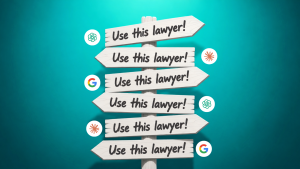
We asked all three the same 3,200 questions across 100 U.S. metros and 32 practice areas, then recorded every site each one cited. Between them they recommended 19,692 different law firms. Only 578 were recommended by all three, and when we looked at just the first firm named in each answer, all three agreed 0.9 percent of the time.
Law Firm SEO That Works is where we show attorneys what their competitors wish they knew.
AI OPTIMIZATION
LINK BUILDING
CONTENT CREATION
LOCAL SEO
TECHNICAL SEO
It all starts with a conversation.
Let's get growing with you law firm's brand.

Schedule your free phone call:
What Our Clients Are Saying
