






with Visual Media
Getting high-quality dofollow backlinks now often depends on your ability to create content that publishers, journalists, and even AI-powered search engines want to reference, cite, and share.
Get high-quality dofollow backlinks with visual media.
A Law Firm Guide to Earning Real Dofollow Links

LINK BUILDING
Visual media, such as infographics, eBooks, videos, and downloadable guides, have become powerful tools for ranking on Google, as well as for securing visibility in AI-driven answer engines. Below, you'll find actionable strategies and detailed instructions tailored for law firms that want to use visual media to build authority, attract attention, and earn credible links that move the needle for legal marketing.
Why Visual Media Earns Backlinks
Traditional link building for law firms once relied on outreach emails, guest posting, and directories. While those tactics still matter, visual content has risen as a key asset for two reasons: publishers want ready-to-use resources, and AI engines now extract and cite information from tightly formatted visuals.
For law firm marketing, this means infographics, downloadable charts, data visualizations, and educational videos are useful because local news outlets, legal education blogs, and industry publications might pick them up. Additionally, AI bots crawl multimedia and increasingly feature images, video explainers, and embeddable guides within their answers. This visibility is not just for Google’s bots. ChatGPT, Perplexity, and Claude all utilize multimodal sources, so visuals that combine authority with practical information have a higher chance of being cited and linked.
Infographics: Creating, Distributing, and Earning Dofollow Links
Infographics are the perfect tool for distilling complicated information into easy-to-understand visual references. To get your infographics noticed, have a plan from topic generation to distribution.
Step 1: Choose a Topic with Syndication Potential
The first step in creating useful infographics is to choose a topic with syndication potential. Look for legal topics that combine education, newsworthiness, and a “shareable” format. Good examples for law firms include:
- “The Personal Injury Claim Timeline in [State]”
- “Common Defenses in DUI Cases: 2024 Edition”
- “Estate Planning Process Explained: Step-By-Step”
- “2024 Statistics: Divorce Trends in [Local County/State]”
Step 2: Design for Embedding and Syndication
Compress and optimize your infographic for faster loading. Include your law firm’s logo, web address, and phone number. Provide clear, direct answers to questions commonly found in People Also Ask boxes and AI query results.

Step 3: Publish with an Embed Code
On your law firm’s website, post the infographic with a custom embed code underneath. This code should include an HTML snippet that links back to the original source page with a dofollow tag. Add a short paragraph about the infographic’s purpose, author, and any supporting data sources, which helps with E-E-A-T for AI bots.
Step 4: Outreach and Distribution
Target three main audiences:
- Local journalists and news editors (pitch as a reference for local legal trends)
- Legal education blogs and .edu resources (offer as a student or public resource)
- Industry publications (highlight unique statistics or insights)
Use personalized emails and never bulk send. Offer the infographic as a free resource that they can embed. Politely request attribution with a dofollow link using your embed code.
Pro Tip: Track mentions with Google Alerts and reach out if your infographic is published without a link. Most publishers will add your dofollow link if you ask.
eBooks and Downloadable Legal Guides: Linkable Assets People Want to Reference
Legal eBooks offer more depth than an infographic and tend to attract links from law school blogs, government pages, and AI-driven answer engines due to their authority.
How to Build a Linkable eBook for Your Law Firm:
- Pick a niche but broad topic, e.g., “2024 Practical Guide to Workers’ Comp in [State],” not just “Workers’ Comp.”
- Collaborate with attorneys in your firm for input, and co-author with a subject matter expert if possible.
- Use clear, actionable chapters: eligibility, process, timelines, what to expect, FAQs, common pitfalls.
- Include real-life case examples (anonymized), charts, checklists, and sample forms.
- Design an attractive PDF with your law firm’s branding, author headshots/bios, and links to relevant pages on your site.
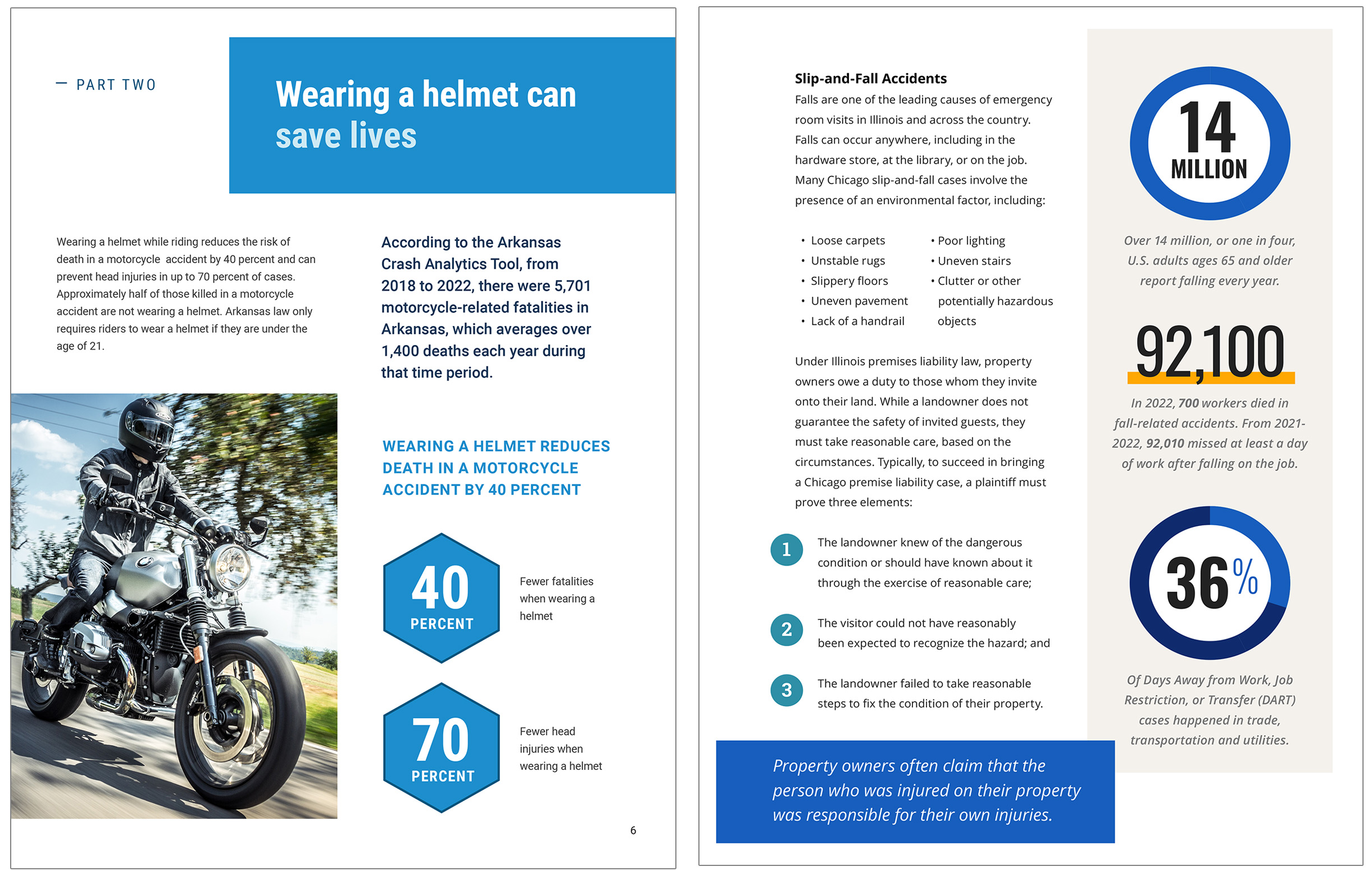
Examples of pages from two different law firm ebooks.
Distribution and Link Building:
- Create a dedicated landing page featuring the eBook description, a preview section, and a download form (requiring an email address).
- Share the eBook on LinkedIn, local Bar Association groups, and in legal newsletters.
- Offer the eBook to educational organizations and local government offices as a public resource. These pages often provide dofollow citations for downloadable materials.
- Submit to relevant eBook directories and legal content roundups.
AI-First Optimization: Use structured data and provide a chapter-by-chapter table of contents both on the landing page and in the file, making it easier for AI models to extract, cite, and link to your resource.
Educational Videos and Webinars: Earning Links and AI Mentions with Multimedia
Video content is cited more frequently in AI Overviews and featured snippets, especially for legal topics that benefit from visual explanations.
How Law Firms Can Use Video for Link Building:
- Record short explainer videos on common legal questions (e.g., “What should I do after a car accident in [City]?”).
- Host live webinars or Q&A sessions with attorneys on trending topics (“Employment Law Changes: What Employers Need to Know”).
- Include clear branding, lawyer credentials, and verbally state your law firm’s name and URL in each video.
- Upload to YouTube (which Google and AI engines deeply index), then embed the video on your website with a transcript and summary.
Distributing for Links:
- Pitch local news outlets and Bar Associations to feature your video on their resource pages.
- Offer to answer community questions on Reddit, Quora, or local forums, and link to your video as an in-depth resource.
- Encourage partners and clients to share or reference your videos in their content.
- Submit to legal resource libraries and educational video platforms that welcome expert contributions.
Maximizing AI Visibility: Use video schema markup, add timestamps for each subtopic, and provide a detailed, well-structured transcript on the page. AI and LLMs pull directly from transcripts for answers and citations, often linking back to the source page.
Building Authority and Getting Cited by AI Engines
Traditional backlinks are only half the battle. Today, legal marketing must also focus on “entity presence”—being named, cited, and referenced as a trustworthy source by AI bots and knowledge engines.
Strategies to Legitimize Your Visual Media for AI and Human Link Builders:
Visual media isn’t just a creative add-on for law firm SEO and legal marketing—it’s an engine for authentic, highly-cited backlinks and emerging AI visibility. By strategically creating, optimizing, and promoting infographics, eBooks, and videos, your law firm will attract more dofollow links from reputable sources and position itself as the expert that both humans and machines trust for legal answers.

CLM is singularly focused on my firm's success and frequently over-delivers. I don’t think that you could make a better choice.
- Paul Greenberg, Briskman Briskman & Greenberg
We have been using CLM for our websites for a number of years and they have been outstanding! Their entire team has always been highly responsive and met all of our marketing needs.
-Todd J. Leonard, Todd J. Leonard Law
