








for Law Firms
Most attorney marketers are familiar with the importance of backlinks, practice area keywords, and Google Business Profiles. But one of the most overlooked and underutilized SEO tactics is also one of the most powerful: internal link building.
Internal links boost Google rankings and help AI tools find your firm.
How to Boost SEO and AI Visibility


INTERNAL LINK BUILDING
What Is Internal Link Building?
Internal links are hyperlinks that connect one page on your website to another page on the same domain. For example, linking from your “Car Accidents” practice area page to a blog post titled “What to Do After a Rear-End Collision in Chicago.”
These links do several things:
Done right, internal link building turns your law firm’s website into a web of connected knowledge—just like Wikipedia.
Wikipedia: The Gold Standard of Internal Linking
If you’ve ever visited a Wikipedia article, you’ve seen internal linking at its finest. Nearly every paragraph includes links to related articles on Wikipedia.org. This strategy does two things incredibly well:
1. Guides users to more information on related topics
2. Helps search engines and AI understand context and relationships between topics
We’ve adopted the same strategy and built AI powered tools to help our SEO team perfect the art of internal link building. And it works.
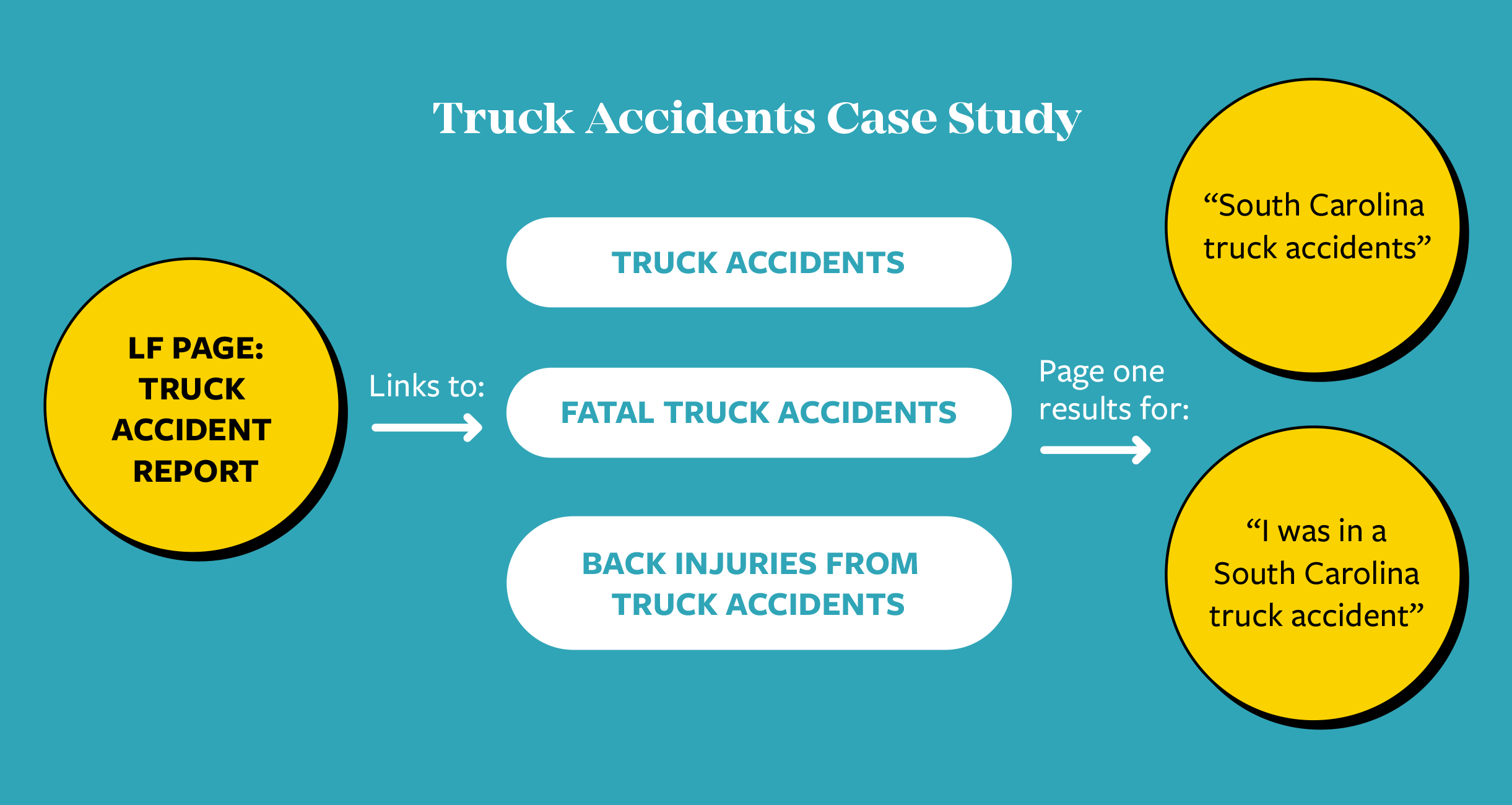
Case Study: Steinberg Law Firm’s Truck Accident Report
When we built Steinberg Law Firm’s Truck Accident Statistics page, we didn’t stop at just hitting "publish." We went one step further and internally linked to that page from:
- Their Truck Accidents practice area page
- A page about Fatal Truck Accidents
- An article on Back Injuries from Truck Accidents

In just one week, the new page landed on page one of Google for key terms like:
- “South Carolina truck accidents”
- “I was in a South Carolina truck accident”
This success wasn’t just about good content—it was about internal linking.
How Internal Linking Helps with Google SEO
1. It Distributes Page Authority
Every page on your site earns its own "page authority" based on backlinks, time on page, engagement, etc. Internal links share that authority with other pages—especially new ones. This means your well-performing Car Accidents page can give a boost to a new article about whiplash injuries.
2. It Improves Crawlability and Indexation
Google uses internal links to discover and prioritize which pages to crawl. If a page isn't linked to from anywhere, it might not get crawled—or indexed—at all. Internal links help ensure every page is discoverable and indexed quickly.

3. It Enhances Relevance Through Context
When Google sees anchor text like “rear-end accident injuries” pointing to a blog post about soft tissue damage, it gains more clarity on the topic and intent of that destination page. This helps your content rank for more specific queries.
4. It Decreases Bounce Rate and Increases Time on Site
Well-placed links guide users to explore more content, increasing session duration and reducing bounce rates—both signals that Google rewards with higher rankings.
Why Internal Linking Is Crucial for ChatGPT, Perplexity, and Claude
Google isn’t the only entity crawling your site. AI models are being trained and tuned on vast amounts of public content—including your law firm website. These models use structured internal linking to:

Best Practices for Internal Link Building on Law Firm Websites
So, you're convinced of the necessity of internal link building. Where should you start?
1. Link from High-Authority Pages to New Content
Got an established Personal Injury page that ranks well? Use it to link to a new blog post about slip and fall injuries. Pass some of that authority down the chain.
2. Use Descriptive Anchor Text
Avoid generic phrases like “click here.” Instead, use anchor text that describes the destination page. This helps both Google and AI understand the connection between topics.
Good: “common causes of rear-end accidents”
Bad: “learn more”
3. Update Older Content with Links to New Pages
Internal linking isn’t a one-time task. Revisit older blogs and practice area pages to add new links to recently published content. Every time you publish, ask: “Where else can I link to this from?”
4. Use a Wikipedia-Like Linking Strategy
Link terms in your copy as naturally as possible—just like Wikipedia. If you mention a legal concept (e.g., “comparative negligence”), link it to your explainer post on that topic.
Remember, don't overdo it! Avoid stuffing 10 links into a single paragraph. Stick to 2–4 high-quality internal links per piece of content, naturally woven into the copy.
Where to Internally Link from on a Law Firm Website
As a general rule, link from top-level and highly visited pages. Examples include:
- Practice Area Pages (your highest-authority content)
- Blog Posts (especially older evergreen posts)
- Resource Guides (FAQs, checklists, legal explainers)
- Attorney Bios (link to cases they’ve worked on)
- Case Results Pages (link to related legal services)
Internal link building should be a part of your entire content strategy by creating an internal web of context and authority. And as AI becomes the new front door to the internet, internal linking helps tools like ChatGPT and Perplexity to understand, trust, and share your content.
Just like Wikipedia turned its massive database into the most-cited source on the web using internal links, your law firm can do the same in the legal space.
Treat every piece of content as part of an interconnected system—not a standalone page. Because in search and AI discovery, connected content wins.

CLM is singularly focused on my firm's success and frequently over-delivers. I don’t think that you could make a better choice.
- Paul Greenberg, Briskman Briskman & Greenberg
We have been using CLM for our websites for a number of years and they have been outstanding! Their entire team has always been highly responsive and met all of our marketing needs.
-Todd J. Leonard, Todd J. Leonard Law
