











SEO
Your Google Business Profile is a launchpad for legal marketing and online credibility across every modern search experience. Optimize for Google Business, excel at law firm SEO, and ensure your practice stands out in all major search engines and answer platforms.
The real question is, what can lawyers do to optimize their profiles?
Google Business SEO for Lawyers: Winning Local Search


GOOGLE BUSINESS SEO
Google Business Profile Optimization: Beyond the Basics for Law Firms
Google Business Profile (GBP, formerly Google My Business) is the backbone of local law firm marketing. Law firms can leverage their Google Business Profiles by utilizing the platform's comprehensive suite of tools to accurately describe their practice.
Optimization begins by nailing the basics. Make sure your firm's Name, Address, and Phone number (NAP) match exactly across your website, GBP, legal directories, and citations. Consistency signals trust to both Google and other AI engines. Enter accurate hours and keep them current, including updates for holidays.
Detail your practice by using legal categories & services. Don’t just select “Law Firm.” Specify every relevant category and add all services you offer. This level of detail helps both traditional and AI-driven search engines match your firm with user queries. Additionally, use the “Products” and “Services” sections to list specific legal offerings. This provides rich, structured data, boosting your law firm SEO.
Write your “About” section with both humans and algorithms in mind. Start with a direct, value-driven summary and follow with details about your expertise, credentials, and client success. List your attorneys’ credentials, bar admissions, and include links to attorney bios. Trust signals matter for both humans and search bots.
Legal Reviews & Reputation: Building Trust Across Every Platform
Trust is everything in law firm marketing. Google reviews are the primary currency for local visibility, but that trust footprint extends much further. AI-driven answer engines now factor in reputation signals from across the web, including legal review sites and social proof. Do not wait passively to receive reviews. Interact with clients ethically to encourage them.
After each successful matter, invite clients to leave a review and provide specific suggestions. Never incentivize reviews, and always follow state bar marketing ethics.
Reply to every review, whether positive or negative. A thoughtful, professional response demonstrates your commitment to service and resonates with both search engines and prospective clients.
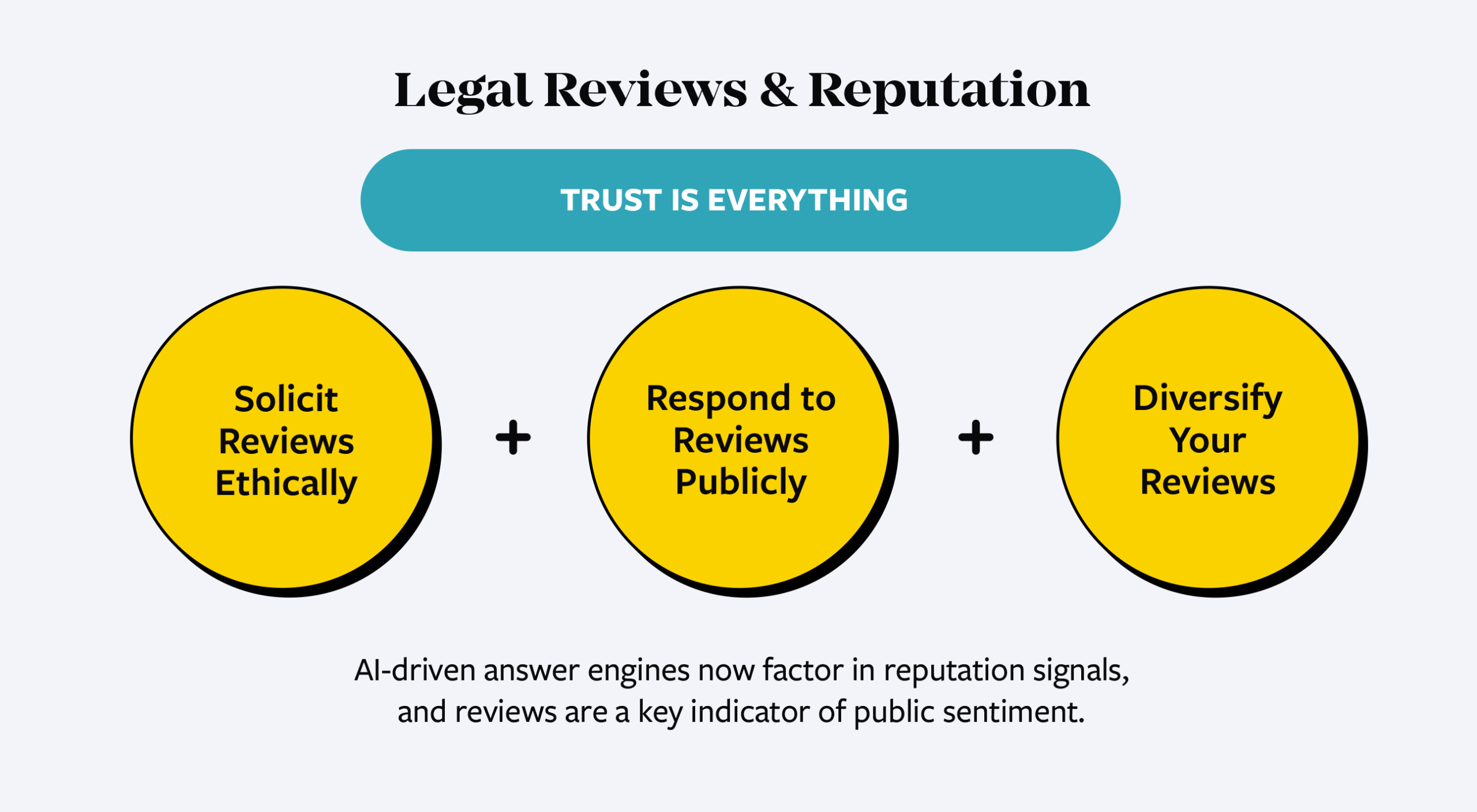
Diversify your review platforms by encouraging clients to leave reviews not only on Google, but also on Avvo, FindLaw, and your law firm’s Facebook page. Aggregating positive feedback across platforms helps you dominate the entity space where AI bots look for reputation data.
And of course, showcase reviews, with permission, on your website: Use review schema markup and testimonial carousels to display client quotes directly on your law firm’s site. This not only aids in ranking within Google but also signals trustworthiness to ChatGPT, Perplexity, and other LLM-powered interfaces.
AI-Ready Advice: Many answer engines summarize public sentiment from reviews. Ensure your firm’s voice in these reviews reflects your brand values and areas of excellence.
Local SEO Signals that Work for Google and AI Overviews
Traditional local SEO strategies are still powerful, but new AI-powered search experiences are raising the bar. AI overviews, featured snippets, and People Also Ask results rely on concise, entity-rich, and intent-matching content.
Fortunately, your law firm can adapt by simply doing what you are good at: answering questions, solving problems, and providing great service. All you marketing agency has to do is translate your successes into language future clients and algorithms understand.
One key way you firm can translate its successes to bots is to implement LocalBusiness, LegalService, and Attorney schema on your website. This helps all search engines, including AI, understand your credentials, practice focus, and location. Schema markup increases your chance of being cited in AI-generated summaries and answer boxes.

On your website, build FAQ sections that address actual, nuanced client questions. You should not have to look far to come up with questions to answer. Pull from your own experience and intake process and choose the most commonly heard concerns to address. Use clear, direct answers as these are more likely to be featured in AI overviews and answer snippets.
Additionally, go deeper with your practice area content. Develop content clusters around specific practice areas, like DUI Defense, Trucking Accidents, or Estate Planning for Seniors, of course, depending on your firm. Each cluster should include a primary pillar page and interlinked subpages answering related queries. This approach signals topical authority to both Google and AI models.

Pro Law Firm SEO Move: Monitor new AI-driven search experiences and update your content to answer trending queries in your field. Keep your FAQs and service pages current with the exact language clients are typing and asking.
Leveraging Content & Authority for Next-Gen Search Engines
Google isn’t the only game in town anymore. Large Language Models (LLMs) powering ChatGPT, Claude, and Perplexity are quickly becoming key discovery tools for legal consumers.
- Publish Thought Leadership: Regularly post articles, guides, or videos addressing legal news, frequently changing statutes, or major case results in your area. Link to credible sources and cite statutes or court opinions. AI engines love verifiable, referenced content.
- Be Transparent: Clearly disclose if any content is AI-assisted and always have a lawyer review for accuracy and relevance. Transparency is a trust factor for users, Google, and LLMs alike.
- Get Mentioned: Reach out to local news, bar associations, and legal organizations for interviews, guest posts, or panel participation. Being cited by third parties increases your chances of being summarized or referenced by AI chatbots and Google AI Overviews.
Authority Tip: Google and AI platforms now look for both direct and indirect evidence of expertise. The more your law firm is referenced as a source, even without a backlink, the stronger your legal marketing position

CLM is singularly focused on my firm's success and frequently over-delivers. I don’t think that you could make a better choice.
- Paul Greenberg, Briskman Briskman & Greenberg
We have been using CLM for our websites for a number of years and they have been outstanding! Their entire team has always been highly responsive and met all of our marketing needs.
-Todd J. Leonard, Todd J. Leonard Law
