










“Near Me” Is Not the Keyword Your Law Firm Thinks It Is
Jason Bland | August 13, 2026
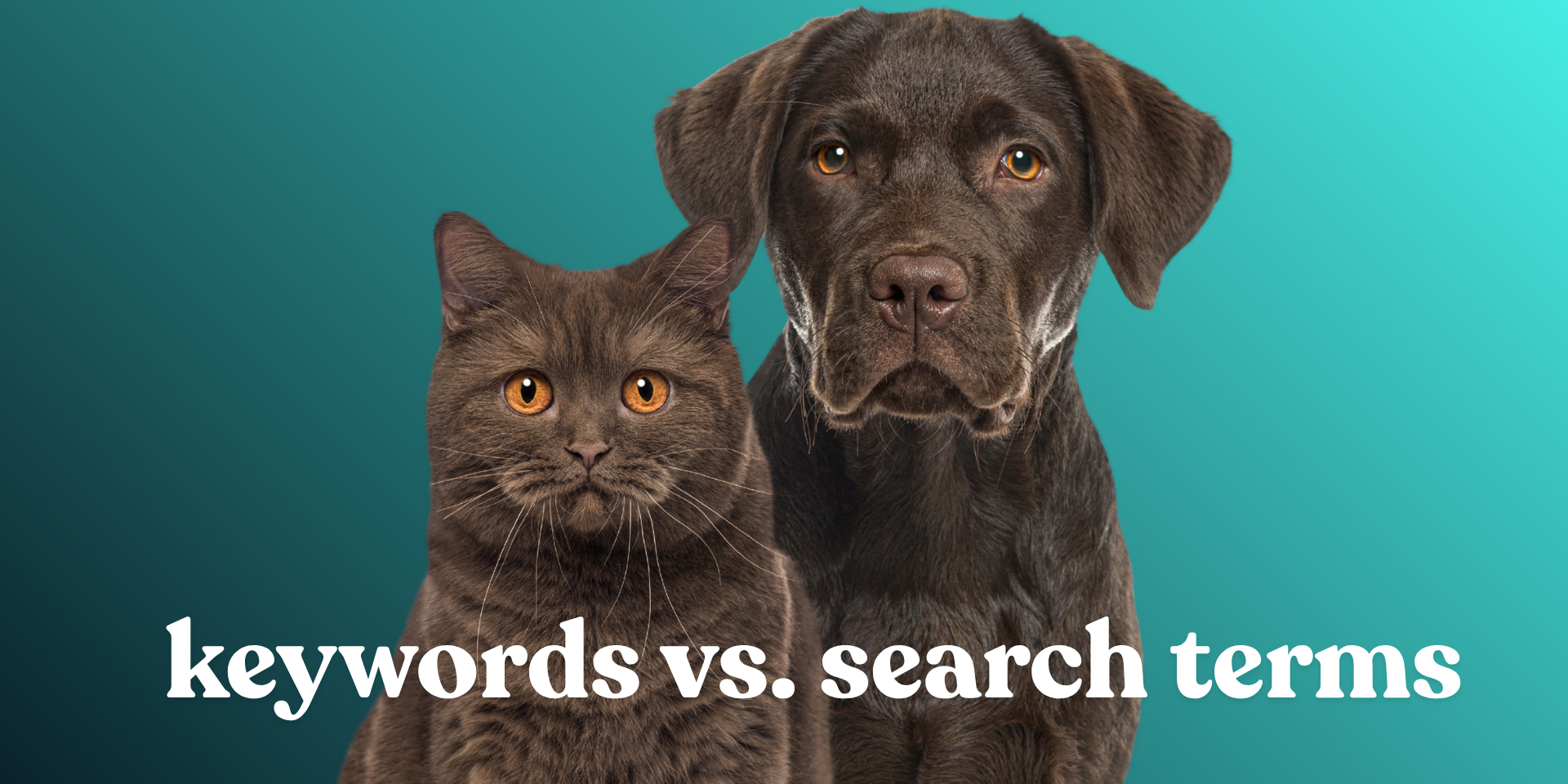
While your firm’s pay-per-click campaign doesn’t do anything to help or hurt your law firm’s SEO efforts, it does provide some valuable data on what keywords people are actually using vs the keywords you think are the most important.
Table of Contents
We looked at search terms, not keywords
We analyzed thousands of search terms across multiple practice areas in many different corners of the country to find out which searches actually lead to cases. Two years of Google Ads data, pulled from firms working in medical malpractice, workers’ compensation, personal injury, estate planning, elder law, criminal defense, family law, consumer protection, and every practice area in between.
The important distinction is that this is search terms data, not keyword data. Keywords are what their law firm marketing company decided to bid on. Search terms are the actual strings of text human beings typed into Google before they clicked. The difference is “car accident lawyer” (the keyword) vs “I think I need a lawyer for my car accident” (the actual search term.)
The word “lawyer” is quietly doing a lot of work
Search terms containing the word “lawyer” convert meaningfully better than search terms containing the word “attorney.” Same practice areas, same firms, same time period.
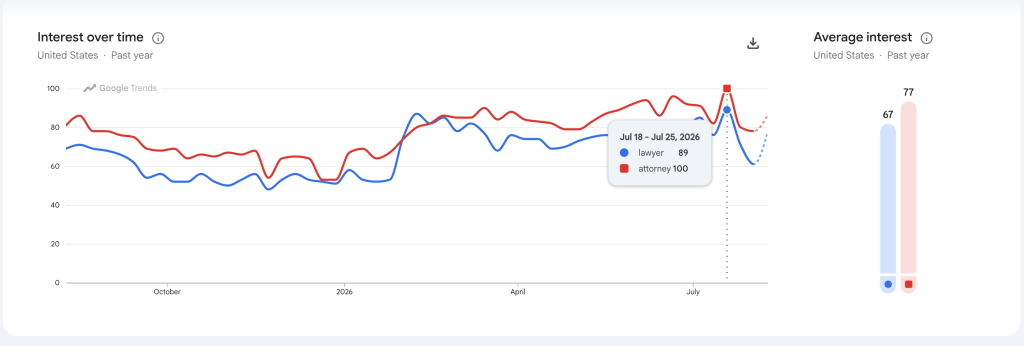
Even though “attorney” is more popular than “lawyer” it’s ultimately “lawyer” that makes the phone ring. Split across practice areas, “lawyer” came out ahead in nearly all of them. Split across individual firm accounts, it came out ahead in most. The one consistent exception was estate planning, where “attorney” performed better, which fits with something we will get to about how estate planning and elder law searches behave differently from everything else.
But if you have been treating “lawyer” and “attorney” as interchangeable variants to pad out a keyword list, they are not behaving that way in the data.
Having a problem is not the same as needing a lawyer
Let your organic SEO answer questions about general topics. It’s not worth the PPC spend if the user is not looking for a lawyer.
Search terms that name a practitioner convert substantially better than search terms that only name the legal problem. “Medical malpractice lawyer” outperforms “medical malpractice.” “Workers comp attorney” outperforms “workers compensation.” “Special needs trust lawyer” outperforms “special needs trust.”
Someone typing “medical malpractice” is trying to understand a situation. They might be a nursing student. They might be a person who had a bad hospital experience and is trying to figure out whether what happened to them has a name. They might be a paralegal. Someone typing “medical malpractice lawyer” has already completed that reasoning and moved on to the next question, which is who they should call. The word “lawyer” is a marker that a decision has already happened.
Those problem-only queries are frequently the ones with the best search volume and the most attractive cost per click. Like every baragain, you should approach it with skepticism. They are cheaper because a large share of the people typing them are not hiring anyone.
“Near me” is not the local intent signal it appears to be
Every firm I talk to wants “near me” traffic. It feels like the most local, most ready-to-hire phrasing available. It shows up in every keyword research tool.
In our data, searches that name an actual place outperformed “near me” searches by a wide margin. “Michigan malpractice lawyers” and “personal injury lawyer Charleston” performed better than the near-me equivalents. Naming a place also edged out queries with no geography in them at all, though by a narrower margin.
My read is that “near me” is a proximity search, and proximity is a convenience criterion. It is what you type when you want the closest option, the way you would search for a pharmacy or a car wash.
Lawyers are not restaurants or local service providers that need to be an arm’s length away. Your clients want the best damn attorney… I mean lawyer… in town. If you’re across town, they’ll drive or ask to meet virtually. They don’t need a lawyer who is in their neighborhood next to their favorite sushi restaurant.
On some limited personal injury campaigns, the “near me” variant converted at decent rates but overall, the keyword is overvalued and underperforms.
The people searching for the “best” lawyer are not hiring one
Superlative searches underperformed. “Best,” “top,” and “good” all landed below the baseline, and “best” was the weakest of the three. This held in every single dataset.
This is the one that gets an emotional reaction in meetings, because “best personal injury lawyer in NYC” is the query firms most want to own. It looks like the top of the mountain. What it actually looks like in the data is comparison shopping. A person searching for the best of something is still building a list. They are going to open six tabs. They are running a process, and your ad is one of many expensive clicks in that process.
Comparison shoppers are comparison clickers and those clicks in some categories can cost hundreds of dollars. So put your SEO to work on the “best” and “top-rated” traffic rather than overbidding on those terms in your PPC campaign.
What actually connects all of this
Let’s recap our journey through search terms.
- Naming the practitioner beats naming the problem. “Medical malpractice lawyer” instead of just “medical malpractice”.
- Naming a jurisdiction beats asking for proximity. “Divorce lawyer in Kansas City” instead of “divorce lawyer near me.”
- Superlatives are overpriced. Don’t overpay for “best” keywords that will get hit with comparative clickers. Let your SEO take care of those “best” and “top-rated” queries.
- The winning query belongs to someone who has already made a decision, and the losing query belongs to someone who is still forming one.
The queries that look most impressive in a keyword research tool tend to be the ones written by people who are still figuring out their situation. That is precisely why they have volume but underperform on conversions.
The Same Case, Eight Ways of Asking For It
Query styles ordered by how well they converted, weakest at the top. The pattern is not about length or phrasing. It tracks how far along the searcher already was.
Ordering reflects relative conversion performance across law firm search campaigns over a two year period. Question phrasing is included because it landed at the account baseline, which contradicts the usual assumption that informational searches convert poorly.
Be suspicious of any keyword that feels obvious. “Best injury lawyer near me” contains three signals that all feel like buying intent, and all three of them underperformed. When a query seems perfect, that usually means it seemed perfect to every competitor in your market too, and the auction price reflects that long before the case volume does.
None of this means the obvious keywords are worthless, and it doesn’t mean you should immediately scrub them from your Google Ads campaigns. It means the relationship between how a query looks and how it performs is much weaker than most firms assume, and the only way to know which is which in your market is to look at what your own converting traffic actually typed.
How to use this on your law firm’s organic SEO
In paid search, a person who is just researching and who will never hire you costs you money every single time. In organic search, that same person costs you nothing above and beyond the efforts of ranking for the term. So the terms I would tell you to stop funding in Google Ads (or keep but don’t overpay) are frequently terms you should absolutely rank for organically.
Ranking number one organically for “top-rated car accident lawyer” and getting pounded with clicks all day long is totally worth it because you will get a case and there’s no cost per click. When each of those clicks from a bunch of comparative shoppers is costing $300-$500, that changes things.
Build your money pages around the practitioner phrasing, not the problem phrasing. Your conversion-focused pages should target the way people search when they have already decided to hire someone. That means the page targeting “dog bite lawyers in Austin” is a different page with a different job than the one targeting “what if my neighbor’s dog bit me but I didn’t go to the hospital?”
Build named city and county pages instead of trying to optimize for “near me.” This is the recommendation that translates most directly. You cannot really optimize a page for “near me” anyway, because that phrase is resolved by proximity signals, your Google Business Profile, and the searcher’s own location rather than by anything in your page copy. Sure, you will see other law firms try, but typing “near me” in your title tag isn’t what’s going to get you on top. What you can do is build genuine location pages for the cities and counties where you actually practice, with real local substance rather than a swapped city name.
The “best lawyer” rankings deserve a different level of aggression in organic than in paid. This is the clearest example of the two channels pulling apart. A comparison shopper who opens six tabs is worth having in the mix in paid, just not worth bidding up to the top of the auction, because each of those clicks is billing you hundreds of dollars while the searcher is still building a list. That exact same person is pure upside when the click is free.
Use your paid search terms report as free organic keyword research. This is the most underused asset most firms already own and your law firm marketing company might be ignoring it. Your search terms report is a list of the exact language real people in your actual market used, with conversion outcomes attached to each one. No keyword tool gives you that. If you are running any paid search at all, that report should be the first input into your organic content plan, ahead of any volume estimate from a third-party tool.

Jason Bland
Jason Bland is a Co-Founder of Custom Legal Marketing. He focuses on strategies for law firms in highly competitive markets. He's a contributor on Forbes.com, is a member of the Forbes Agency Council and has been quoted in Inc. Magazine, Business Journals, Above the Law, and many other publications.

The Definitive Guide to Law Firm SEO That Works
Law Firm SEO That Works is where we show attorneys what their competitors wish they knew.