










Content marketing: 4 tips for creating compelling, sharable infographics
Kristen Friend | March 13, 2026

Most law firm infographics get published, shared once by the firm’s own accounts, and forgotten. Not because infographics don’t work — they do — but because most of them are built without a clear theory for why anyone outside the firm would want to share them.
The infographics in CLM’s portfolio have generated links, press pickups, and cases for clients across personal injury, employment law, family law, lemon law, and workers’ compensation. Looking at what those pieces have in common is more useful than any generic advice about design or word count. Here are four things that actually determine whether a legal infographic earns attention or disappears.
1. Specificity Is What Gets Shared

The most common mistake in legal infographic strategy is starting with a topic that is too broad. “Dog bites” is a topic. “Amazon delivery driver dog bites” is a story.
When CLM produced an infographic on Amazon delivery driver dog bites for Briskman Briskman & Greenberg in Chicago, the piece worked because it targeted a specific person in a specific situation — a delivery driver who had been bitten and needed to understand their rights. That same specificity made it inherently shareable to people who work in delivery, who cover gig economy labor issues, and who write about Amazon’s liability practices. A generic dog bite infographic would have reached none of those audiences.
The same logic drove the DoorDash driver dog bite infographic and the postal employee dog bite piece. Three infographics, three distinct audiences, each grounded in a specific employment context that connects naturally to the legal issue. That specificity is what earns pickups from trade publications, worker advocacy groups, and industry blogs — the kinds of links that a “guide to dog bite law” never attracts.
Before you build an infographic, ask: who specifically is this for, and what is the precise situation they are in? The tighter the answer, the more targeted the distribution path becomes.
2. Lead With a Number That Surprises People

Data-driven infographics earn links because they give other publishers something to cite. But the data has to be genuinely interesting — not a statistic that confirms what everyone already assumed, but a number that makes someone stop and reconsider something.
The electric vehicle trends infographic CLM built for Steinberg Law Firm is a good example of this principle at work. EVs are broadly perceived as a safer, cleaner category of vehicle. The data tells a more complicated story. As EV adoption has accelerated, so have concerns about vehicle weight, battery-related fire risks, and pedestrian safety — because heavier vehicles traveling at the same speed transfer significantly more force in a collision. That counterintuitive finding is exactly what earns attention from automotive journalists, consumer safety researchers, and EV-focused publications that would never link to a standard personal injury firm’s blog post.
The fatal truck accidents in Arkansas infographic for Hatfield Law works the same way at a state level. Arkansas is a major trucking corridor, and state-specific fatality data gives regional business press, transportation reporters, and trucking industry publications a concrete reason to reference the piece. The number has to be specific enough that it cannot be dismissed as a recycled national average, and surprising enough that it reframes how readers think about a familiar risk.
The test for a data-led infographic: would this number make someone want to tell another person about it? If the answer is no, find a different angle.
3. Turn the Process Into a Reference Document
Legal processes are genuinely confusing to people who have never been through them. A workers’ compensation claim, a lemon law case, a slip and fall lawsuit — these involve steps, timelines, parties, and decisions that most clients have no framework for when they first walk in the door.
An infographic that maps out the process visually becomes a reference document people return to, share with family members who are going through the same thing, and bookmark for later. That is a different use case than a data infographic, and it generates a different kind of engagement.
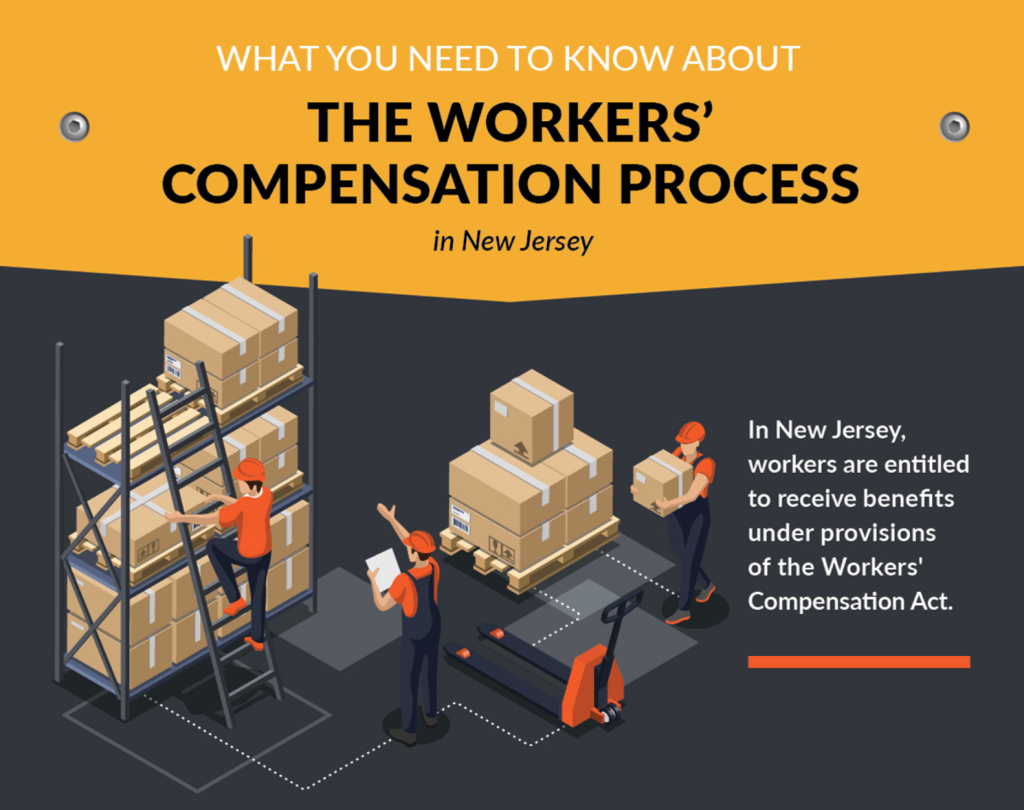
The workers’ compensation process in New Jersey infographic takes a multi-step claim process and makes the sequence clear in a single image. The what to expect from a slip and fall lawsuit piece does the same for premises liability claims. The lemon law claim process for Wirtz Law walks a car owner through exactly what happens from initial consultation to resolution.
These pieces serve a dual purpose. They answer a question that prospective clients are actively asking — “what is this process going to look like?” — and they demonstrate that the firm understands that process well enough to explain it clearly. That is an authority signal that a 1,000-word practice area page cannot replicate in the same way.
The design discipline required here is restraint. A process infographic fails when it tries to include every exception, caveat, and jurisdictional variation. Pick the standard path, show it clearly, and let the attorney answer the edge cases in consultation.
4. Ground It in a Place

National data tells a national story. Local data tells your story.
The most dangerous roads in Fort Smith, Arkansas, infographic built for Hatfield Law is not going to get picked up by a national traffic safety publication. But it is exactly what a Fort Smith-area journalist covers, what a local city council member might share after a public safety meeting, and what a person researching car accident risks in their city is going to find. The local specificity is the distribution strategy.
The same approach runs through the Fayetteville truck accident piece, the hazards for pedestrians in Charleston infographic for Steinberg Law Firm, and the Lake County slip and fall piece for Briskman. Each one takes a legal topic that exists everywhere and anchors it in a specific geography. That anchor is what generates the local citations, the regional press pickups, and the links from community organizations and government sites that move the needle on local SEO.
The local angle also makes the infographic more useful to the actual prospective clients the firm wants to reach. Someone in Fayetteville who was hit by a truck is not looking for a national overview of trucking accident statistics. They want to understand what is happening in their area, why it is happening, and what their options are. An infographic that speaks to that specific context converts better than one that could have been published by any firm in any market.
The Portfolio Tells You What Works
CLM’s infographic portfolio spans personal injury, employment law, family law, workers’ compensation, estate planning, and lemon law across firms in Illinois, Arkansas, New Jersey, Pennsylvania, South Carolina, Michigan, and California. The pieces that generate links and cases consistently come back to the same four qualities: a specific audience, a surprising number, a clear process, or a local anchor. Usually more than one of those at once.

Kristen Friend
Kristen Friend holds two bachelors degrees from Indiana University and an associates degree from the International Academy of Design. As Art Director for Custom Legal Marketing, her work has been awarded Webby Honorees, WebAwards, Davey Awards, Muse Awards, W3 Awards, and many others.

The Definitive Guide to Law Firm SEO That Works
Law Firm SEO That Works is where we show attorneys what their competitors wish they knew.