











Optimization
Prepare your firm for the future of search, including AI-powered engines like Google’s AI Overviews, ChatGPT, Claude and Perplexity. We structure content in a way that AI prefers and build topical authority so machine learning systems will reward your firm.
Be discovered in traditional SERPs and AI answers.
ANSWER ENGINE OPTIMIZATION
What Is Answer Engine Optimization for Lawyers?
Answer Engine Optimization (AEO) is how you structure a law firm's digital presence so that AI platforms can find your content, make sense of it, trust it, and pull from it when a potential client asks a legal question. Think about what happens when someone types "Do I need a lawyer after a car accident in Chicago?" into ChatGPT. The chatbot picks one source, maybe two, and builds a response. If your firm created the clearest answer to that question, you get cited. If you didn't, someone else does.
Traditional SEO has always been about ranking web pages. AEO is about ranking answers. When a person asks ChatGPT for a personal injury lawyer recommendation, or when Google generates an AI Overview summarizing the statute of limitations in their state, the content that gets selected often has nothing to do with who has the most backlinks or the highest domain authority score. What matters is which page answers the question most clearly, most directly, and in a structure that machines can actually parse.
This is already happening at scale. Potential clients ask AI chatbots specific legal questions every day, and those chatbots pull from whatever online sources give them the most usable material. When your website, attorney profiles, and practice area pages aren't built for AI visibility, you simply don't exist in that channel.
AEO builds on top of law firm SEO. Your firm still needs solid technical performance, mobile responsiveness, a strong backlink profile, and content that targets the right keywords. What AEO adds is the structural and strategic layer that lets AI systems confidently extract your content, summarize it, and attribute your firm as the authoritative source on a given legal topic.
Traditional SEO vs. Answer Engine Optimization
YOUR FIRM BECOMES THE ANSWER IN
Why AEO Matters for Law Firms Right Now
Legal searches have always been driven by questions. Nobody searches for legal help the way they'd search for shoes on Amazon. They ask things like "How long do I have to file a lawsuit after a car accident in Texas?" or "What should I do if the insurance company denied my claim?" These are conversational, high-intent queries, and they're exactly what AI answer engines were built to handle.
The number of platforms delivering these answers keeps growing. Google's AI Overviews now sit above traditional search results for a large share of legal queries, pulling information from multiple sources and summarizing it before anyone scrolls to a blue link. ChatGPT handles millions of legal questions every day. Perplexity shows its sources with every answer, directly linking to the pages it pulls from. Claude and Gemini both handle complex, multi-step legal questions with long-form, nuanced responses. Every one of these platforms is a surface where your firm either shows up or gets left out entirely.
The early movers have an advantage here, and that advantage compounds. Once an AI platform cites your content and the response performs well for users, the association sticks. That platform becomes more likely to pull from your content again on related topics. We call this information asymmetry: the firms building AI authority now are making it harder for everyone else to catch up later.
CLM's own research backs this up. Our proprietary studies, analyzing law firm SEO data at scale, have consistently shown that the conventional signals most agencies obsess over, like Domain Authority scores and PageSpeed metrics, have negligible correlation with actual rankings. The signals that do matter are the ones AEO prioritizes: content clarity, topical depth, structured data, and entity-level trust. AI answer engines push these factors even further because they're picking content for direct extraction, not just deciding where to place a link in a list.
The AI Answer Engine Landscape
for Legal Search
How AI Answer Engines Actually Work
If you're going to optimize for AI-generated answers, you need to understand what happens between the moment someone asks a question and the moment a chatbot responds. These systems don't work like traditional search engines. They don't just match keywords to pages and sort them by authority.
Retrieval and Grounding
When someone asks a legal question, AI platforms first pull potentially relevant content from their index or from live web results. Google's AI Overviews run on a proprietary system called FastSearch, which relies on a signal set called RankEmbed. Court documents from Google's antitrust case show that RankEmbed measures semantic relationships between queries and documents. It evaluates how closely a piece of content aligns with the actual meaning behind what someone asked, rather than just counting backlinks or checking domain metrics.
That's why AI Overviews sometimes surface pages that wouldn't appear at the top of traditional search rankings. FastSearch works with fewer documents and lighter signals, but it puts a premium on semantic clarity. For a law firm, this means a well-structured page that directly answers a specific legal question can outperform a page with a higher domain authority score that covers the same topic in vague, unfocused language.
Synthesis and Citation
After pulling relevant content, the AI model combines information from multiple sources into one coherent answer. Content structure matters enormously at this stage. AI systems look for discrete answer blocks: a clear question, a direct response, and supporting evidence or context. Pages built this way are significantly easier for AI to pull from and credit.
Perplexity, for example, shows its sources with every answer. When it responds to a legal question, it cites the specific pages it drew from. If your firm's practice area page or legal guide has the clearest, most credible answer available, Perplexity will link to it. ChatGPT draws on live web data and knowledge bases, favoring content from sites it considers trustworthy. Claude and Gemini both do well with longer, more complex answers and tend to favor in-depth guides that cover multiple scenarios.
Trust Evaluation
AI answer engines evaluate trust on several levels at once. They look at domain credibility, expertise signals on the page itself (like author credentials and citations to statutes), and whether information stays consistent across your site and across other sources on the web. They also cross-reference mentions of your firm on external sites: legal directories, bar association profiles, news outlets, and review platforms. AEO is about more than what's on your pages. It's a full-spectrum approach to building a digital reputation that AI systems can verify independently.
How AI Answer Engines Process Legal Queries
Combines sources into one answer
The Three Levels of Answer Engine Optimization
We structure AEO in three layers. Architecture goes at the bottom, authority in the middle, and structured signals at the top. Each layer depends on the one below it.
The Three Levels of AEO
Level 1: Content Architecture — Building the Foundation AI Can Navigate
The way you organize content on a law firm's website creates relationships between topics. Those relationships determine whether AI systems read your site as a pile of disconnected pages or as a comprehensive, well-organized resource on specific legal subjects.
Content siloing and topic clustering have been core SEO strategies for decades, and this is nothing new. But AI answer engines give these concepts more weight than traditional search ever did. AI models tend to retrieve and cite content from sites that show clear, deep coverage of a topic with strong semantic consistency across related pages. A well-interlinked cluster of content about personal injury law in Illinois, for instance, tells an AI system that your firm has covered that area thoroughly. That makes it far more likely to get cited for any query within that topic family.
Pillar Pages and Supporting Content
Every practice area your firm handles should anchor its own content ecosystem. A pillar page targeting "Personal Injury Lawyer in Chicago" should connect to a network of supporting pages that cover the full range of questions a prospective client would have:
- What should I do immediately after a car accident in Illinois?
- How long do I have to file a personal injury lawsuit in Illinois?
- What damages can I recover after a car accident in Chicago?
- What happens if the other driver is uninsured?
- How are personal injury settlements calculated in Illinois?
- What is Illinois comparative fault law and how does it affect my case?
- How much does it cost to hire a personal injury lawyer?
Each supporting page should open with a clear, direct answer in the first two or three sentences, then expand into deeper context with legal citations and practical guidance. This gives AI answer engines exactly what they're looking for: an extractable question-answer pair, backed by thorough topical coverage that demonstrates authority.
Internal Linking as Semantic Architecture
The links between your pages carry just as much weight as the content itself. Internal linking builds a virtual architecture that AI systems follow to understand how your topics relate to each other. Every supporting page should link back to the pillar page and to related supporting pages, using natural, descriptive anchor text.
This goes beyond passing link equity for SEO purposes. You're creating a navigable knowledge web that AI models can walk through to confirm your site covers a subject completely. When an AI system lands on your page about car accident settlements in Illinois and finds links to authoritative pages about comparative fault, insurance claims, and the statute of limitations, all on the same domain, that reinforces the signal that your firm is a full-service resource on the topic.
URL Structure and Physical Organization
When possible, set up your URL structure to mirror your topical hierarchy. Something like example.com/denver/personal-injury/car-accidents/ communicates the relationship between topics right there in the URL. Physical siloing like this reinforces the semantic connections you've built through internal linking, and makes it easier for both crawlers and AI retrieval systems to grasp the scope of your coverage.
Content Cluster Architecture
Personal Injury Lawyer in Denver
Supporting Pages
Level 2: Authority and Expertise — Content That AI Trusts Enough to Cite
Architecture gives you the structure. Authority gives you the substance. AI answer engines aren't just scanning for content that addresses a query. They need content they can confidently recommend for complex, sensitive, high-stakes decisions. Legal content sits squarely inside Google's "Your Money or Your Life" category, which means the trust bar is higher for law firms than for almost any other industry.
E-E-A-T: The Trust Framework AI Systems Enforce
Experience, Expertise, Authoritativeness, and Trustworthiness aren't just Google's guidelines anymore. They're the evaluation criteria every AI answer engine applies, whether explicitly or implicitly, when choosing which sources to cite. AI platforms look for reliable, original, transparent information when building their summaries.
Experience: Write from actual legal practice. Reference real case scenarios (anonymized where necessary), describe what clients should expect during the process, and walk through the practical realities of working with a lawyer. The gap between generic legal information and content grounded in real experience is something AI systems can pick up on.
Expertise: Put a named attorney on every piece of content. Include bios with bar admissions, years in practice, association memberships, notable results, and areas of focus. Link those bios to full attorney profiles. AI systems factor in author credibility during trust evaluation, and signed, attributed content outperforms anonymous or generically bylined pages.
Authoritativeness: A firm's authority comes from what you publish and from how the rest of the web references you. Citations in legal directories, bar association profiles, news coverage, speaking engagements, and published articles all feed into the entity-level authority that AI systems evaluate. CLM builds this authority through strategic citation development and brand signal optimization as part of every AI legal marketing campaign.
Trustworthiness: Transparency builds trust. Display your firm's contact information prominently. Keep your attorney directory current. Publish a clear privacy policy. Back up every legal claim with citations to statutes, court rules, or official government sources. When you answer "How long do you have to file a workers' compensation claim in California?", link to the actual statute or the relevant state agency website. AI platforms and human readers both look for those signals.
E-E-A-T for Law Firms
Process walkthroughs
Client expectations
Practice insights
Bar admissions
Specializations
Credentials on page
Bar profiles
News coverage
Speaking & publications
Contact transparency
Privacy policy
Updated attorney info
Writing Content That AI Can Extract and Cite
How you write directly affects whether AI platforms can use your content. There are a few principles we've found make the biggest difference:
Direct and Answer-First: Start every section with a clear answer to the question the section addresses. Don't bury the answer three paragraphs deep under context-setting. State the answer, then provide the supporting detail. When a potential client reads "In Illinois, the statute of limitations for filing a personal injury claim after a car accident is two years from the date of the accident," they get what they need right away. The AI system parsing your page gets what it needs, too.
Conversational and Question-Structured: Use headings that mirror how people actually ask questions. Swap out generic headings like "Damages" for something like "What Damages Can I Recover After a Car Accident in Chicago?" That tells AI systems exactly what each section answers, which makes matching your content to user queries far more straightforward.
Comprehensive and Journey-Aware: Don't just answer one question and stop. Cover the full arc of what a potential client would want to know, from the initial incident through resolution. After the primary question, address the natural follow-ups: "What should I do immediately after a slip and fall?" followed by "How long does a slip and fall claim take?" and then "What is the average settlement for a slip and fall injury?"
Entity-Rich and Legally Specific: Name relevant statutes. Reference local courts. Include neighboring cities and counties. Use specific legal terminology where appropriate and explain it clearly. AI engines pull from your site more readily when entities like "Illinois Comparative Fault Law," "Cook County Circuit Court," or "Texas Civil Practice and Remedies Code" appear and are properly contextualized.
Original Research and Proprietary Data
In a world where AI-generated content is flooding every corner of the internet, all synthesized from the same pool of public sources, original research cuts through the noise. If your content provides unique data, original analysis, or proprietary findings, no other site can replicate it. AI systems pick up on that originality and are more likely to cite it because the information isn't available anywhere else.
CLM's research program is built around this principle. Our AI Content & Rankings study analyzed the relationship between AI-generated content and search performance across thousands of law firm pages. Our PageSpeed study examined whether Core Web Vitals scores actually predict rankings. In both cases, the data challenged the assumptions most agencies operate on. That kind of research gives our clients content that AI engines treat as uniquely valuable.
For individual law firms, original content might look like analysis of local verdict trends, case study narratives that walk through legal processes in a specific jurisdiction, or data-driven assessments of claim values drawn from your firm's own experience. The key is that nobody else can produce this content because it comes from your actual practice.
Level 3: Structured Signals — Making Your Content Machine-Readable
Architecture gives the framework. Authority gives the substance. Structured signals make sure AI systems can actually interpret all of it accurately and efficiently. This is the technical layer where human-readable legal content gets translated into machine-parseable data.
Schema Markup for Law Firms
Schema markup is the most direct way to communicate structured information to AI systems. For law firms, the key schema types include:
FAQ Schema: Wraps question-and-answer content so AI engines can identify and extract specific answers. Every FAQ section, every question-structured heading with a direct answer, should carry FAQ schema. This creates discrete, labeled answer blocks that AI systems can reference directly.
Article Schema: Goes on blog posts, legal guides, and practice area content. Include author information, publication date, and last-modified date so AI systems can evaluate freshness and attribution.
Attorney Schema (Person): Marks up attorney profiles with credentials, bar admissions, practice areas, and professional affiliations. This builds entity-level recognition for your individual attorneys, which AI systems use when evaluating expertise.
LocalBusiness and LegalService Schema: Structures your firm's name, address, phone number, service areas, and practice areas in a machine-readable format. Supports local AI visibility and helps AI systems match your firm to location-specific queries.
HowTo Schema: When your content walks someone through a legal process step by step, HowTo schema makes each step explicitly parseable.
The guiding principle is straightforward: schema should accurately represent the content that's visible on the page. Don't mark up content that doesn't exist. Implement schema everywhere it applies, not just on the homepage. And run everything through Google's Rich Results Test to catch errors.
Schema Markup
FOR ATTORNEYS THIS MEANS
Entity Optimization
AI answer engines think in entities: people, organizations, places, legal concepts, statutes, courts. The more clearly your content defines and connects these entities, the easier it becomes for AI systems to understand what your firm does, where it operates, and what it knows.
Entity optimization means making sure your firm name, attorney names, practice areas, service locations, and relevant legal concepts are referenced consistently both on your website and across the web. It also means linking to authoritative external entities like state bar associations, court websites, and government agencies, which places your content within a recognized knowledge graph.
When an attorney profile mentions bar admission in Illinois, links to the Illinois State Bar Association, references practice before the Cook County Circuit Court, and matches the information on your Google Business Profile and Avvo listing, AI systems can cross-reference all of those data points and confirm your firm's identity with high confidence.
Accessibility and Technical Performance
Our research has shown that PageSpeed scores don't correlate with traditional rankings, but technical performance still matters for AI accessibility. Your site needs to be crawlable, which means clean HTML structure, logical heading hierarchy, proper semantic elements, and accessible content. Alt text on images, correct heading nesting (H1 to H2 to H3 without skipping levels), and mobile-responsive layouts all affect how well AI systems can parse your pages.
CLM's Sequoia platform includes tools that handle these technical requirements systematically across client sites, ensuring that the structural foundation is in place for AI retrieval.
Answer Engine Optimization Platforms: Where Your Firm Needs to Appear
Each AI answer engine retrieves, evaluates, and presents legal information differently. A complete AEO strategy accounts for those differences while building on the common foundation of clear, authoritative, well-structured content.
Google AI Overviews
Google's AI Overviews sit at the top of search results, synthesizing information from multiple sources into a summary before traditional organic listings. Even if your page ranks on page one, a potential client may get their answer from the Overview without ever scrolling down.
The system behind Overviews uses FastSearch and RankEmbed, which prioritize semantic alignment between the query and the content. Pages that answer questions directly, use conversational headings, and cover the full topic journey perform best.
Priority: Answer-first content structure, comprehensive topic clusters, entity-rich language that matches how clients phrase legal questions, and conversational question-structured headings.
ChatGPT
ChatGPT pulls from live web data, knowledge bases, and well-structured content. It gravitates toward sites it considers trustworthy and authoritative. Getting your firm recommended by ChatGPT requires strong on-site content, consistent off-site citations, and clear entity signals working together.
When a user asks "Who is the best personal injury lawyer in Dallas?", ChatGPT evaluates entities, review signals, web citations, and content quality before constructing its answer.
Priority: Authoritative attorney profiles, consistent NAP (name, address, phone) across directories, strong review profiles, content showing genuine expertise.
Perplexity
Perplexity shows its sources with every answer, making it the most transparent AI answer engine you can target. When it answers a legal question, it links directly to the pages it drew from. Clear, well-formatted, authoritative content on your site can generate direct attributed traffic.
Strong legal authority signals matter here: client reviews, bar memberships, press mentions, well-researched legal guides, and citations to primary legal sources.
Priority: Well-formatted legal guides, statute citations, external trust signals, full-scope topic coverage.
Claude
Claude handles longer, more nuanced answers and does especially well with complex legal questions requiring multi-step reasoning. For a family law firm, that might mean covering "How is child custody decided in Florida?" along with "What factors affect a judge's custody decision?", "How can I modify a custody agreement?", and "What is the difference between legal custody and physical custody in Florida?" Claude rewards comprehensive treatment of complex topics.
Priority: Long-form legal guides, deep FAQ coverage, multi-scenario content addressing edge cases and follow-up questions.
Gemini
Google's Gemini integrates with Search and works across multiple Google products. It processes multi-modal content and favors well-structured, entity-rich pages. Gemini visibility means your content, structured data, and Google Business Profile all need to be aligned and consistent.
Gemini benefits from the same structured data and entity work that supports AI Overviews, but also evaluates visual content and multimedia. Original graphics, infographics, and short explainer videos provide additional signals that set your content apart.
Priority: Google Business Profile optimization, consistent entity data across Google properties, visual content with descriptive alt text, schema markup site-wide.
Platform Implementation Priorities
AEO vs. SEO vs. GEO: Understanding the Landscape
These three disciplines overlap, but they're distinct enough that understanding the differences helps law firms allocate resources more effectively.
Search Engine Optimization (SEO) targets traditional search results. It covers technical performance, keyword research, backlink development, content quality, and local optimization. SEO drives organic traffic through clicks on search listings.
Answer Engine Optimization (AEO) targets AI-generated answers. AEO takes your SEO foundation and layers on content structuring for AI extraction, schema markup for machine readability, entity optimization for trust verification, and cross-platform optimization for engines beyond Google.
Generative Engine Optimization (GEO) targets generative AI platforms specifically. GEO focuses on getting your content into model training datasets, optimizing for AI retrieval patterns, and building entity-level authority that generative models use to decide which sources to recommend.
In practice, these strategies overlap substantially. Strong SEO creates the base that AEO and GEO build on. A well-optimized page that ranks in traditional search is also more likely to get picked up by AI answer engines. But the reverse isn't always true: a page that ranks well in Google may still lack the structural clarity, schema markup, or entity signals that AI answer engines need before they'll cite it.
At CLM, we treat all three as integrated components of one strategy. Every piece of content we create and every technical optimization we run is designed to perform across traditional search, AI answer extraction, and generative model citation simultaneously.
How SEO, AEO, and GEO Connect
Strong SEO forms the base. AEO adds the AI extraction layer. GEO extends into generative model visibility.
How CLM Builds AEO Into Every Campaign
Custom Legal Marketing has been working toward answer engine optimization for years, well before the term became industry shorthand. Our proprietary AI marketing platform, CLM Sequoia, was built specifically to create the kind of information asymmetry that gives our clients a structural advantage in both traditional search and AI-powered discovery.
CLM Sequoia: The AI Marketing Platform Built for Legal
CLM Sequoia isn't a white-labeled third-party tool. We built it from the ground up, purpose-designed for legal marketing's specific complexities. Sequoia powers every part of our AEO approach:
Content Intelligence: Sequoia analyzes the competitive landscape for every practice area and location. It identifies the specific questions AI answer engines are processing, which firms are getting cited, and where gaps exist. This intelligence shapes content strategy that targets AI citation opportunities with precision. Sequoia even fact checks content, checks for bar attorney advertising compliance, and cross-references our legal library to make sure your audience and answer engines are getting the truth and nothing but the truth.

Technical Optimization: Schema markup implementation, accessibility compliance, and content audit tools all run through Sequoia. Our content audit tools flag AEO readiness issues and rank improvements by potential impact.
Proprietary Research: CLM's research studies analyze thousands of law firm pages and AI responses to produce the original data and insights that set our clients' content apart from the generic material flooding legal marketing. These findings drive real strategy decisions and provide the kind of unique, citable material that AI answer engines reward.
The Prompt Ranking AI Monitor
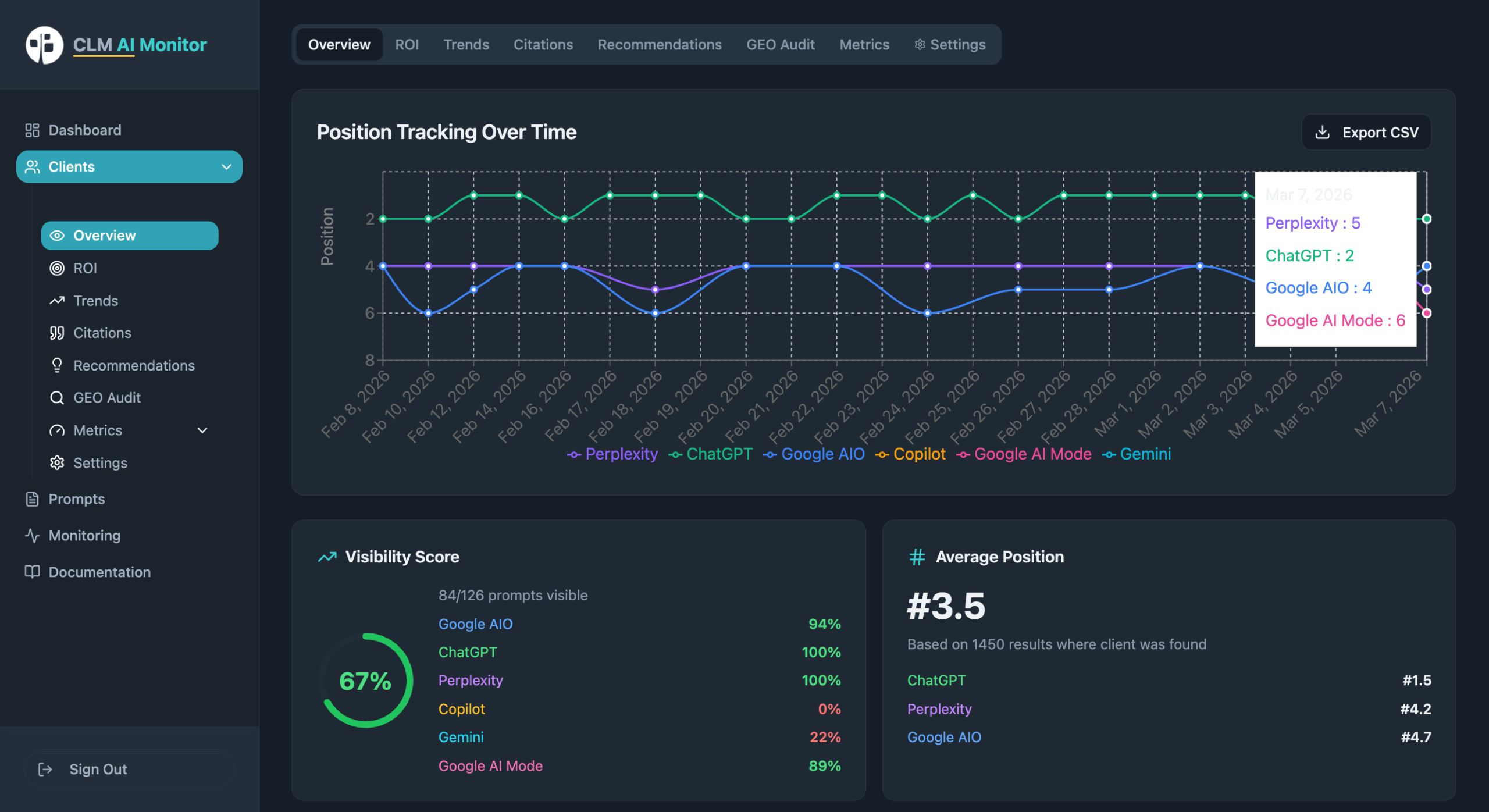
The most important question in AEO: "When someone asks an AI chatbot about a legal issue in my market, does my firm appear in the answer?" CLM's Prompt Ranking AI Monitor gives you the data to answer that question.
The AI Monitor systematically tracks how law firms show up across AI chatbot responses for targeted legal queries. It watches which firms get recommended, how they're described, and which content sources the AI platforms draw from. Most agencies can't measure this channel at all. We can monitor and put the intelligence to work for you.
With the AI Monitor, we track:
- Your firm's citation frequency and sentiment across AI platforms
- Which competitors appear in AI responses for your target queries
- How your AI visibility changes over time as optimization work kicks in
- The specific content and trust signals driving AI citations in your market
There's no guesswork here. This is systematic, data-driven monitoring of a rapidly growing client acquisition channel.
Research That Challenges Conventional Wisdom
CLM's research program produces findings that directly shape our AEO strategy and separate us from agencies that run on assumptions instead of data.
Our AI Content & Rankings study looked at the relationship between AI-generated content and search performance across thousands of law firm pages. What we found: the percentage of AI content on a page doesn't correlate with rankings. What does matter is quality, relevance, and structure, regardless of whether a human or machine wrote the first draft.
Our PageSpeed study examined whether Core Web Vitals scores actually predict search performance. They don't. That doesn't make site speed irrelevant, but it means agencies positioning PageSpeed optimization as a primary ranking lever are spending their clients' money on the wrong things.
We also studied Domain Authority's predictive value. The finding: DA has negligible correlation with actual rankings for law firm websites. Authority matters, but the third-party metrics that most agencies use to measure it don't actually predict performance.
These findings matter for AEO because they clarify which signals drive visibility. AI answer engines put even more emphasis on content quality, structure, and genuine authority, while making vanity metrics even less relevant.
Tracking AEO Performance: Measurement Beyond Rankings
Traditional SEO measurement revolves around keyword rankings, organic traffic, and click-through rates. AEO introduces new dimensions that call for new measurement approaches.
AI Citation Monitoring
The most direct indicator of AEO success is whether your firm shows up in AI-generated answers for your target queries. CLM's Prompt Ranking AI Monitor tracks this across multiple platforms, capturing data on citation frequency, sentiment, and how you stack up against competitors.
Impression and Engagement Analysis
Google Search Console shows which queries trigger AI Overviews that pull from your content. Watching impressions for informational and conversational keywords, the ones most likely to generate AI Overview results, tells you where your content is gaining traction. Click-through rates from AI Overview impressions help you understand how citations translate into actual site visits.
Content Citation Tracking
Because Perplexity attributes its sources, you can track exactly which pages on your site get cited in its answers. Monitoring these citations reveals which content formats, topics, and structures are most effective at earning AI visibility.
Competitive Intelligence
Don't just watch your own AI visibility. Track which competitors show up in AI responses for your target queries, too. Identifying the content, trust signals, and structural choices that separate firms appearing in AI answers from those that don't is one of the most actionable insights we provide.
Continuous Optimization
AEO isn't a project you complete and walk away from. AI platforms update their retrieval methods, retrain their models, and adjust how they evaluate trust on an ongoing basis. Staying visible requires ongoing monitoring, regular content refreshes, and strategic adaptation.
We review client content quarterly to make sure it's accurate, current, and aligned with the latest legal standards. We update schema markup as new structured data types become relevant. We expand content clusters based on emerging queries and evolving client journeys. And we track everything through CLM Sequoia to make sure the work produces measurable returns.
The Six Pillars of CLM's AEO Framework
CLM's AEO strategy runs on six integrated pillars that cover every dimension of AI visibility for law firms.
The Six Pillars of CLM's AEO Framework
1. Content Architecture
Interconnected topic ecosystems with pillar pages, supporting content, and strategic internal linking that signal topical authority to AI retrieval systems.
2. Answer-First Content
Every page structured around specific questions, with direct answers in the opening sentences and comprehensive supporting context. Headings that mirror real client queries.
3. Entity and Trust Signals
Consistent entity information across your website, legal directories, bar associations, review platforms, and news sources. Cross-referential trust that AI systems can independently verify.
4. Schema and Structured Data
FAQ, Article, Attorney, LocalBusiness, LegalService, and HowTo schema implemented on every relevant page, validated and maintained as content evolves.
5. Multi-Platform Optimization
Tailored optimization for the retrieval patterns and trust evaluation criteria of each platform: Google AI Overviews, ChatGPT, Perplexity, Claude, and Gemini.
6. Monitoring and Adaptation
Ongoing AI citation tracking, competitive positioning analysis, and content effectiveness measurement through CLM Sequoia's AI Monitor.
Frequently Asked Questions About Answer Engine Optimization for Law Firms
What is the difference between AEO and traditional SEO?
SEO targets web page rankings in search engine results. AEO focuses on getting your content selected as the direct answer when AI platforms respond to legal questions. AEO builds on your SEO foundation, then adds content structuring for AI extraction, schema markup, and multi-platform optimization across Google AI Overviews, ChatGPT, Perplexity, Claude, and Gemini.
Does AEO replace SEO for law firms?
No. AEO extends SEO. Your firm still needs solid technical health, relevant content, local optimization, and a credible backlink profile. AEO layers on the structural and signal work that ensures AI platforms can cite your content in addition to ranking it. The firms performing best right now are doing both.
How do AI answer engines decide which law firms to recommend?
They evaluate a combination of factors: how clearly and directly your content answers the question, topical authority across related pages, entity-level trust signals (like consistent information across directories, review platforms, and bar profiles), structured data that makes content machine-parseable, and whether you cite credible primary sources. Each platform weighs these somewhat differently, but all of them favor clear, authoritative, well-structured content. Beyond that, you can read about which directories matter most to ChatGPT.
Can small law firms benefit from AEO?
Absolutely. AEO rewards clarity and depth over size. A solo practitioner or small firm that provides well-structured, specific answers to legal questions in a defined geographic area and practice area can outperform much larger firms with vaguer, less focused content. Smaller firms are often better positioned to go deep on a niche.
How long does it take to see AEO results?
Quick wins, like schema implementation and content restructuring, can produce measurable shifts within a few weeks. Broader gains in competitive markets typically take three to six months to develop as content clusters get built, trust signals accumulate, and AI platforms start consistently citing your content.
How does CLM measure AEO performance?
Through our Prompt Ranking AI Monitor, which tracks your firm's citation frequency, sentiment, and competitive positioning across AI chatbot responses for your target queries. We also monitor Search Console data for AI Overview impressions, track Perplexity citation rates, analyze competitor AI visibility, and measure conversion impact from AI-driven traffic. All of it runs through CLM Sequoia.
What makes CLM's approach to AEO different from other agencies?
Proprietary data, proprietary tools, and two decades of working exclusively in legal marketing. Our Sequoia platform was built from scratch for legal AI visibility. Our Prompt Ranking AI Monitor gives us measurement capabilities most agencies don't have access to. And our research program produces original findings that go against conventional SEO assumptions. We don't depend on the same third-party tools and secondhand wisdom that the rest of the industry runs on.
Is my firm's current content AEO-ready?
Most law firm websites have significant AEO gaps, even those performing well in traditional search. Common issues: missing schema markup, generic headings that don't match real client queries, answers buried deep in paragraphs where AI systems can't easily extract them, and inconsistent entity information across directories and platforms. CLM's content audit, powered by Sequoia, pinpoints these gaps and prioritizes fixes by impact.
Build Your Law Firm's AEO Strategy with CLM

AI answer engines are adding a new, high-value layer to how potential clients find and evaluate law firms. The firms that optimize for both traditional search and AI-powered answers now are building a compounding advantage that gets harder to challenge over time.
Custom Legal Marketing has been developing the tools, running the research, and refining the strategies for this exact moment, long before answer engine optimization became a conference buzzword. Our Sequoia platform, Prompt Ranking AI Monitor, and ongoing research program give our clients an AEO strategy built on data and original insights, not recycled best practices from a blog post.
If your firm needs to build an AEO strategy from scratch or sharpen an existing digital presence for AI visibility, CLM has the tools, the research, and the track record to get you there. Schedule a free consultation to find out where your firm stands and what it would take to become the answer AI chooses.

CLM is singularly focused on my firm's success and frequently over-delivers. I don’t think that you could make a better choice.
- Paul Greenberg, Briskman Briskman & Greenberg
We have been using CLM for our websites for a number of years and they have been outstanding! Their entire team has always been highly responsive and met all of our marketing needs.
-Todd J. Leonard, Todd J. Leonard Law

